« March 2011 | Main | May 2011 »
Steve Denning: practising what we preach?
Filed in Business storytelling.
Why would one of the world's foremost business storytelling experts say he was going to use storytelling to convey his message and then not tell a story?
Reading my email this morning I was excited to receive Steve Denning's latest newsletter. In it he tells us about how TED has thrown open its doors and now anyone can submit a 60 second video to audition for a much lauded TED speakers spot.
Steve tells us the story of his thought process for entering and then concludes with,
My third reaction, why not use storytelling and give it a shot? If storytelling is really worth its salt, surely it should be able to communicate anything very rapidly and powerfully. Why not radical management? So I crafted my story, did my video, had fun doing it and submitted it on Monday.
Excellent, I thought. Can't wait to see this story.
I opened the video and this is what I saw.
It's not a story. My heart sunk. It's a series of opinions about what makes firms delight or disappoint their customers.
A story would describe something that happened or might happen. It would have had characters and we would have had a sense of when it happened. A good story would have an element of surprise. There was no dramatic tension in this presentation. We know it's not a story because we can't see it happening.
Steve, why did you decide not to tell a story when storytelling is such a powerful approach? Why did you tell us you had told a story when it is patently not one?
When someone who knows so much about storytelling, and Steve obviously does, says he's told a story and then doesn't, it only serves to further confuse people who are trying to apply storytelling techniques. Knowing what a story looks like is the foundation skill. As one small gesture we've developed the storytest.com to help people in building this capability. But more importantly our actions must coincide with our words.
We are now on the lookout for anyone who purports to tell a story and doesn't because by highlighting these mismatches we might have an impact on building everyone's narrative intelligence so we can all benefit from storytelling.
The Power of the Short Story
Filed in Business storytelling.
"I only have a few minutes to get my message across, I just haven't got time to tell a story."
This is a comment we often hear this when we are running one of our Storytelling for Business Leaders courses. I don't believe having limited time, or a short amount of copy space, however is an excuse not to tell a story.
I was reminded, yet again, of how engaging, insightful and powerful a short story can be when I read an article from actress Rebecca Gibney where she was discussing her 'six secret rules for a happy life'.
Her first rule was 'Kindness Costs Nothing' and she told the following story, when she was living in Sydney, to bring this to life:
“Back when they used to collect tolls by hand, I always used to pay for two or three cars behind me, because it gave me a kick,” she says. “I used to look in the rearview mirror and see the smile on their face, and I’d just think, ‘Well, maybe that’s going to make the next five minutes of their day really good’. It’s great for your soul to do that.”
Three sentences, that's it. She has taken the abstract concept of kindness and, in a beautiful short story, made it concrete. She has shown you what she did around this value, not just told you her opinion of why kindness is important. And in a very short space she has painted a very clear picture which 'pulled' you into the story. Like me, could you see the people smiling in her rear view mirror?
Having limited time is no excuse not to tell a story, in fact if you have a limited amount of time, surely a story is the best way to make use of that time?
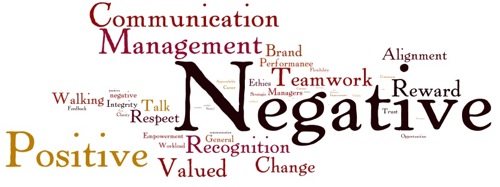
As the tag cloud shows, on average staff relate four times as many negative experiences as they do positive ones. This is almost the inverse of the managers' self-assessment. For many leaders this comes as a revelation - they need to change their behaviour for staff engagement to improve. They need to look past their intentions and focus on the impact they are having in the workplace.
The data has been collected from over 250 leaders from four large organisations between 2008 and 2011.
Is really listening to someone about your listening abilities, or is it about your motivation to listen? Is it about the 'skills' of listening or is it the desire to want to listen that makes the difference?
I have been running a series of workshops lately where we do a very simple listening exercise that gets the participants to actually feel what it is like not to be listened too. The exercise takes it from being a purely rational/logical thing (i.e. "I know that not being listened too isn't nice") to one where they actually feel the anger, frustration and almost diminishing sense of self worth that comes when you are not being listened too.
At the end of the exercise I do a de-brief and one of the questions I ask is; "What do you think is more important when you listen - your ability to listen, or your desire to listen?" You can see people have this light bulb moment as they realise it is not the ability side of listening that they are struggling with, it's the motivation to want to listen in the first place.
When asked they can all tell you what you need to do to be able to listen better, from a skills perspective - mirror body language, lean forward, make eye contact, avoid distractions etc. etc. A good outline of some of these were covered in a blog Shawn did in May last year.
However, these things only become useful if you want to listen in the first place.
For me listening, really listening to someone, is an issue of motivation first and foremost. Once I want to listen to you, then my skills and abilities to listen can really kick in.
Yes, m'lady
Filed in Fun.
One of the things we Anecdoters strive for is to meet new people and have interesting conversations. I had one of these this afternoon.
In the middle of 2010, Danielle DiMasi followed her passion, and forsaking corporate life, struck out on her own and started a business speaking, coaching and training Gen X and Gen Y leaders on business etiquette. A very good idea, especially seeing that everyone else working on business etiquette is a baby boomer with only tenuous relevance to the younger generations.
Danielle blogs for sites like Smart Company and a little while ago I noticed she had started referring to herself as Lady Danielle. So I asked her about it today.
A little tongue-in-cheek, Danielle went online and purchased a certificate pronouncing her as entitled to use the title of 'Lady'. Not surprisingly, this certificate was a fraud and had no status in law. So Danielle dug a bit deeper and discovered that, through an ancient loophole, she could purchase a plot of land in Scotland that came with both a land deed and a title deed.
So she did. in October 2010, Lady Danielle DiMasi became the proud owner of a plot of land in Scotland and her use of the title 'Lady' is recognised in law internationally. Cool huh?
The nice twist is that the block of land is about the size of a small table top and cost a few hundred dollars. Danielle also bought one for her partner who is now a Lord.
If you have young execs needing some rough edges taken off, Check out her website.
Permalink | Comments (0) | TrackBack
Lemon Anyone?
Filed in Changing behaviour.
Some people collect stamps, knit or spend hours planning their next exotic holiday - I collect articles and books on behaviour change! I admit it, I'm a geek when it comes to trying to understand why we do what we do, and how you can go about changing it.
I'm not too proud to say: "Hi, my name's Kevin and I am addicted to understanding how to change behaviour".
One of the most fascinating areas I have been looking at lately is the impact scents have on our behaviour.
Retailers have long recognised the positive effects that smells can have on people's buying behaviours. Supermarkets lure shoppers with wafts of baking bread and we have all heard stories of Real Estate agents telling people to freshly brew coffee when having an open home. Other businesses are signing on too, some choosing scents that carry apt connotations for particular products they want to sell, a technique called billboarding.
Bloomingdale's, for instance, billboards the smell of baby powder in its infant-clothing department, while hints of lilac waft around the department store's intimate-apparel displays. American upscale ice cream chain Emack & Bolio's recently adopted a waffle-cone smell to attract patrons to the scoop shop within their Hard Rock Hotel branch, where sales had been flagging. The effect? Ice cream sales shot up more than a third.
Now the office world, too, is seeking its own unique aroma to lift employees' spirits and even reduce mistakes.
A recent study in a financial services company concluded that staff made 40% fewer errors when surrounded by the smell of cinnamon. Another employer used lavender to soothe the stressed-out staff at a frenetic call centre.
Despite the Big Brother connotations of squirting mood-enhancing smells into the workplace via air cooling systems or stand-alone "fragrance delivery" machines, the use of aromas to get up the noses of employees is on the increase.
Signature Aromas currently supplies more than 40 different natural, oil-based fragrances . "Japanese employers routinely use their air-conditioning systems to disperse 'wake-up' fragrances such as citrus early in the morning, floral notes to boost concentration when the late morning hubbub is at its height and woody scents like cedar or cypress to relieve tiredness in the afternoon," says Brian Chappell, the director of Signature Aromas.
C Interactive, a client of Scent Technologies, had initial reservations when it decided to introduce citrus smells into its sales office to boost alertness. "We didn't really expect anything much to happen and started off surreptitiously, with an aroma box that looked like an air vent, because we weren't sure of the staff would like the idea," says Daniel Graham. However the effects were so dramatic that the company explained to its sales staff their new enthusiasm for work. "Since introducing aroma machines into the office, our turnover has increased by 10%, absenteeism is down and we have a far more energised sales force," says Graham.
The idea of having scents pumped through the air conditioning system at work, either with or without my knowledge, is one that doesn't appeal to me in the least. You can not avoid it, you don't have a choice whether to breath it in or not, and feels way too 'Big Brother' for me.
Smell can also have an impact on our ethics.
Chen-Bo Zhong, a psychologist at the University of Toronto, conducted a series of small experiments designed to test how changes in an environment -- differences in smell -- can affect human behaviour. Participants were randomly assigned to rooms, some sprayed with citrus-scented window cleaner. In some of the experiments, the participants played a game of trust with an anonymous partner involving money. The way the game typically works is that one partner is given a sum of money and told to put some or all of the money in an envelope. He is told his anonymous partner will receive triple that amount and will give some of the money back. Of course, the second partner could just keep all the money.
In Zhong's experiment, the participants played the role of the second partner and were all told their partner had given them the full mount, $4, which was then tripled to $12. The participants were free to anonymously return some or none of the money.
"What we found was that in the citrus-scented room, people were more likely to engage in good behaviours," Zhong said. "They were more likely to honour the trust that other people displayed."
He went on to say; "Based on the experiments we have conducted and the findings we've found, I think it's reasonable to speculate that people in a real environment, where they can smell these scents that are associated with purity and cleanliness, also may tend to be behave more ethically or socially."
Have you ever realised the impact that smell has on our behaviour? Have you ever considered using different scents in your working environment, or do you actually do it? I would love to hear any real world examples out there.