« August 2010 | Main | October 2010 »
Have you ever had this happen to you? I was chatting with a senior leader asking him about their organisational values. "Yeh, sure, we have a set of values. Let me see, where did I put the annual report?" He then ferreted around his office to find the list of values.
There are some things we should have in our head (and in our heart and gut) while others are better just written down. We need these things in our head because, and you've heard this many times before, the world continues to be more complex and unpredictable. So everyday we are faced with new and unpredictable situations where decisions are needed. We wont have time to re-plan. So we will have to rely on the things in our head (our mental models, beliefs, attitudes,values) to do good things for yourself and the company. Here are four things to have in your head:
Values - we know what's really valued in an organisation by the actions people take; especially those people with power. So lists of values such as integrity, transparency, professionalism are worthless if people can't see them lived and when they are transgressed consequences happen. Now you can do nothing and just hope your values support your business, but that's a high-risk strategy. As Gary Hamel once said: "Every organization is "values-driven." The only question is, what values are in the driver's seat?"
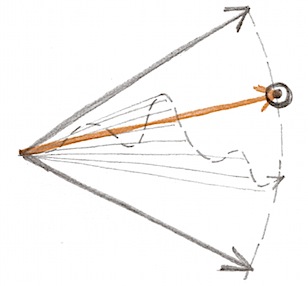
Direction - you should really understand your strategic direction otherwise how do you decide what to say "no" to. But don't be fooled into thinking that because you know your strategy the future is crystal clear like a large painted target on the side of a barn. A useful strategic direction is less like a bulls-eye target to be hit and more like a range of desirable destinations to be discovered (on my diagram the destinations lie on the dotted line arc between the two arrows). Strategic stories are useful because they provide context, explain why and show a range of possibilities and avoid the target metaphor.

Identity - Are we local or are we global? Are we a services business or a product business? Are we more like a rolls royce or more like a mini? Knowing the business identity and the identity of your part of the business and how that compliments other identities, helps you connect and complement others inside and beyond the boundaries of the enterprise.
Purpose - I was lucky enough to have the following coincidence. One afternoon I met with the CEO of an insurance company and asked what the purpose of his business. He thought about it for a while and said, "you know what, we are here to sell insurance." Really? Does that get your people out of bed in the morning so they can make a difference? I don't think so. The very next day I happened to have another meeting with a second CEO of an insurance company and I asked the same question. The CEO shot back at me, "we help Australians build a privately funded safety net." Now, that seemed more interesting. It's true that some businesses have an obvious purpose where people really feel they are making a difference to other people's lives. But whatever you enterprise it's important that your purpose inspires your people to make a difference. At Anecdote our purpose is to help bring humanity back to organisations.
I mentioned at the beginning of the post that there are some things that are best written down. Following on from the ideas of David Allen and his Getting Things Done approach, projects and tasks are best written down in a trusted system so you can get these things out of your head and stop them from cluttering your mind.
Permalink | Comments (6) | TrackBack
How do you remember so many stories? I get this question a lot and for some time I didn't really know the answer. I certainly believe stories are important, that they are memorable, help you connect with your audience and all the other many benefits we talk about on this blog. But how does one remember the right story when you need it? In the last few of months I worked out a critical element.
We've been working with the Victorian Bushfire Recontruction and Recovery Authority (VBRRA) for a number of months now and back in July I facilitated an event of 200+ Community Recovery Committee (CSC) leaders to help them better connect across their 33 CSCs. We helped them share their stories to make new connections.
In preparation for the event I met with Christine Nixon (then VBRRA Chairman) and Ben Hubbard (CEO) and described our story-based approach and ask whether they would like to share a story or two with me. Christine told me this.
In the first few weeks of the fires I was in Narbethong at the Black Spur Inn. I met a team from OPSM who were helping people with lost glasses and other sight problems. They told me about one elderly couple that had come to see them. The man was technically blind from diabetes. The lady had smoke damaged eyes. The OPSM team examined them both and decided the man should see an opthalmic specialist for a fresh opinion on his eye problems. Technology had changed considerably since he lost his vision and new procedures were available. They arrange the visit and ultimately this resulted in surgery that dramatically improved his vision, so much that care was no longer needed.
After hearing this story I was out in the corridor talking to Deb, who worked with Christine, and asked what the story meant for her. Deb said that it was an example of how good things can come out of terrible situations. She also said it showed that corporate involvement can make a difference. For me I thought it was an example of how small things can make a big difference. And then it struck me, this is an important practice for remembering stories: you need to ask yourself what an experience or story means, what's the point of this story?
But knowing the point of a story doesn't guarantee you'll remember it. It does, however, provide a trigger for the story to be retold and the retelling reinforces those synaptic pathways that help you remember the story.
This experience made me realise that I often ring Mark (my business partner) and tell him a story I've just heard and we talk about the point of the story and when we might retell it. Inadvertently we had created a story remembering practice.
Yes, we also record our stories, albeit briefly. And The Story Finder helps. But there is nothing better to be able to illustrate a point with an example on the fly and having these stories in your head makes all the difference
Permalink | Comments (0) | TrackBack
I'm in Singapore at the moment. Had an amazing time last week because I spent three days with many of the story practitioners I really admire at the Origins Business Narrative Conference and learned heaps.
But there was a glitch. Whenever I travel overseas with my trusty iPhone I get hit with ridiculous global and data roaming costs by my provider, Optus.
So on this trip I decided to get thrifty and went down to Starhub (local telco) and bought a 5-day mobile broadband SIM card (don't forget your passport) for $25. It has up to 2GB of data downloads, a bunch of free text messages and cheap calls.
So I popped my sparkling new SIM into my iPhone and nothing happened. Couldn't find the Starhub signal. Restarted the phone, still nothing. Then is occurred to me that my phone was probably locked to Optus.
Ready for a fight I called Optus (+61 2 8082 2642 24/7 support) and asked for my phone to be unlocked and the nice call centre man said "sure thing," punched some numbers into his computers and said, "it's done."
So I synced my iPhone and got a message from iTunes saying my phone had been unlocked. I'm now a happy camper.
Permalink | Comments (1) | TrackBack