« March 2010 | Main | May 2010 »
Here is a nice little story from CEO of Nike, Mark Parker.
Permalink | Comments (0) | TrackBack
I'm off to Malaysia in May to help run a leadership development program for a telecommunication company. While I'm there I'm meeting senior leaders from a range of companies and government departments and showing them our strategic story work. As an ex-IBMer I remember our CEO at the time, Lou Gerstner, say that strategies are the easy bit. But strategy execution is what's difficult. And if you want to get strategy execution right you needed world class processes, strategic clarity and a high performance culture. Our strategic story work helps everyone to really know and understand the strategy (they tell it as a story) providing the much needed strategic clarity.
I have two days set aside to meet people: 18th and 19th May. If you are in KL and would like to meet or you know someone who might be interested in our work, please send me an email (shawn@anecdote.com.au). Looking forward to hearing from you.
Permalink | Comments (0) | TrackBack
You know the feeling. You are waiting in a cafe for a meeting and its 10 minutes past the agreed time...am I in the right place, is it the right day?
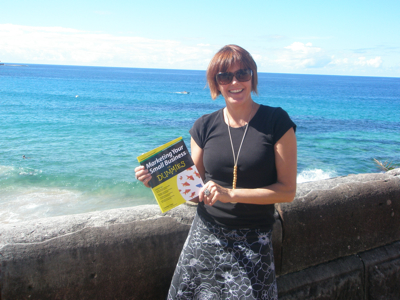
Well, that was me on Monday morning. About 15 minutes late, Carolyn Tate arrived. She explained that as she was leaving for the meeting a courier arrived. The delivery was the advance copies of her latest book, Marketing Your Small Business for Dummies. As far as excuses go it was a good one. I now possess the very first copy of the book which is available in stores in June. I was amazed to learn that she had written the book inside four months.
Carolyn runs a company, Connect Marketing, focussed on helping small businesses be brilliant at marketing. We met in 2008 when we were both guests on the Sky News Money Makers program hosted by David Koch. We were speaking on various aspect of collaboration.
And in case you are wondering, we met at Coogee beach.
.
Permalink | Comments (0) | TrackBack
We start most of our projects by collecting stories. We collect stories in groups (using anecdote circles) and one-on-one. We've learned a lot about getting people comfortable, building trust and asking questions that elicit stories. There's still a lot to learn. A couple of weeks ago something happened while filming stories for a mentoring program we're creating for a client. And since we had a camera at the time we filmed my recollection of what happened.
Time is important and so is your intent.
Paul Cooper over at SMS Consulting Group shared with me this simple way of thinkng about trust.
TRUST = (credibility + reliability + intimacy) / intent
I like it. For one thing, I can remember it and after all the trust-related literature I've read over the years I think it describes the important elements (btw when I first saw the formula depiction I initially recoiled. "Trust can't be a simple formula." I got over it.)
When collecting stories you need to start with a warm up. Back in 2004 I described what the warm up looks like when collecting stories. All those ideas still hold true but I would like to emphasise INTENT. Your storyteller must know you have a good intent and that you will safeguard the stories and the storytellers. . When we collect stories we make it clear how we intend to retell the stories and whether we have their permission.
A couple of weeks ago I attended a teleconference with Doug Lipman on story elicitation (he's running some courses on this topic too). He's also noticed that business books that talk about the importance of questions often neglect story-eliciting questions. There are a few good places to find story-eliciting questions. You can check out our Questions category on this blog. And just yesterday I was reminded by @AmandaFenton about StoryCorps' story collection guide.
Doug's talk cover the 7 things not to do when collecting stories.
1. Don't compromise safety.
Ensure the storyteller understands your goals and how the stories will be used. I've had times when a storyteller has revealed something that could be career-limiting an we have removed the story at their request.
2. Don't show delight
You must be interested in the stories they are telling. If they think you are not interested you end up getting high-level, shortened versions just so they can get it all done and get out of their.
3. Don't enter the imagined world they are creating for you in the story
Your interest and delight will be a function of how much you let the story transport you to the experience they are recounting.
4. Don't be a slave to your questions
Often someone will tell you a story which will prompt new questions and avenues of investigation. You need to listen carefully too because there is nothing worse that asking a question that has already been answered in a previous story.
5. Fail to pursue scenes
The best stories have details. Details create imagery that creates context, adds authenticity and makes the story memorable. So as the interviewer it's important to pursue these specific scenes: one day, in one place, one person, did one thing (OK, that's an exaggeration but you get my drift).
6. To not hypothesise the storyline
I think what Doug meant here is to ask follow up questions in the pursuit of details such as "so that was adversely effecting your relationship?" If that is not the case then your hypothesis was wrong and the storyteller can correct you.
7. Hijacking the story
Taking over the story and telling it your way. I think some trained journalists do this. I was speaking at a conference this year and the facilitator quickly interviewed me so she could introduce me. What I said and then the story she told didn't match in my mind. When this happens the storyteller loses control and is no longer a collaborator in the process.
Permalink | Comments (3) | TrackBack
Yesterday I ran a workshop for a group of executives on how to find bright spots in your organisation (groups of people who excel with the same resources as everyone else) and then work out ways to transfer the behaviour evident in these bright spots to other parts of their business. I tried to help them feel what this is like to transfer these bright spot behaviours by telling some stories. I think I was moderately successful. It was clear to me that many participants favoured the analyse-think-change approach while I was advocating see-feel-change (Kotter and Cohen make this distinction in The Heart of Change).
I wish I had some videos like these ones that really help you feel it. In this case they have a road safety message. In both cases they trigger a future story for us increasing the chance we will modify our behaviour. Which one of these two videos had the biggest impact for you?
Thanks to the Nudge blog for pointers to the videos.
Permalink | Comments (2) | TrackBack
This post is by our guest blogger, Kevin Bishop, who recently was in Australia and ran a series of workshops with Anecdote on Influencing Change. Shawn met Kevin last year in London. Kevin was responsible for the change program for 40,000 people at the Royal Bank of Scotland.
I was working with a programme team recently who were preparing a detailed business case for Executive agreement and sign-off. During this process, the team have become very frustrated with the number of review meetings and discussions which were being held with each member of the Exec. team, and the number of times they had to go back through the loop when minor alterations were requested in the business case.
There seemed to be a disproportionate amount of time spent making very minor changes to documents and presentations and then having to meet with each Executive to talk through the changes to ensure they were happy with them. An example was when a request came through to change the font colour on a diagram, and the size of the font; "as it would have more impact". After making these changes, the whole pack had to be re-printed and re-issued.
A culture therefore existed where huge amounts of time and resource were invested in making sure the Exec. felt involved, engaged and listened too before key meetings, were expecting to provide detail on the minutiae in the pack, and every time a change occurred, they expected to be reengaged and be able to comment all over again.
It got me thinking about what you could do to potentially change these behaviours, behaviours I believe were:
- disempowering and disengaging people;
- not making the best use of the expertise in the organisation;
- adding little or no value; and
- costing the organisation financially.
I believe one strategy that could work is to help make the financial costs of these behaviours visible and known to all involved. I thought back to two examples where this has worked.
In 'The Heart of Change', (http://www.theheartofchange.com) John Kotter recounts a story about a purchasing manager who was convinced that a great deal of money was being wasted on their purchasing processes. The change required to reduce these costs would not be possible unless top management saw the opportunity, which for the most part they didn't.
To get a sense of the size of the problem, he did a small study looking at one item being purchased across the whole organisation – rubber gloves. When the study was complete, it showed that the company brought 424 different kinds of gloves! Every factory had their own supplier and their own negotiated price. The same glove could cost $5 at one factory and $17 at another.
They collected the gloves, literally all 424, put price on each one, took these to the Boardroom and invited all the division presidents to come visit the room;
"What they saw was a large, expensive table… stacked high with gloves. Our executives would stare at this for a minute. They would say, 'we buy all these different kinds of gloves?' Well, as a matter of fact, yes we do... Then they would walk around the table… They could see the prices. They would look at two gloves that seemed exactly alike, yet one was marked $3.22 and the other $10.55. It's a rare event when these people don't have anything to say. But that day, they just stood with their mouths gaping. Even today, people still talk about the glove story."
Another example was told to me by a friend recently. He was asked to assess the effectiveness of a programme's change request process, including understanding its costs. The change request process can be vital in any large programme, particularly those that have a significant IT component. It provides a degree of control around changes that may have impacts on budgets, timelines, and scope.
There were questions in this programme about the value the change request process was adding. In his analysis he found that the vast majority of change requests had no material impact on the programme, and were in fact minor, cosmetic changes. These were things like dates that had not been updated properly in master plans, even though everyone knew the correct dates and were working towards these.
When he worked at the cost of assessing each change request – and remember these were requests that for the most part had no material impact on the programme – he was staggered to find that, on average, it cost $20,000 to action each one! The vast majority of this cost was people’s time and effort to discuss, complete the appropriate documentation, and meet to approve each change request – requests that added little value to the overall programme.
Once the costs were visible, there was an immediate focus on improving and changing the change request process within the programme. Having the $20,000 figure staring people in the face certainly seemed to contribute to a change in behaviour.
So back to the problem at hand, how do you get the Executive team to change some of their behaviours around reviewing and signing off business cases? My idea is to put the amount spent in preparing a presentation, pack or business case, clearly visible on the first page of anything that goes to the Exec.. You would calculate the cost of everyone's time (programme team, support staff, Exec. etc.) in drafting papers, setting up and attending meetings, reviewing, making changes, and printing the packs etc. and then clearly show this.
You would need to ensure the number is accurate and backed up with the details behind it if challenged (e.g. the cost per resource, the numbers of hours spent on every process etc.). It would require a degree of work to set it up, but I would not see this becoming a permanent need, more like a one off to stimulate debate.
I have seen examples of this around what a meeting actually costs (see http://www.effectivemeetings.com/diversions/meetingcost.asp ), but have never seen it around preparing documentation. Can you imagine the different conversations in that Executive meeting if they were confronted with a figure of say $25,000 in preparing a pack for their approval? A figure which could equate to employing a person, full-time, in the organisation for six months.
Permalink | Comments (2) | TrackBack
We've just refreshed our materials for our popular Storytelling for Business Leaders workshop. We offer this workshop to organisations who are looking to build their internal communication and influence skills. We run it regularly for a variety of companies such as NAB, Jemena, BAE, and IBM and it forms part of our overall programme of Making Strategies Stick.
Permalink | Comments (0) | TrackBack
If you are community of practice leader and want to experience learning in a relaxed atmosphere with some of the very best minds, then you might like to check out Bev and Etienne's BEtreat. It will be an interesting mixture of the professional and the personal. One day you will be at the cutting edge and the next at a birthday party, and your family is invited too. I wish they lived in Australia but for all those who can make it to California 6-10 July pop in, have some fun and learn something along the way.
Permalink | Comments (0) | TrackBack
Our mind is full of beliefs, assumptions and values which affect what we do and how we do it. Much of what we assume comes from our experiences, especially if we've told ourselves and others the story of what happen and what it means for us. Our stories help us remember and embed our assumptions.1 If we want to change our actions we need new stories that create and embed a new belief, assumption or value. We need to see it and feel it before we will change.2
One can take a systematic approach to triggering these new stories by first uncovering the assumptions you or your group live by and then designing simple experiments to test these assumptions. Kegan and Lahey do a terrific job describing a process for uncovering assumptions in Immunity to Change.3 They don’t mention stories in their approach but as I was reading their practical chapters at the end of the book it was screaming out to me that what they were advocating was a systematic way to trigger stories that could replace the unhelpful ones. The aim is to create new stories for yourself that help you to act in a new way.
Our assumptions and beliefs nearly always serve a purpose because if they didn’t they would have gone the way of the Dodo. But sometimes these same assumptions hold us back. Here is an example of a big assumption that really seemed to limit what this person thought was possible.
I remember running a workshop last year for a group of senior academics, many of them professors, on how they might improve collaboration. We were discussing two behaviours that should exist that have been shown to improve productivity: Whenever anyone has a concern, he or she speaks up and explains the concern in a complete, frank, and respectful way; and everyone holds everyone accountable for meeting expectations, for commitments, and for bad behaviour—regardless of role or position.4 As I was explaining this idea I could see a woman rolling her eyes at my comments and clearly disagreeing with what I was saying so I turned to her and said, “I can see you are uncomfortable with this idea. Would you like to share your view with the group?” Without hesitation she blurted out, “There is no way known you can just tell a professor about a concern in a completely frank and open way. I did that once and in the end I had to leave the department.”
It was clear she’d had a bad experience and was operating under the assumption that you must be guarded and careful with whatever you say to those in power otherwise you might loose your job. Now here was an assumption worth testing.
The first step is to start to think like George Costanza from the Seinfeld sitcom when he decided to do the opposite of everything he would normally do. As Jerry says in the episode, “if every instinct you have is wrong, then the opposite would have to be right.” So take the assumption “I assume if I’m frank and open with my boss, he will get angry” and design a test that does the opposite of what the assumption would advise and do the opposite. It’s important to note that your experiment should be safe. Avoid tackling assumptions where you believe an action will result in death, being fired, losing a relationship etc. Break down these more dramatic assumptions into smaller, less dramatic ones and test around the edges at first.
Then, most importantly, notice what happens. Kegan and Lahey suggest you plan for the results and think about the things that will indicate what happened and whether they tell you something new about the assumption. What did you think and feel? What did others think and feel? Which outcomes would really lead you to question the validity of your assumption?
Strong assumptions are unlikely to yield in a single test. You will need to conduct a series of experiments and reflect deeply on the results. Each experiment will create a new story for you and the ones that produce something counter to your preconceived ideas, the ones that are unanticipated will be the ones you will tell others and a change in mindset and behaviour will follow. Of course all this assumes you really want to change.
References
1. Schank, R.C. & Berman, T.R. 2002, 'The Pervasive Role of Stories in Knowledge and Action', in MC Green, JJ Strange & TC Brock (eds), Narrative Impact: Social and Cognitive Foundations, Lawrence Erlbaum Associates, Mahway, New Jersey.
2. Kotter, J.P. & Cohen, D.S. 2002, The Heart of Change: Real-Life Stories of How People Change Their Organizations, Harvard Business School Press, Boston, Massachusetts.
3. Kegan, R. & Lahey, L.L. 2009, Immunity to Change: How to Overcome it and Unlock the Potential in Yourself and Your Organization, Harvard Business Press, Boston, Massachusetts.
4. Patterson, K., Grenny, J., Maxfield, D., McMillan, R. & Switzler, A. 2008, Influencer: The Power To Change Anything, McGraw Hill, New York.
Permalink | Comments (0) | TrackBack
Dave Bruebeck, the jazz virtuoso, once said "there is no mistake if you can resolve it."
I was reminded of this quote when Steve Hopkins told me this story about what happened at World Vision around the time of the Haiti earthquakes.
Permalink | Comments (1) | TrackBack