« February 2010 | Main | April 2010 »

Strategic stories

Posted by Shawn Callahan - 21/03/10
Filed in Anecdotes, Business storytelling, Leadership, Strategic clarity.

Every company wants to tell a compelling story that conveys the essence of what they're about. If it's a success their customers and employees will know where they have come from and where they are going and what makes them unique and worthwhile. And with this knowledge they become attracted to what they are offering. Stories are great for answering the question, 'why?' Why are we investing in this equipment? Why are we hiring these type of people? Why are we spending so much time with our new employees? Why? Why? Why?

I've a treat for you (thanks @vivmcw for the link). A superb example of an company telling a series of stories to explain what makes them tick. But before you feast your eyes on some terrific storytelling keep the following in mind: while it can be important to share your company story to a mass audience with the artistry only a Madison Avenue ad firm can deliver, it's more important your leaders can tell your organisation's story, without notes, to everyone they work with. And from my experience helping executive teams craft and tell their strategic story, the process of working it out is as important as telling the strategic story.

Did you enjoy that? What I really enjoyed was how the narrator (company founder Kihachiro Onitsuka--or perhaps an actor playing him) recounted a series of anecdotes describing key events in the history of ASICS so that we inferred a bunch of things that are not actually said explicitly in the video. For example I felt that ASICS was continually innovating, that they had a long a proud history, they invested in state of the art technology, and they were willing to destroy the past to create the future.

Can your leaders tell your strategic story?

Send this entry to:  Share on Twitter Share on Facebook    Clip to Evernote   | Email to a friend

Permalink | Comments (0) | TrackBack


Death, Sex and Children at Risk

Posted by Shawn Callahan - 19/03/10
Filed in Anecdotes, Business storytelling, Communication.

I've just found Garr Reynold's recent post on stories and experience. He makes the good point that people remember stories because they convey emotions, which is very true. We remember what we feel. In this post I would like to briefly explore another reason why we remember stories and touch on the types of stories which are most memorable. Let's take the last point first.

Garr tells us that he visited Haleakala National Park in Japan The park has beautiful but dangerous water falls and sign-posts warn visitors to be careful. Garr noticed that one of the sign-posts seemed more effective that the others because it included actual news clippings of people who had lost their lives. These tragic incidents were told as stories.

Apart from the obvious emotion these stories generated what else might be drawing our attention to these stories? One possibility comes from taking a human evolution and natural selection perspective. Over the 10,000s of years our species has been evolving we've been preoccupied by our own survival (avoiding death), the survival of our children (continuing the species) and sex (creating the next generation). Consequently we care deeply about death, sex and the safety of our children. Any story that feature these topics gains our attention. It helps explain the proliferation of hospital and police dramas on our TVs. So stories of death are hard for us to resist and warning signs that contain these types of stories are attention magnets.

It's true that we remember what we feel but we also remember what we conjure for ourselves. To illustrate this point would you please read this story. I have some questions at the end.

After 21 years of marriage, my wife wanted me to take another woman out to dinner and a movie. She said, 'I love you, but I know this other woman loves you and would Love to spend some time with you.'

The other woman that my wife wanted me to visit was my Mother, who has been a widow for 19 years, but the demands of my work and my three children had made it possible to visit her only occasionally.

That night I called to invite her to go out for dinner and a movie. 'What's wrong, are you well,' she asked?   

My mother is the type of woman who suspects that a late night call or a surprise invitation is a sign of bad news. 'I thought that it would be pleasant to spend some time with you,' I responded 'just the two of us.' She thought about it for a moment, and then said,'I would like that very much.'That Friday after work, as I drove over to pick her up I was a bit nervous. When I arrived at her house, I noticed that she, too, seemed to be nervous about our date. She waited in the door with her coat on.   

She had curled her hair and was wearing the dress that she had worn to celebrate her last wedding anniversary. She smiled from a face that was as radiant as an angel's.

'I told my friends that I was going to go out with my son, and they were impressed,' she said, as she got into the car.. 'They can't wait to hear about our meeting.' We went to a restaurant that, although not elegant, was very nice and cozy. My mother took my arm as if she were the First Lady. After we sat down, I had to read the menu.

Her eyes could only read large print. Half-way through the entrees, I lifted my eyes and saw Mother sitting there staring at me. A nostalgic smile was on her lips..'

It was I who used to have to read the menu when you were small,' she said. 'Then it's time that you relax and let me return the favor,' I responded. During the dinner , we had an agreeable conversation nothing extraordinary but catching up on recent events of each other's life. We talked so much that we missed the movie. As we arrived at her house later, she said, 'I'll go out with you again, but only if you let me invite you.' I agreed.

'How was your dinner date?' asked my wife when I got home. 'Very nice, much more so than I could have imagined,' I answered.

A few days later, my mother died of a massive heart attack. It happened so suddenly that I didn't have a chance to do anything for her. Sometime later, I received an envelope with a copy of a restaurant receipt from the same place Mother and I had dined.   

An attached note said: 'I paid this bill in advance. I wasn't sure that I could be there; but, nevertheless, I paid for two plates - one for you and the other for your wife. You will never know what that night meant for me.

'I love you, son'

OK, as you were reading this story what could you see in your mind's eye? Could you see the mother and son having dinner? Did you see them walking arm in arm? Did you see him ring his mother? Did you see the envelop and the receipt it contained?

People see stories. We literally re-experience the story with the person telling it and this act of re-creation make the story our own. We remember what we can see and experience.

OK, what about this.

  • Stories are memorable because they evoke emotion.
  • We remember stories because we visualise what's happening and create our own personal version of the story
  • Three of the most memorable types of stories feature death, sex and the safety of children.

What did you see? If you are like me you didn't see a thing. Dots points and opinions don't create imagery and therefore don't conjure emotions and are mostly forgettable.

The story was posted to PassionHR list 16/3/10 by Mannish Aggarwal

Hat tip to David Zinger's post 23 Employee Engagement Eclectic Resource Zingers (No. 13) for the link to Garr's post.

Send this entry to:  Share on Twitter Share on Facebook    Clip to Evernote   | Email to a friend

Permalink | Comments (1) | TrackBack


Influencing change using stories

Posted by Mark Schenk - 16/03/10
Filed in Changing behaviour, News.

Influencing Wkbk Cover

In late February and early March we ran workshops in Melbourne and Sydney with Kevin Bishop from the UK. The workshops focussed on Influencing Change using Stories. Until recently, Kevin was heading the change activities for 60,000 staff at the Royal Bank of Scotland. We learned heaps and the feedback from participants was fantastic.

P3040087
The photo show the three of us (L to R: Shawn, Kevin, Mark) last Thursday at the LIW Centre for Leadership at Chowder Bay in Sydney. The photo below shows the group having lunch overlooking the harbour. You might as well do it in style!

P3040084

Our venue in Melbourne was also fantastic - the headquarters of Lifesaving Victoria right on Sandridge Beach in Port Melbourne.

Send this entry to:  Share on Twitter Share on Facebook    Clip to Evernote   | Email to a friend

Permalink | Comments (0) | TrackBack


Origins - Asia Pacific Business Narrative Conference 2010 - Call for Case Studies

Posted by Shawn Callahan - 11/03/10
Filed in Business storytelling, News.

part of The Singapore International Storytelling Festival

6-8 September, Singapore

Call for Case Studies

In early 2009 we (Patrick Lambe and I) wanted to see if we could put together a conference on storytelling for business. Our concept was for a very practical, workshop-focused conference, designed to help Asia Pacific business people apply story approaches to boost business performance. But we weren’t sure if anyone would come!

So we organised a two-day masterclass on business narrative as part of The Singapore International Storytelling Festival, and the festival did a terrific job in telling people about the event. We waited anxiously to see if anyone would register. Did Asia Pacific organisations really value storytelling as a legitimate and effective business technique? Patrick called me in Melbourne a couple of weeks after we announced the event: registrations were coming in fast. We were booked out months in advance.

This year we want to build on that success and focus on the many story practitioners in our region to create an event where we can learn from each other while also expanding the awareness of narrative approaches among the region's organisations. We’re looking for proposals for case study presentations from within the Asia Pacific region to share what you have done and what you have learned.

The conference has three objectives

  • To build a network of practitioners to deepen the practice of storytelling and story use in organizations.
  • To create awareness of the broad utility of narrative techniques for dealing with business issues, their capacity to humanise the workplace, and to help organisations deal with complexity and uncertainty.
  • To inspire leaders to take the first steps in applying narrative techniques in their businesses.

Conference design

The event will have three parts:

Day 1 will be a closed practitioner's forum for the conference speakers and case study presenters only. We will spend the day sharing what we have learned from a practitioner's perspective. The day will be designed for dialogue rather than presentations.

Day 2 will be a public conference where practitioners will present case studies that illustrate the effectiveness of story-work; and

Day 3 will consist of a set of 1/2 day workshops to enable attendees to build their business story skills in specific areas such as coaching, organisational change, leadership development and communication.

Do you have a case study to share?

We are seeking expressions of interest to share a case study at the conference. We are particularly interested in stories of working with narrative in organizations, across private, public and non-profit sectors. They should clearly illustrate the value of how stories and storytelling can be used to meet the organisation's business needs.

Case presenters will:

  • Participate in the closed practitioners’ forum on 6 September
  • Share their case study in round table discussions in the morning of 7 September
  • Offer to share a technique they have successfully used in a “techniques marketplace” session in the afternoon of 7 September

How we will select the case studies

We will select case studies based on:

  • richness of the case for learning
  • transferability of the lessons
  • demonstrated impact
  • innovative approaches
  • geographic representation
  • representation of different kinds of organization

Please send a short description (a couple of paragraphs) to both Patrick Lambe (plambe@straitsknowledge.com) and Shawn Callahan (shawn@anecdote.com.au) before 22nd March. We’re also happy to trade ideas by email or Skype if you want to develop an idea before you decide to put a more formal description together.

Shawn Callahan

Patrick Lambe


Send this entry to:  Share on Twitter Share on Facebook    Clip to Evernote   | Email to a friend

Permalink | Comments (0) | TrackBack


Research shows that stories create personal motivation and increase productivity
Posted by Shawn Callahan - 11/03/10
Filed in Anecdotes, Business storytelling, Changing behaviour.

The second Tuesday of every second month the Strathmore Unicorns Junior Basketball Club's committee meets. I'm the club Secretary and last Tuesday we were discussing the perennial topic of how to encourage our players (and their parents) to pay their registration fees on time.

Each year the Treasurer send a letter to laggards warning them that if they don't pay their fees they will not be insured and wont be able to play. This letter might have worked in the past but over the years coaches rarely stop their players from playing because of outstanding fees. So unless we become more draconian, the threatening letter approach has run its course.

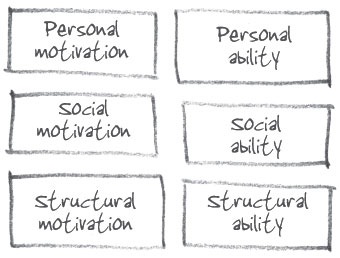
As everyone was chatting I was recalling Influencer's six sources of influence and based on that model I suggested an alternative that appealed to personal and social motivation of an important person on every team: the team manager.


influencer_6box.jpg

Here are my two suggestions. Love to hear yours in the comments.

Personal motivation initiative: we are creating a one-page handout describing why the team manager is an important role and listing four things every manager must do to be great at the job. The first on the list is to collect registration fees on time. I did think we should include a short story of how a manager did one of these tasks (more on this idea below).

Social motivation initiative: For the next four months we will share with all the team managers the overall percentage of teams that are all paid up and either congratulating them of getting all their fees in or encouraging to be as good as the rest. The overall percentage at the outset will be large which will send the message that most people are paying (social proof).

To add to this thinking I discovered this morning some important influence research which shows how stories can be added to this mix with tremendous effect. Over at the Inside Influence Report Noah Goldstein reports on Adam Grant's research showing that reminding people of the meaning and significance of their work can double their productivity. And he did this by simply sharing stories from those people who benefited from the call centre worker's hard work: in this case benefactors of a fundraising organisation.

Here is how Grant ran his experiment.

Working in a fundraising organisation call centre, Grant divided his participants into three groups: people who were reminded of their personal benefits of the job; people reminded of the significance their tasks was having on the benefactors of their work; and the control group. The personal benefit group read stories from other employees about the benefits of the job such as money, skills and knowledge. The task significance group read stories from the people the organisation was giving scholarships to and how these scholarships effected their lives. The control group didn't hear any stories.

Here's how Golstein reports the results:

What they found was amazing. Employees in the Personal Benefit and Control conditions looked almost exactly the same after the intervention as before it in terms of amount of donation money raised and the number of pledges earned. Yet, those in the Task Significance condition earned more than twice the number of weekly pledges (from an average of 9 to an average of 23) and more than twice the amount of weekly donation money (from an average of $1,288 to an average of $3,130). Additional analyses suggest that the huge increase was driven by previously unmotivated employees increasing the number of calls they made per hour.

So my question is who's story does the team managers need to hear? I can't imagine hearing a story from the committee of how getting the money in on time will motivate anyone. Perhaps it needs to be a story from one of the players that received a scholarship or from a parent in the under eights who gets reduced fees to get them started. Or maybe it is a story from one of the coaches who all just received new coaches tops.

Grant, A. M. (2008). The significance of task significance: Job performance effects, relational mechanisms, and boundary conditions. Journal of Applied Psychology, 93, 108-124.

Send this entry to:  Share on Twitter Share on Facebook    Clip to Evernote   | Email to a friend

Permalink | Comments (1) | TrackBack


TheStoryTest Results

Posted by Shawn Callahan - 8/03/10
Filed in Anecdotes, Business storytelling.

Congratulations on doing TheStoryTest—and if you haven't done it, reading this blog post now is tantamount to cheating—shame on you :-)

Here are the quick answers. Below we will explain why each example is or is not a story.

  1. Pizza innovation - no
  2. Basement flood at Tree Hill - yes
  3. Hewlett Packard's European operations - no
  4. The role of a leader - no
  5. Gloves on the boardroom table - yes
  6. Pin board of movie directors - yes
  7. Tappers and listeners - yes
  8. Mark Burnett's bathtub 'story' - no
  9. Peter Lowry Technical and Quality Coach - no
  10. Suggesting a Caesar salad at Southwest - yes

Spotting a story—a practical definition of a story

Many story aficionados will be unhappy with our practical definition of a story because in their mind it doesn't illustrate the shear beauty and intricacy of stories. And they would be right. This definition is a practical one for spotting stories. It says nothing about what makes a good story, a subject as deep an Borges' fabled library.

At its most basic level a story is when someone does something, somewhere, at some time and usually for some reason. In other words a story describes an event (or sequence of events) at a place and time featuring one or more characters who take some action for some purpose. A story is about something that happened or might happen. What's happening now is life.

There are four features to look out for to spot a story:

  1. Time marker: stories often start with a time marker such as "In 1991 ..." "Just the other day" "Last Tuesday ..." "When we last spoke to the CEO ..." The archetypal time marker is, of course, "Once upon a time" but I find this opening less common in a business context.
  2. Place marker: sometimes a story will start with a place marker such as "We were outside Jim's office ..." "At basketball ..." "On our way to the client ..."
  3. Characters: stories feature people (or other people-like entities such as Thomas the Tank Engine) doing things. They have names, speak and take action.
  4. Events: stories have one or more events. These events might be moments in time or scale up to eons.

This should be enough to spot a story. So here are the ones in TheStoryTest.com

Examples that were stories

Story two - Basement flood at Tree Hill

Remember when we flooded the basement at Tree Hill. Smithie dragged me into his office, “Right, now your going to explain to me the facts, you're going to tell me exactly what you did and why you ended up doing what happened.” Then it was over; that was the appropriate decision at the time, and he just walked out of the office, didn't he, and said to everyone, “Case closed.” Nothing was a problem. If there was a problem, he'd kick your arse from one end of the room to the other and then it would be over.

Source: Collected by Anecdote (NB: The names and locations have been changed).

This is a story we collected in an Anecdote Circle. It's exactly how someone told it. It starts with a place marker "the basement at Tree Hill." Then the the teller talks about his manager, Smithie, and how he deals with mistakes.

Story five - Gloves on the boardroom table

We had a problem with our whole purchasing process. I was convinced that a great deal of money was being wasted and would continue to be wasted into the future, and that we didn't even know how much money was being thrown away. I thought we had and opportunity to drive down purchasing costs not by 2 percent but by something in the order of $1 billion over the next five years. A change this big meant a big shift in the process. This would not be possible, however, unless many people, especially in top management, saw the opportunity, which for the most part they did not. So nothing was happening.

To get a sense of the magnitude of the problem, I asked one of our summer students to do a small study of how much we pay for the different kinds of gloves used in our factories and how many different gloves we buy. I chose one item to keep it simple, something all the plants use and something we can all easily relate to.

When the student completed the project, she reported that our factories were purchasing 424 different kinds of gloves! Four hundred and twenty- four. Every factory had their own supplier and their own negotiated price. The same glove could cost $5 at one factory and $17 at another. Five dollars or even $17 may not seem like much money, but we buy a lot of gloves, and this was just one example of our purchasing problem. When I examined what she had found, even I couldn't believe how bad it was.

The student was able to collect a sample of every one of the 424 gloves. She tagged each one with the price on it and the factory it was used in. Then she sorted the bags by division in the firm and type of glove.

We gathered them all up and put them in our boardroom one day. Then we invited all the division presidents to come visit the room. What they saw was a large, expensive table, normally clean or with a few papers, now stacked high with gloves. Each of our executives stared at this display for a minute. Then each said something like, "We buy all these different kinds of gloves?" Well, as a matter of fact, yes we do. "Really?" Yes, really. Then they walked around the table. Most, I think, were looking for the gloves that their factories were using. They could see the prices. They looked at two gloves that seemed exactly alike, yet one was marked $3.22 and the other $10.55.

It's a rare event when these people don't have anything to say. But that day, they just stood with their mouths gaping.

Source: Kotter, J.P and Cohen, D.S: (2002): The Heart of Change: Real-Life Stories of How People Change Their Organizations. Harvard Business Press, Boston.

The first paragraph is context setting so we haven't got to the happening yet. Then the story starts with "I asked one of our summer students ..." A character doing something for some purpose.

Story six - Pin board of movie directors

Arriving in Hollywood in the late ‘60’s as a young man, a fast track ascension up the career ladder seemed challenging to me. The men at the ‘big table’ who made the major decisions were all in their 60’s with white hair or no hair. I needed to distinguish myself from my colleagues who had similar aspirations as I did. I found it in solving a problem that the senior executives didn’t even know they had.

When any movie is made, one of the most critical decisions is who the director will be. This choice was currently being decided upon by the central figure at the table who I once heard announce that, ‘he was having a tuna fish sandwich yesterday with a particular filmmaker and he believed he was available.’ Was this the whole criteria to choose a filmmaker based on a tuna fish sandwich and ‘available?!’

Even in these pre-internet days, I had a sense that information was currency, so I set about to organize the data about all the Hollywood directors on a corked wall in my office with thousands of stick pins. Like a giant Wikipedia, everyone coming or going could add to it or take from it information about availability, propensity for staying on budget and core strengths of all the directors cross-referenced against other categories as well as talent.

Without realizing it, I’d constructed a launch pad for my career by giving concrete form to the call to action of my tuna sandwich ahha! moment—the story I’d tell forward to every visitor who asked why I was doing this giant board of directors. By surrendering control of my board of directors, I allowed my listeners to embrace it, participate in it, and own it. One person told another my story, who told another person about the story, which brought more talent and influencers to my office, and my star steadily rose.

Source: Guber, P (2011): Tell to Win: Connect, Persuade, and Triumph with the Hidden Power of Story. Crown Business, New York.

"Arriving in Hollywood in the late '60s" is the time marker but the real action starts in the third paragraph when Peter is organising his pin board of directors.

Story seven - Tappers and listeners

In 1990, a Stanford University graduate student in psychology named Elizabeth Newton discovered the ‘curse of knowledge’. She created a simple game in which she assigned people to one of two roles: 'tapper' or 'listener'. Each tapper was asked to pick a well-known song, such as “Happy Birthday,” and tap out the rhythm on a table. The listener’s job was to simply guess the song.

Over the course of Newton’s experiment, 120 songs were tapped out. Listeners guessed only three of the songs correctly: a success ratio of 2.5%. But before they guessed, Newton asked the tappers to predict the probability that listeners would guess correctly. They predicted 50%. The tappers got their message across one time in 40, but they thought they would get it across one time in two. Why?

When a tapper taps, they are hearing the song in their head. Go ahead and try it for yourself - tap out 'Happy Birthday'. It's impossible to avoid hearing the tune in your head. Meanwhile, the listeners can't hear that tune - all they can hear is a bunch of disconnected taps, like a kind of strange Morse code.

It's hard to be a tapper. The problem is that tappers have been given knowledge (the song title) that makes it impossible for them to imagine what it's like to lack that knowledge. When they're tapping, they can't imagine what it's like for the listeners to hear isolated taps rather than a song.

This is the Curse of Knowledge. Once we know something, we find it hard to imagine what it was like not to know it. Our knowledge has "cursed" us. And it becomes difficult for us to share our knowledge with others, because we can't readily re-create our listeners' state of mind.

Source: Adapted from http://hbr.org/2006/12/the-curse-of-knowledge/ar/1

This story clearly starts with a time marker, "In 1990 ..." and then tells us about an experiment conducted by Elizabeth Newton. The story really only extends for the first two paragraphs and the following three paragraphs are the implications drawn from the story.

Story ten - Suggesting a Caesar salad at Southwest

Herb Kelleher [the longest-serving CEO of Southwest] once told someone, “I can teach you the secret to running this airline in thirty seconds. This is it: We are THE low-cost airline. Once you understand that fact, you can make any decision about this company’s future as well as I can.

“Here’s an example,” he said. “Tracy from marketing comes into your office. She says her surveys indicate that the passengers might enjoy a light entree on the Houston to Las Vegas flight. All we offer is peanuts, and she thinks a nice chicken Caesar salad would be popular. What do you say?”

The person stammered for a moment, so Kelleher responded: “You say, ‘Tracy, will adding that chicken Caesar salad make us THE low-fare airline from Houston to Las Vegas? Because if it doesn’t help us become the unchallenged low-fare airline, we’re not serving any damn chicken salad.’”

Source: Heath, C and Heath, D (2007): Made to Stick: Why Some Ideas Survive and Others Die. Random House, New York.

In this case we start with the character "Herb Kelleher" and the time marker "once told someone". This is a good example of a specific moment because we are hearing what Herb actually said. It is also an example of a story inside a story. When Herb gives his example he tells the story of Tracy from marketing, which we can assume is a fictional story based on things that could happen. A very good teaching story as well.

Examples that were NOT stories

Story one - Pizza innovation

In pizza retailing, innovation is a key factor in bringing in customers. But beyond introducing new toppings and playing with the base, what potential for innovation is there? To solve this challenge ?What If? helped the team from Pizza Hut stop thinking about products and start thinking about insights and unmet needs.

The team got out of the office and into restaurants and the lives of their consumers—going at a variety of times during the day, sitting and eating with real customers, not just talking to the staff and restaurant managers, but finding out what it’s really like to take your family out and about.

The team identified a very simple but enormously powerful insight—when ordering pizza, the kids, Dad and Mum all want different toppings. And although it is a product that is supposed to be all about sharing, it can turn into a nightmare of negotiation and compromise—until Mum finally falls on her sword and shares what someone else has chosen.

But if you’re a family restaurant with a core target of mums, you really do need to worry about Mum losing out all the time. So the idea of the 4forALL Pizza was born from this insight—4 individual square pizzas, each with its own individual topping that come together to be purchased as a single unit. Everyone gets their favourite topping, no one has to compromise—not even Mum!

Initially launched as the Quad in the UK, this was the first example of a real product innovation coming from the UK as opposed to being drawn from the US innovation pipeline. The concept then landed on American shores, was reframed and tweaked to create the 4forALL Pizza and was launched by Jessica Simpson at Superbowl 2004. Sales records were broken as the largest pizza company in the world saw sales go through the roof across the company’s 7,000 stores.

Source: Baréz-Brown, C: (2006) How to Have Kick-Ass Ideas: Get Curious, Get Adventurous, Get Creative. Harper Element, London.

This example is close to a story but is not quite there because it is mainly a set of opinions: "innovation is key", "the team identified a very simple but enormously powerful insight", "you really do need to worry about Mum losing out all the time." There are some near story components but told at a high level and therefore loses its impact: "The team go out of the office ..." "Initially launched as the Quad ..."

Story three - Hewlett Packard's European operations

In Hewlett-Packard’s European operation in the late 1990s, executives had created an internal benchmarking system that compared the time it took to process computer orders at factories in different countries. The idea was to enable managers to measure their weak spots and learn from the best. But managers at the under performing factories were not interested in learning from others. It didn’t help that the French factory was worse that the Belgium. The idea that they had to go to Belgium to learn from Belgium managers didn’t sit well with the French managers. They did not believe that others could teach them useful practices, in part because they viewed their problem as unique. But they were not.

Source: Hansen, M.T (2009): Collaboration: How Leaders Avoid the Traps, Create Unity, and Reap Big Results. Harvard Business Press, Boston.

Now you could be fooled into thinking this was a story because is starts our with a character (HP's European operation) and a time marker (in the late 1990s) but by the second sentence we move to a viewpoint about the idea rather than what happened. The rest of the paragraph is then opinions about how the French would react to the Belgians. We selected this one because it has the feeling of a story without really being one.

Story four - The role of a leader

When one is vested with the role of a leader, he inherits more freedom. The power of leadership endows him with rights to a greater range of self-determination of his own destiny. It is he who may determine the what or the how and the when and the where of important events. Yes, as with all rights, there is a commensurate, balancing group of responsibilities that impose upon his freedom. The leader cannot avoid the act of determining the what or the who or the where. He cannot avoid being prepared to make those determinations. He cannot avoid being prepared to make these terminations. He cannot avoid seeing to their implementation. He cannot avoid living with the consequences of his decisions on others and the demands these consequences impose on him. Only time will prove the merit of his stewardship.

Source: Speech by Bob Galvin (ex. CEO of Motorola) on leadership cited in: Jick, T.D and Peiperl (2003) Managing Change: Cases and Concepts. McGraw Hill, New York.

Hopefully you got this one easily. It is straight forward rhetoric with no story elements.

Story eight - Mark Burnett's bathtub 'story'

One of the most high-octane advocates of telling to win that I know of in any business is Mark Burnett, who pioneered reality television. Since 2001 Burnett has been nominated for forty-eight Emmy Awards--for series such as Survivor, The Apprentice, The Contender, Martha Stewart, Are You Smarter Than a 5th Grader?, and The MTV Awards. Because Mark has turned personal enthusiasm into career rocket fuel, I wanted him to discuss this element of the tell with my UCLA grad students.

Burnett was even more emphatic than I'd expected in stressing the role of passion in the telling of business stories. "Our success or failure is determined by our level of energy," he said flatly. "I tell my people, ‘Much more than our creativity, our level of energy inspires the people around us.' "

To explain how this works, he told the students the story he tells his employees. "The problem for successful businesspeople is really one of energy conservation. I put in a fourteen-, fifteen-, sixteen-hour day, and I need so much energy. Think of that figuratively as a bathtub full of water that you fill every morning to the brim. You crack that plug and let it drain, so by the time you come home the last drop has gone through the drain." Ideally, he emphasized, there's still some energy in the tub to get you home, but if you're confronted by "energy suckers," you'll be running on empty before noon.

Source: Guber, P (2011): Tell to Win: Connect, Persuade, and Triumph with the Hidden Power of Story. Crown Business, New York.

The first two paragraphs are context. Then the third paragraph says we are going to hear a story. But what we are told is an analogy about a bath tub and not a story at all.

Story nine - Peter Lowry Technical and Quality Coach

Peter Lowry has raced through the ranks to become a Technical and Quality Coach. He plays footy on the weekends, hits the beach in summer and - like most of his friends - enjoys overseas travel. “I love training people. I get a huge sense of fulfilment in seeing people develop and become more knowledgeable. So often people don’t get recognition for what they do know. When I coach, I tend to focus on people’s positives. And I try and turn the negatives into a way to improve.”

Source: In a collection titled: “Stories Have The Power to Surprise” in the foyer of a large financial services headquarters (NB: Name has been changed)

This is a good example of what some PR and corporate communications people think is a story but is merely a description of someone with some of their opinions. Nothing happens.

Send this entry to:  Share on Twitter Share on Facebook    Clip to Evernote   | Email to a friend

Permalink | Comments (5) | TrackBack


Endings are important for how we remember experiences
Posted by Shawn Callahan - 8/03/10
Filed in Anecdotes, Changing behaviour.

Daniel Kahneman, the founder of behavioural economics and winner of the Nobel prize in Economics, tell this story in a recent TED talk.

A friend was recently listening to a recording of a beautiful symphony and then at the end of the recording there was a terrible screeching noise. "It ruined the whole experience for me," he said.

Of course the screeching didn't ruin his whole experience because he had 20 minutes or so listening to a beautiful symphony. It did, however, ruin his memory of the experience.

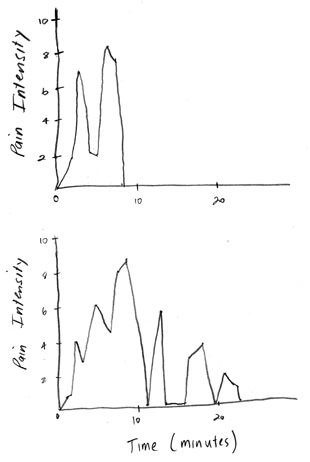
Endings are important. Kahneman describes Dan Ariely research1 on how people perceive pain when they have a colonoscopy.

Check out these two graphs Kahneman showed in his TED talk. They report two patients' experience of pain during a colonoscopy. The second patient clearly endured more pain over a longer period. Interestingly, when ask to report on their memory of the experience the second patient remembered it to be less painful than the first. Ariely's research concludes that people remember an experience based on what happens as the end, especially if it's trending in a direction (such as, to lower pain).


graph3.jpg

So it's important to focus on the end. We remember the whole in terms of what happens at the end. With the colonoscopy research they found that just leaving in the tube for longer and not wiggling around too much gave people a happier ending.

It's no coincidence then that a common plot structure is one where the story builds to a strong ending.

plot310.jpg

You can use this type of plot structure to plan and deliver a presentation so everyone remembers the experience. Of course a good memory of the event happens when the last thing you did is satisfying.

1. Ariely, D. 1998, 'Combining Experiences Over Time: The Effects of Duration, Intensity Changes and On-Line Measurements on Retrospective Pain Evaluations', Journal of Behavioral Decision Making, vol. 11, pp. 19-45.

Send this entry to:  Share on Twitter Share on Facebook    Clip to Evernote   | Email to a friend

Permalink | Comments (1) | TrackBack


« February 2010 | Main | April 2010 »