« January 2010 | Main | March 2010 »

It's how you recover when things fail that counts

Posted by Shawn Callahan - 26/02/10
Filed in Anecdotes, Communication, Leadership.

Since we started Anecdote in 2004 our local Kwik Kopy in Coburg has printed most of our posters and workshop materials. Kelvin does a great job. Always high quality, delivered when we need it despite the outrageous time frames we sometimes impose.

That was the case up until this Wednesday. We'd created a high quality handbook to support our Influence Change workshop and I picked them up from Kelvin at 4.30pm ready for the next day. At about 6pm I open the box and my heart sunk. The workbooks looked shoddy. Some of the pages were in the wrong order and all of them had edges that weren't trimmed and aligned properly. Very unusual for Kelvin. And I needed them for 7.15am the next morning.

I called Kelvin. I could hear his concern in his voice and he came over to my house right away. He apologised, kept extremely calm and said he would set it right. He went back to his store a personally redid our handbooks and arrived back at my place at 10pm with a perfect set.

It's interesting how we often don't make a comment when someone provides a great service day in, day out but we really notice when someone recovers well when the chips are down.

So if you are anywhere near Coburg and need printing services I highly recommend Kelvin's Kwik Kopy shop. Here is his address and contact details.

Kwik Kopy Printing Centre Coburg

Kelvin Minerds

583 Sydney Road, Coburg, VIC 3058

Phone (03) 9354 5822

Send this entry to:  Share on Twitter Share on Facebook    Clip to Evernote   | Email to a friend

Permalink | Comments (4) | TrackBack


Strategy alignment and execution consultants: Melbourne, Canberra, Sydney Australia

Posted by Shawn Callahan - 24/02/10
Filed in Business storytelling, Leadership, Strategic clarity.

Anecdote helps you harness the natural power of stories to bring your strategy to life. We help you tell your strategic story and then engage your employees in the strategic process so everyone has a hand in creating it. The result is a strategy everyone understands in concrete, specific terms where the level of commitment to its achievement is vastly increased.

We apply four specialties to bring your strategy to life.

Business Storytelling

Anecdote trains and coaches leaders to find and tell their stories to influence, persuade and communicate more effectively, and to provide a coherent path when times are turbulent.

Facilitating change

Anecdote facilitates complex change initiatives by balancing the nuts and bolts of what needs to be done with insight into what’s really going on and through engaging emotions to create a resolve among your people to take action.

Leadership and management development

Anecdote delivers leadership development programs that enable leaders to conclude for themselves the essential traits of a leader and starts them off on their own personal change journey and then act as a powerful model for employees.

Building collaborative workplaces

We help our clients be more effective and resilient through developing their capabilities to work collaboratively, in teams, in communities of people with shared interest and expertise, and across diverse networks.

Contact Us

NB: For our regular readers you might be wondering why we are explaining what we do in a blog post. We just wanted to make sure people could find our services around making strategies stick and our four speciality areas.

Send this entry to:  Share on Twitter Share on Facebook    Clip to Evernote   | Email to a friend

Permalink | Comments (0) | TrackBack


Business storytelling consultants: Melbourne, Canberra, Sydney Australia

Posted by Shawn Callahan - 24/02/10
Filed in Business storytelling, News.

Anecdote helps you harness the natural power of stories to bring your strategy to life. We help you tell your strategic story and then engage your employees in the strategic process so everyone has a hand in creating it. The result is a strategy everyone understands in concrete, specific terms where the level of commitment to its achievement is vastly increased.

We apply four specialties to bring your strategy to life.

Business Storytelling

Anecdote trains and coaches leaders to find and tell their stories to influence, persuade and communicate more effectively, and to provide a coherent path when times are turbulent.

Facilitating change

Anecdote facilitates complex change initiatives by balancing the nuts and bolts of what needs to be done with insight into what’s really going on and through engaging emotions to create a resolve among your people to take action.

Leadership and management development

Anecdote delivers leadership development programs that enable leaders to conclude for themselves the essential traits of a leader and starts them off on their own personal change journey and then act as a powerful model for employees.

Building collaborative workplaces

We help our clients be more effective and resilient through developing their capabilities to work collaboratively, in teams, in communities of people with shared interest and expertise, and across diverse networks.

Contact Us

NB: For our regular readers you might be wondering why we are explaining what we do in a blog post. We just wanted to make sure people could find our services around making strategies stick and our four speciality areas.

Send this entry to:  Share on Twitter Share on Facebook    Clip to Evernote   | Email to a friend

Permalink | Comments (0) | TrackBack


Book review: Switch—How to Change Things When Change is Hard

Posted by Shawn Callahan - 18/02/10
Filed in Book reviews, Business storytelling, Changing behaviour.

It was going to be difficult to surpass their last book, Made to Stick, where they showed us that people wont pay attention unless our message is simple, unexpected, concrete, credible, emotional and a story. And it was going to be even harder practising what they preached to make Switch stick. But I'm delighted to report that they've pulled it off and have created an engaging and useful work on how to change things when change is hard.

Switch is arranged around an analogy (immediately visual and sticky). When we are making a decision we're often torn between our rational, logical reasons and our emotional, intuitive feelings. Chip and Dan ask us to imagine an Elephant and its Rider (the mahout). The Rider represents the rational and logical. Tell the Rider what to do, provide a good argument and the Rider will do it. The Elephant, on the other hand, represents our emotions, our gut response. The Rider might like to avoid that hamburger and chips but there is very little the Rider can do if the Elephant really wants it (OK, so I'm telling you what happened last night). To complete their analogy they include the Path they are travelling along. If the Rider can direct the Elephant down a well prepared Path then there is a good chance for change. The Path might represent, for example, access to user friendly technology or effective office space design. Switch is arranged in three parts: Direct the Rider, Motivate the Elephant and Shape the Path.

On Saturday in 2000 ... In 1990 ... A doctor was asked ... Crystal Jones joined Teach for America in 2003 ... These are the first few words of the first four chapters and apart from the last chapter each starts with a story. And within each chapter are more stories. These stories are well chosen and illustrate the behaviours we need to adopt to effect change. The whole book is focussed on behaviours and rightly makes the point that change comes from changing people's behaviour. That's the level you need to take. A leader cannot afford to stay aloof. For change to occur they need to get into the detail as well as stay strategic.

As a business storyteller Switch is a treasure trove of stories to be retold in organisations. Last week I was running a strategy workshop and I wanted the group to identify a set of guiding principles for their organisation. So I told them the story of the Brazilian railway that was going broke and how Alexandre Behring and his CFO created four rules to guide everyone's spending behaviour to get them out of debt. I shared the rules with the participants and they knew exactly what I meant and were able to easily create their own guiding principles. Strategy execution is a change initiative and Chip and Dan advise us to script the critical moves.

Here is the structure of the book. Notice how each section is a pointer to behaviour.

Direct the Rider: Find the bright spots; Script the critical moves; Point to the destination

Motivate the Elephant: Find the feeling; Shrink the Change; Grow your people

Shape the Path: Tweak the environment; Build habits; Rally the herd

On page 58 we encounter our first clinic and I must admit I groaned slightly when I bumped into it. Getting me to do exercises while I'm reading is normally a pain. I was going to just skip the clinic but decided to have a read and the thing I noticed was that the repetition of the ideas in another context was really helping me to remember. I knew repetition is important but I guess the story approach sucked me in and reinforced it.

One the first things I check when I get a book like Switch is to see whether it is comprehensively referenced and what type of studies are being referred to (if any). Switch passed with flying colours. The endnotes are expansive and they share a swag of evidence for each point they make and often used the psychological experiments as stories rather than just presenting the facts.

Switch is a book that will be read by senior leaders. It's engaging, well written, funny in parts and insightful. If you're an change practitioner in an organisation I recommend you buy a handful of copies and give them to your leaders. In my experience they wont read it right away but then they'll jump on a flight and start and wont stop. At this point you'll not only have a supporter but someone who will compel your involvement. Malcolm Gladwell has served me well in the past and Switch is in the same league.

Send this entry to:  Share on Twitter Share on Facebook    Clip to Evernote   | Email to a friend

Permalink | Comments (2) | TrackBack


Some tips for capturing stories on video

Posted by Shawn Callahan - 17/02/10
Filed in Business storytelling, Story collection.

A few nights ago I watch Changeling starring Angelina Jolie. It's directed by Clint Eastwood (has he ever directed a dud movie?) and I was fascinated by a short documentary we found in the DVD extras where Clint explained why he never calls out 'Action' when directing a scene. As an actor Clint found a director's call to 'Action' off putting. He was immediately reminded that he was an actor, acting and his performance suffered. Instead Clint calmly and quietly says things like, "OK, in your own time ..." or "when you are ready ..."

I'll add that advice to my repertoire of tips for getting people to tell their stories on video. I like to use my Flip Video to make rough and ready clips. Here are the seven things I keep in mind when filming:

  1. Sit the person in front of plain background--you don't want to be distracted by what's behind the storyteller
  2. Have light come in from the side (sit them next to a window) to give their face more depth. But not in direct sunlight.
  3. Hold the camera as still as I can.
  4. Start filming well before you ask the person to recount their experience and engage them in some idle chit chat. This gets them used to being filmed.
  5. Keep the camera as close to my face as possible and tell the storyteller to tell me, not the camera, the story. Ask them to look me in the eye. With the camera close by it will look like they are looking at the camera.
  6. Keep filming after they finish their story. You never know what they will say after they relax and then there is plenty of space to edit the ending.
  7. Try to avoid making noise and nodding while they are telling their story (hard to do). Otherwise your sounds and movement also get captured.

Send this entry to:  Share on Twitter Share on Facebook    Clip to Evernote   | Email to a friend

Permalink | Comments (3) | TrackBack


Collaboration provides autonomy

Posted by Shawn Callahan - 15/02/10
Filed in Changing behaviour, Collaboration.

Last week I started a new Making Strategies Stick project with a large IT company. The guys I'm working with are the technical sales folk and as we were working out their strategic story they mentioned that the passion that was once there for their products seemed to be waning among some of their technical specialists.

These guys work closely with the sales people. The way they work together, however, varies dramatically from being merely instructed by the sales people to do demonstrations of the product (they call this being demo dollies) to working collaboratively as peers with the sales people.

I asked whether those who showed a lack of passion were also the ones treated as demo dollies. Th answer was yes.

Dan Pink has done a good job in his latest book, Drive, to show that there are three important factors that affect our motivation: purpose, mastery and autonomy. It seems that in this case those treated as demo dollies were losing their autonomy (and also unable to apply their mastery) and were losing the spark for the product. Collaboration (where collaboration is when peers work together to tackle complex activities--see our paper), on the other hand, provided all three factors.

Another good reason to get serious about collaboration in your business.

Send this entry to:  Share on Twitter Share on Facebook    Clip to Evernote   | Email to a friend

Permalink | Comments (3) | TrackBack


Leaders should tell a story to explain why

Posted by Shawn Callahan - 11/02/10
Filed in Business storytelling, Leadership, Strategic clarity.

On a recent trip to Canberra I was lining up to board the plane. Behind me was a young family. Their young son, probably four or five, was quizzing his dad.

The boy said: "Why are we in the line?"

"Because we are getting on the plane," his dad replied.

"Why are we getting on the plane?"

"Because we are visiting Grandma in Canberra.," says dad.

"Why are we visiting Grandma?"

"Because we love Grandma and she likes us to visit."

Our urge to know 'why' is deeply embedded in our psyche. From an early age we want to know the reason things happen. It helps us predict what might happen in the future and makes us feel safe.

The desire to know why doesn't diminish with age. If a CEO announces that the company is shifting direction to concentrate on customer service, everyone in the company will want to know why.

And if they haven't been told the story of how the shift came about, they will create their own story.

Imagine two colleagues chatting after the CEO announcement to focus on customer service.

"After all these years banging on about innovation, now it's customer service. What's that about?" says Paul

"Well, I heard the new chairman is a zealot for customer service and at his last position there was a dramatic improvement when they focussed on their customers. He must have twisted the CEO's arm," says David

"Good to know the CEO can think for himself," Paul chuckles rolling his eyes.

If leaders don't tell the story that explains important decisions then employees will use the best information they have to create their own story. At best this only confuses everyone and stalls action. At worse the new direction is actively undermined by the competing stories.

You might be thinking, "so do the senior leaders simply spin a story that's serves their purpose?" You could try but employees are too smart to believe a porky pie. It's in everyone's interest for the leaders to tell what really happen to prompt the change. There are two things someone hearing the story will ask themselves before they will really listen to what's being said: is it relevant? and, is it plausible? Fail these two tests and you may as well be telling the stationery cupboard. With something as important as a new strategic direction it's vital that all the leaders want and can tell this story.

We call this type of story a strategic story and we've been having fun helping some interesting companies find and tell their strategic story.

Send this entry to:  Share on Twitter Share on Facebook    Clip to Evernote   | Email to a friend

Permalink | Comments (2) | TrackBack


The people part of change

Posted by Mark Schenk - 3/02/10
Filed in Anecdotes, Changing behaviour.

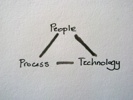
In late May 2009 I was invited to advise on change management on a big project in Sydney. P2030086

The client was a medium size logistics organisation with a history of poor performance, low staff engagement and sub-standard customer service. They were in the midst of something of a crisis. They had been directed to substantially down size, two recent reviews had condemned them for their inefficiency and appalling service and a recent reorganisation appeared to have made matters worse.

One of the first things I did was to talk with the senior leaders. The CEO explained that they had reorganised twice, reviewed and substantially modified all operating procedures and introduced new and more efficient technologies to support their work. And despite all that he explained with frustration, nothing had improved. Most of the staff were "hopeless" and he thought the best thing was to replace them all. He had introduced a compliance team to monitor staff adherence to the new rules and processes, but despite many staff being caught and punished, they hadn't improved.

I gently explained that there was no point changing structures, processes and technology if people continued to behave as they had in the past. They had neglected the people bit of their change agenda. I was mildly surprised when this explanation appeared to come as a revelation for them.

My surprise was short-lived as I observed the way they talked about their staff and behaved over the next few days. I wish this story had a happy ending. I also wish it were an isolated incident.

Send this entry to:  Share on Twitter Share on Facebook    Clip to Evernote   | Email to a friend

Permalink | Comments (3) | TrackBack


One public workshop this year: influencing change with stories

Posted by Shawn Callahan - 2/02/10
Filed in Business storytelling, Changing behaviour, News.

We often get asked whether we are running any public courses on our techniques but for the last couple of years we have reserved these courses for our clients.

But this February and March we are running one workshop on influencing change with stories in collaboration with Kevin Bishop, most recently the Royal Bank of Scotland's change manager in the UK.

If you would like to attend here are all the details.

We only have limited places so please let us know as soon as you can to secure a spot.

Send this entry to:  Share on Twitter Share on Facebook    Clip to Evernote   | Email to a friend

Permalink | Comments (0) | TrackBack


Keeping richness in our decision making

Posted by Shawn Callahan - 2/02/10
Filed in Anecdotes.

Jean Louis Rodolphe Agassiz (1807–73) was a Swiss-born American zoologist and geologist who taught at Harvard. Imagine that you went to Louis Agassiz’s laboratory at Harvard as a student. Agassiz would place a small tin pan in front of you with a small fish and utter the stern requirement that you “should study it, but should on no account talk to any one concerning it, nor read anything related to fishes” (Cooper, 1987: 79) nor use any artificial aids like a magnifying glass until he gave you permission to do so. As one student said, “To my inquiry ‘What shall I do?’ he said in effect “Find out what you can without damaging the specimen; when I think you have done the work, I will question you” (Cooper, 1987: 82). Students kept telling Agassiz what they had found and Agassiz kept saying “That is not right.” This went on, typically, for 100 or more hours with the same now “loathsome” fish. Agassiz would keep asking “What is it like?,” “Do you see it yet?” and saying “You have not looked carefully” and “You have 2 eyes, 2 hands, and 1 fish” (Cooper, 1987: 81). Gradually, things would begin to change. One student replied to the professor’s query as to whether he had seen one of the most conspicuous features of the fish, the symmetrical sides with paired organs, “No I have not seen it yet, but I see how little I saw before.” Agassiz replied, “That is next best . . . now put away your fish, go home; perhaps you will be ready with a better answer in the morning. I will examine you before you look at the fish” (Cooper, 1987: 81; emphasis added). Another student reported the following experience: “I pushed my finger down its throat to feel how sharp the teeth were. I began to count the scales in the different rows, until I was convinced that that was nonsense. At last a happy thought struck me—I would draw the fish; and now with surprise I began to discover new features in the creature. Just then the Professor returned. ‘That is right,’ said he; ‘a pencil is one of the best eyes’” (Cooper, 1987: 81; emphasis added).

Agassiz (nicely told by Karl Weick on an article on richness) was acutely aware of the human propensity to name something, to categorise it, and then discover its properties vanish before our eyes. Once named we no longer need to attend to the details to work it out. As Weick points out, naming things is an essential action to coordinate activities. Unfortunately we lose detail in the process.

One way to keep richness in our understanding is to identify the stories that represent situations. We are currently working for a government agency helping them to create and tell their strategic story. They've identified seven strategic directions and in and of themselves are abstract ideas such as, achieve with our partners, be easy to deal with, nurture independence. These ideas only make sense when illustrated by an prototypical story.

References

Cooper, L. 1987, 'Louis Agassiz as a teacher', in CR Christensen (ed.), Teaching and the case method, Harvard Business School, Boston, pp. 79–82.

Weick, K.E. 2007, 'The Generative Properties of Richness', Academy of Management Journal, vol. 50, no. 1, pp. 14–9.

HT to Tim Kannegieter for pointing me to the Weick paper.

Send this entry to:  Share on Twitter Share on Facebook    Clip to Evernote   | Email to a friend

Permalink | Comments (0) | TrackBack


« January 2010 | Main | March 2010 »