« December 2009 | Main | February 2010 »
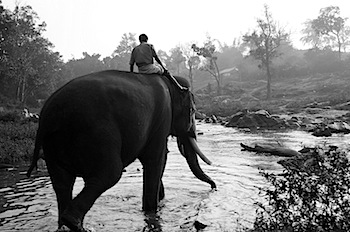
Dan and Chip Heath have a new book coming out (Feb) and they sent me a copy of the first chapter. The title is Switch and like their last best seller, Made to Stick, it promises to be a keeper. It's all about how to motivate people to change. The first chapter has left an indelible impression because of the strong image they conjured to explain what we need to consider to influence change: the Mahout (they call it The Rider), the Elephant and the Path.

Changing behaviour involves a struggle between our rational and well-reasoned thinking and our emotional urges. The mahout represents the rational and reasoned. If the mahout clearly understands where he needs to go he'll direct his charge that way.
The elephant represents emotional urges. While the elephant might be happy to go the way the mahout directs, if she decides to go another direction there is not a single thing the mahout can do about it.
The path represents anything that might impede or assist the mahout and the elephant to get to where they are going. You want the path to be as easy to follow as possible.
So how does this translate to a business setting? Imagine you're a leader of an organisation that's decided to compete on exemplary customer service. To engage the mahout you need a clear rationale describing why customer service is so important. You would find the research that shows the factors that influence customer service and illustrate to the mahout in everyone the concrete actions you want them to take. Engaging the Mahout, however, is the easy part and the one most organisations spend most of their time doing. The hard bit is the elephant.
Engaging the elephant, the emotion, will take action and stories about things that happened. You might start by telling some stories of customer service blunders to grab their attention. Here's one that happened to me recently. It's important you find stories from the organisation. Real life examples. Negative stories, however, often in themselves wont change behaviour, partly because people don't know exactly what they need to do to get it right. So you also need to find stories of great customer service from your company. We call them Gibson stories because William Gibson (the sci-fi writer) once said: "the future is already here; it's just unevenly distributed." You just need to find these stories that represent your company's future. Tell them. Get people to discuss them. Inspire that elephant.
After engaging the mahout and the elephant you need to pave the path and remove anything that's getting in the way of progress. This might be a rewards system that's encouraging the wrong behaviour. Or it might be an IT system that is unintegrated and hard for call centre staff to use slowing down their support for customers. There are a myriad of obstacles to remove from the path.
Don't forget, the Heath brothers were the authors of Made to Stick which dedicates a chapter to the power of stories. Chapter one is full of great stories. Some you might have already heard, such as the 424 gloves that save a company millions or the 100,000 lives saves by the Donald Berwick and the Institute for Healthcare Improvement.
The Heath brothers conclude the chapter by saying:
Whether the switch you seek is in your family, in your charity, in your organization, or in society at large, you’ll get there by making three things happen. You’ll direct the Rider, motivate the Elephant, and shape the Path.
Photo credit: goofball12
Permalink | Comments (4) | TrackBack
Creating more humanistic workplaces
Filed in Quotes.
"If you go into a grey concrete box with one little window, it's claustrophobic, it's cold. If you put a skylight in it and you make the window bigger and put a tree outside and put wood on the floor, it gets better. And it can get better and better until it becomes a humanistic space to which our bodies respond, our emotions respond." Frank Gehry in Wisdom by Andrew Zuckerman.
We can do the same in our workplaces. Not just with the physical space but with how we work, interact, connect and get things done. Frank Gehry adds skylights, wood flooring and trees. We add stories.
Permalink | Comments (1) | TrackBack
A story designed to change your mind
Filed in Anecdotes, Book reviews, Business storytelling, Changing behaviour.
Seth Godin has a new ebook out called What Matters Now. It consists of 80 or so thought leaders each with a page to talk about an idea that matters to them. Each idea is summed up in a single word such as Dignity, Autonomy, Attention, Difference. You can download the ebook here.
Dan and Chip Heath have a page with the title, Change. They incorporate three ideas in their one-pager that is dear to our work: stories, positive deviance and changing behaviour. Here is what they wrote.
A troubled teenager named Bobby was sent to see his high-school counselor, John Murphy. Bobby had been in trouble so many times that he was in danger of being shipped off to a special facility for kids with behavioral problems.
Most counselors would have discussed Bobby’s problems with him, but Murphy didn’t.
MURPHY: Bobby, are there classes where you don’t get in trouble?
BOBBY: I don’t get in trouble much in Ms. Smith’s class.
MURPHY: What’s different about Ms. Smith’s class?
Soon Murphy had some concrete answers: 1. Ms. Smith greeted him at the door. 2. She checked to make sure he understood his assignments. 3. She gave him easier work to complete. (His other teachers did none of the three.)
Now Murphy had a roadmap for change. He advised Bobby’s other teachers to try these three techniques. And suddenly, Bobby started behaving better.
We’re wired to focus on what’s not working. But Murphy asked, “What IS working, today, and how can we do more of it?”
You’re probably trying to change things at home or at work. Stop agonizing about what’s not working. Instead, ask yourself, “What’s working well, right now, and how can I do more of it?”
Chip and Dan Heath are the authors of Made to Stick and the soon-to-be-released book Switch: How to Change Things When Change is Hard.
It's not a coincidence that the Heath brothers decided to tell a story to illustrate their idea and try and persuade the reader to adopt a different approach to change. They dedicate a chapter to the power of stories in their book, Made to Stick and conclude the book saying that most of the other effects described in the other chapters are encapsulated in stories. So let's look at some of the features of this story and why it might be effective.
The simple story structure creates an image for us of both Bobby and Murphy (and let's not forget Ms. Smith). I can see Bobby sitting on a swivel chair restless and bored. If the story creates vivid images for us there is a good chance it will grab our attention and we will remember it. We've all seen Bobbys in our life, so it's easy to picture him in this story.
Names are important. Humans care about other humans. We want to know the names. Case studies often lack names and suffer for it. Again it creates attention through authenticity and empathy for people.
Also notice how they start with the story and then provide the advice. They didn't want the reader to slip into a confirmation bias where we automatically discount suggestions as our first instinct. The story first allows us to pull the idea to us, own the idea ourselves before a suggestion is made by the experts.
Permalink | Comments (2) | TrackBack
Three ways to make your strategy stick
Filed in Anecdotes, Business storytelling, Leadership, Strategic clarity.
In my hands is a corporate strategy. It’s a glossy six-page document designed for every employee to memorise and enact. There are seven themes each with three sub-themes. There are also seven values. All the information is presented as dot points well set out with lots of white space for easy reading. Sadly this strategy is unlikely to stick. Perversely, it could even cause the exact opposite behaviour the leaders desire. Here are three reasons for my statement.
1. It’s hard to remember a set of ideas without an organising schema. Neuroscientist John Medina reminds us that we need to get the overall gist of something before we can attend to the details. Watch this video for an example of what he means.
One way to provide the overall context for a strategy is to create a strategic story that places the company’s directions within a schema. That way people get the gist of the strategy and can then attach more and more meaning.
2. Too many things on our mind diminishes our willpower. Implementing a strategy requires willpower and as a recent Wall Street Journal article describes it only takes a moderate cognitive load before we succumb to temptation. In my opening example here are at least 28 things to remember about the corporate strategy which will definitely overload our ability to remember it but more importantly it could be sapping our will to stay the new strategic course.
In one experiment conducted by Baba Siv at Stanford University undergraduate students were divided into two groups. One group was asked to remember two numbers and the other had to remember seven numbers. They then had to walk down a hall and choose one of two snacks: a slice of chocolate cake or a bowl of fruit. The students remembering the seven numbers were nearly twice as likely to choose the cake than students with two numbers to remember.
In applying this idea we would be better off introducing parts of the strategy over time so people can concentrate on one or two changes at a time, perhaps over a 90 day period, before introducing the next part.
3. We remember what we see. In a corollary to the aphorism, 'we remember was we feel,' it is also true that we much more likely to recognise and recall something when we can see it. As John Medina puts it, “The phenomenon is so pervasive, it has been given its own name: the pictorial superiority effect.”
This idea immediately gets us thinking of the splendid pictures we can include with our strategies, those striking images that conjure the essence of what our company is all about. This is the standard approach but there are two other types of images you should consider back-of-the-napkin drawings and the images created by stories.
Dan Roam has created a business from helping people sketch out their thinking, back-of-a-napkin style. In his book with the unsurprising title, The Back of the Napkin, Roam illustrates the power of a simple diagram to share an idea. If you can’t sketch it on a napkin, forget it, it’s too complicated. So ensure everyone can tell your company’s strategic story with the aid of some simple sketches.
Effective stories paint pictures for us as well. When someone recounts a compelling story we visualise what’s happening. And because we are playing out the action in our mind’s eye the story becomes memorable for us. If we tell the story a number of times it becomes embedding in what we know. As the story researcher Roger Schank said, “To tell a story is to remember.”
Permalink | Comments (3) | TrackBack
Trusting the system
Filed in Anecdotes.
Registered Post is reliable system for getting important items from one place to another, right? Well read on - you might re-think your answer.
Last night Con and Faye, old friends from Queensland, came over for dinner. As is usual in these circumstances, the beer and wine flowed and the conversation was non-stop as we tried to fill in the details of the year or so since we last got together. At one stage, Faye asked if I had received to letter she had sent by registered post. My answer was no.
Faye has been guiding Anecdote's new trademark 'Putting Stories to Work' through the approval and registration process. The letter she had sent (on 6 November) contained the certificate of registration for this trademark - an important and valuable document. Naturally, Faye was very concerned that the letter hadn't shown up. This morning, she knocked on my door and voila, she handed over the letter. Faye is very organised and had all the necessary paperwork to collect the letter from the Post Office.
Twice in the past six months I have opened the PO Box and found two registered mail collection notes - you know, the little slips that advise there is something for you to collect. On both occasions, I was advised that there was only one item for collection and they had written out two slips for it. Obviously, on at least one of those occasions that was incorrect. The letter had been there, uncollected and with no subsequent collection notes, since November 6. I recall feeling quite uncomfortable with their explanations at the time, with good cause obviously.
So this should serve as a word of warning if you place a lot of faith in the registered mail system. It has changed my view. As soon as I finish this I am off to the post office to have a word with the postmaster.
Permalink | Comments (2) | TrackBack