« August 2009 | Main | October 2009 »

More than just a launch

Posted by Shawn Callahan - 28/09/09
Filed in Business storytelling, Strategic clarity.

Stories are our natural way to plan. We imagine how things are going to work out, who are the players, what incidents might befall us and what we’re going to do to avoid these traps. We remember what happened last time and what we must steer clear of. We think about those good bits we want happening everywhere in our company. We envisage the opportunities and understand the sequence of events we believe are necessary to make it happen. And then, if we are like most executives, we encapsulate our strategy in a set of dot points that immediately strips it of most of its meaning. It becomes a shell of its former self, a strategic skeleton.

What often happens next involves dangling these strategic bones at one or more major gatherings of the company. We launch our strategies and leaders say things like, “This new strategy will guide our actions and decisions for the next period of growth”. But the context is missing. Employees find it hard to understand, and remember. What’s the significance? What does it look like in practice? And as a result they find it difficult to see their place in the strategy. They also find it hard to see the strategy in their own workplace. “What do we actually do?” they say. There’s little to connect their own story to the company’s mission.

It doesn’t need to be like this.

Anecdote’s program keeps the stories in your strategy so that employees understand its meaning and significance while encouraging everyone to actively participate in the strategic process. Our aim is to harness the natural power of stories to bring your strategy to life. The primary objective is to help everyone in the company identify the vital behaviours that must be in place for the strategy to succeed. And then we help create the opportunities to design and implement small changes to bring those behaviours about. And in doing so really making your strategy stick.

Send this entry to:  Share on Twitter Share on Facebook    Clip to Evernote   | Email to a friend

Permalink | Comments (0) | TrackBack


Dan Pink on Motivation - and his subtle use of stories

Posted by Shawn Callahan - 18/09/09
Filed in Business storytelling, Changing behaviour.

Dan Pink TED talk has an important message: what scientists know about the detrimental effects of incentives remains largely unknown and unpractised by managers. He argues, which I totally agree, that we need to create workplaces which provide autonomy, possibility for mastery and purpose. These factors truly motivate us.

The video, see below, is also interesting for how Dan users stories. Take a look first then I will make some comments below.

Dan is very aware of the power of stories. In his book, A Whole New Mind, he dedicates a chapter to how important storytelling is as a skill. But he also knows that business people are scared by the term and when they hear the word 'story' they assume what is being said is made up, fluffy, unbusiness-like. So Dan frames his presentation as a legal case, focussed on the evidence, with the full persuasive power of the best legal minds (mind you he does some lovely self-deprecation at the start of the talk to connect with the audience).

Dan even goes as far as saying, "this is not a story, it is a fact ..."

But here's the thing. Dan's talk is full of stories. In fact he employs one of my favourite story patterns: the scientific experiment. Scientific experiments are great because to explain them you have to tell what the scientist did and when and the best ones of some unanticipated result--terrific elements for a story.

I counted 7 stories in Dan's presentation (one every 2. minutes or so). Quite a few for someone is telling the audience that he is not telling a story.

Send this entry to:  Share on Twitter Share on Facebook    Clip to Evernote   | Email to a friend

Permalink | Comments (2) | TrackBack


Random thoughts on anecdotes

Posted by Mark Schenk - 16/09/09
Filed in Anecdotes, Story collection.

Here are some thoughts/experiences from last week regarding anecdotes, how to elicit them and story-telling

  • Last Wednesday I listened to Alana, an Aboriginal lady, tell a traditional teaching story and we chatted afterwards. In organisations we generally see stories morph over time, with details changing but much of the meaning being retained. Alana explained that this is not what happens with traditional aboriginal stories. She had been given permission to tell the story with the strict understanding that she would re-tell the story precisely as it had been told to her. By insisting on the exact reproduction of the story the meaning is much less likely to change over time and in this way knowledge can be passed faithfully from generation to generation.
  • Shawn and I have the general view that 'how' and 'why' questions will normally elicit opinions and generalisations rather than anecdotes. 'When' and 'where' questions are generally better at generating experiences. Also on Wednesday, I heard a 'how' question that is fantastic to get anecdotes: 'How did you meet Grandma?' The great thing about this question is that it takes you to a very specific event and it can't help but result in an anecdote (unless Grandpa is in a grumpy mood).
  • A lady told me how she had been nearly hit by a Sydney Buses bus as she was on a roundabout. Instead of indicating he had made a mistake, the driver made a gesture that she interpreted as "tough cookies". Furious, she took down the bus number and by 4.30 that afternoon had sent an email to Sydney Buses complaining. By 9.30am the next day she had a response confirming that they expected high standards of driving behaviour and that the incident she described was unacceptable. They had identified the driver and organised to meet with him that day discuss the matter. She spoke very highly of Sydney Buses as a result, thought they were doing a good job. It goes to show, anger dissipates when people are listened to...

Send this entry to:  Share on Twitter Share on Facebook    Clip to Evernote   | Email to a friend

Permalink | Comments (0) | TrackBack


Successful leadership

Posted by Mark Schenk - 16/09/09
Filed in Communication, Leadership.

kathy-ireland_01This article gives an overview of a new book by Jason Jennings, 'Hit the Ground Running' about the secrets of winning CEOs. He didn't find the most successful CEOs any smarter; they were 'smart enough'. This similar to Gladwell's view in his latest book 'Outliers'. Jennings describes these successful leaders:

what differentiates them from their peers is their authenticity, humility, their determination to never make a decision without contemplating it’s long term consequences and their genuine affection for their workers, customers, vendors and suppliers and shareholders...these leaders are incredible listeners who never tire of asking questions.

The author rails against conventional business wisdom, the Gerry Maguire style "show me the money" approach that brought us the GFC and many corporate and leadership disasters. The book has 10 'rules' for successful leaders, a few of which are listed:

  1. Practice the golden rule in everything you do - you will reap exactly what you sow
  2. Gain the belief of everyone around you instead of demanding of expecting respect.
  3. Ask everyone around for help; don’t pretend to have all the answers or the plan. Remember what happened to Carly Fiorina at HP. On her first day she announced to the company that she had the plan and strategy for HP. Everyone felt left out, came to hate her and her regal ways and during her reign she halved the companies value.
  4. Work ruthlessly to simplify everything instead of making it more complicated.
  5. Make sure that everyone in the company knows the strategy and their role in its achievement.
  6. Cultivate a fierce sense of urgency in everyone because either things aren’t going well and you need to fix them fast or things are going well but the world (and your circumstances) are going to change and you need to be ready.

Why do so many leaders and organisations behave counter to these concepts? They all seem pretty logical. For me, its a good example of the 'knowing-doing' gap: we know this stuff is important but we just don't do it.

It sounds like organisations that apply the rules above would be pretty good places to work. Shawn and I are fortunate in that our narrative insight approaches are about bringing the 'rules' above to life in organisations. As a result we get to work in some pretty good organisations on projects that make a difference. Pretty cool huh?

Send this entry to:  Share on Twitter Share on Facebook    Clip to Evernote   | Email to a friend

Permalink | Comments (0) | TrackBack


Digital Habitats—book review

Posted by Shawn Callahan - 14/09/09
Filed in Book reviews, Collaboration, Communities of practice, Employee engagement.

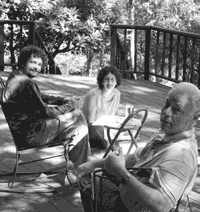
EtienneNancyJohn200.pngDigital Habitats: Stewarding Technology for Communities by Etienne Wenger, Nancy White and John D. Smith

I’m often the technology steward for communities of practice (CoP). I create the Ning spaces and configure ‘em, I setup the email lists, I work out whether we should have a wiki or a blog or a discussion forum or some other combination of communication technologies. As you can see I’m quite a geek: I really do love it.

And whenever I get stuck I’ll contact my friends at CPSquare: Etienne, Nancy and John. And while I know they all have a deep understanding of CoPs I tend to ask Etienne the theory questions, Nancy the technology questions and John the group dynamics questions. Together they are a formidable team. Sadly I think their new book, Digital Habitats, will give them strong cause to suggest I should RTFM: Read The Flipping Manual.

Digital Habitats (DH) has a single goal: to help the reader understand the role of technology steward in cultivating a community of practice: what is it, why you would do it, are you are cut out for it, how to do it and where to find help. But it is not a shoppers guide nor a roadmap for technology selection.

There is a lovely photo of Etienne, Nancy and John in the preface and I feel that reading DH is like have a friendly conversation with them on a sunny balcony. They provide the context, a little theory, then lots of practical tips supported by real life stories to ground it and make it memorable.

For me there are three ideas in this book I have already put into practice with great effect.

Experience shows us that all know that communities of practice are different, and sometimes poles apart. DH introduces the idea of community orientations to help us understand where the emphasis might lie and therefore what technologies make most sense.

There are 9 orientations: meetings, open-ended conversations, projects, content, access to expertise, relationships, individual participation, community participation, serving a context. With my engineering communities, for example, I’ve asked the members where they see their current orientation and then ask them to identify where they would like to be. A community might start off very content focussed but realise that the real benefits will come from providing access to expertise. By understanding this orientation gap the technology steward can start introducing tools to facilitate the future orientation needs.

The second idea I find useful is how my friends (I was going to say ‘the authors’ but it didn’t feel right) describe the range of activities a community might be engaged in. The axis range from informal to formal and learning from to learning with. This diagram helps me ensure I’m thinking about the full range of possibilities when helping communities members design their CoP.

DH envisages three types of readers: deep divers, attentive practitioners and just do it-ers. The just do it-ers are directed to chapter 10 which contains an action notebook. It is a series of checklists to help you think about the role of the technology steward. What I love about chapter 10 is that I can jump in and start learning about the role by doing things and then come back to the descriptions contained in the rest of the book when it is more meaningful for me. DH makes the job of finding the relevant descriptions in the other chapters easy through a multitude of cross-links from chapter 10 to the relevant book section.

There are very few practical community of practice books available (I can think of 3 others) and Etienne has already had a hand in writing one of them. So Digital Habitats is a valuable addition to this exclusive club. It’s highly readable and practical and will definitely help make a difference to the quality of your technology support for your community of practice.

Send this entry to:  Share on Twitter Share on Facebook    Clip to Evernote   | Email to a friend

Permalink | Comments (3) | TrackBack


Telling success stories

Posted by Shawn Callahan - 3/09/09
Filed in Anecdotes, Business storytelling.

Send this entry to:  Share on Twitter Share on Facebook    Clip to Evernote   | Email to a friend

Permalink | Comments (0) | TrackBack


Moments

Posted by Shawn Callahan - 1/09/09
Filed in Business storytelling.

These moments, beautifully depicted in this video, are the stuff of anecdotes, all those little stories we tell everyday that form the chatter that keeps us connected.

via The Obvious

Send this entry to:  Share on Twitter Share on Facebook    Clip to Evernote   | Email to a friend

Permalink | Comments (0) | TrackBack


« August 2009 | Main | October 2009 »