« July 2009 | Main | September 2009 »
There's a perception in business that stories are long and time consuming. "I don't have time to tell a story. I'm just going to give them the facts," I hear business folk say.
The reality is quite different. Every month or so I run a storytelling for leaders workshop. One of the first activities I often run is a jumpstart storytelling session. Each person has 90 seconds to tell their story and from my observation most people finish within a minute or even less. It doesn't take very long to tell a story. See for yourself. Check out the stories we've published here over the years, read them aloud and see how long they take.
Sure, there are the epic stories told by professional storytellers than can last for hours but business stories are mostly short.
This Johnnie Walker ad is a good example of a longer story you might hear in an organisation when someone is recounting the story of a project, a team or in this case, a company. Note how Robert Carlyle gives us the names of the people involved. We are interested in this type of detail and it's often omitted in business stories.
BTW, what did you think of the props? Did they distract you from the story or help build the picture?
Thanks to Terrence Garguilo and Kathy Hansen for finding the video
Permalink | Comments (2) | TrackBack
Value of Storytelling - when terminology gets in the way
Filed in Business storytelling.
Permalink | Comments (1) | TrackBack
Explaining the world around us with stories
Filed in Anecdotes.
In 1944 psychologists Fritz Heider and Marianne Simmel published a paper in The American Journal of Psychology. It was a simple idea. Make a film of geometric shapes moving about and then ask the subjects "... to write down what happened in the picture." 1
Here's a slightly cut down version of the original film (the original was 2.5 minutes long and this one seems to be a mirror image or the original).
Watch the video and write down what happened.
Of the 34 undergraduate women who participated in the experiment only one described what they saw in geometric terms. 31 described the objects as people and two as birds. 33 people told a story of what happened.
Humans have a natural tendency to ascribe purpose and meaning to what we see even when there is very little to suggest it. As Brian Boyd says, "it is safer to mistake a twig for a snake than vice versa." 2
The same is true in the workplace. If the CEO arrives announced on your floor, and she rarely visits your part of the building, you will quickly piece together what you know to tell yourself a story that explains her visit: it's end of the quarter, she is in with one of the comms managers, she is probably getting her speech ready for the analysts' meeting. It's plausible. It puts your mind to rest so you get back to work. Then a colleague scurries over to your desk and says "there has been a major accident at the plant." You quickly reassess what you thought was happening with the CEO's visit and reformulate your story. The new story replaces the old.
Stories help us make sense of what's happening but we do have a tendency to overreact to over-interpret.
Leaders should be always thinking about their actions and what stories will people be telling themselves as a result of their actions.
1. Heider, F. and M. Simmel (1944). "An Experimental Study of Apparent Behavior." The American Journal of Psychology 57(2): 243-259.
2. Boyd, B. (2009). On the Origin of Stories: Evolution, Cognition and Fiction. Cambridge, Massachusetts, The Belknap Press of Harvard University Press. p. 137.
Permalink | Comments (3) | TrackBack
Learning business storytelling through observation and mimicry
Filed in Business storytelling.
Just spent a fabulous day at NAB's new Academy running our storytelling program. Wow, what a venue. We were in the Scribbler room: wall-to-wall whiteboards, pin boards and butchers paper. A facilitator's dream.
After arriving home, and relaxing with a glass of wine in hand, I was chatting to Sheen about her day. She's learned heaps of new ways to teach her 4-7 year olds at her new primary school. In particular the school's emphasis on whole language has enabled Sheen to put these ideas into practice. I asked how she learned these new techniques. "By watching and listening to my colleagues and then giving it go myself," she said.
Makes sense. It's an approach we can all use to develop our business storytelling skills. The pre-requisite is to be able to identify stories when they are being told, but with that skill under your belt it's time to don your ethnographer hat and watch your fellow storytelling colleagues in action.
In particular keep an eye on when they tell stories, and when they don't. How do they move into telling a story? What type of stories do they tell? Are their stories designed to teach, illustrate values, spark action, convey a vision? Where do they tell stories (one on one, informal gatherings, meeting, presentations)? And most importantly watch those people who are listening. What is the response?
By reflecting on what you observe you can then have a crack yourself. And don't forget to set some time aside to reflect on what happens. Then rinse and repeat.
Permalink | Comments (1) | TrackBack
Worthwhile work
Filed in Leadership.
Is there a movement toward meaningful and worthwhile work? Are people increasingly interested in pursuing work that contributes to a more equitable, just, sustainable and inclusive world? Do people increasingly want work that makes the most of their talents? A job they are proud of?
Its certainly getting a push from Gen X and Gen Y concerns about sustainability and purpose, but the trend seems much broader. The rise of thinking in areas such as Appreciative Inquiry, social responsibility, positive psychology, workplace happiness and complexity together with a raft of applications for narrative (both storytelling and narrative insight / storylistening) are other indicators.
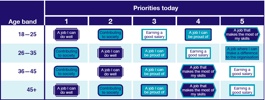
A sizeable UK study in January 2008 suggested that "over three quarters of working people in the UK are concerned that the job they do should be worthwhile and almost half hanker after a job that is more worthwhile than the one they have at the moment." The table below from this study shows how key aspects of worthwhile work vary across age groups.
Another indicator of the rise of worthwhile work is the emergence of organisations such as EthicalJobs that connects people who are looking for worthwhile work with employers who offer jobs that make a difference. I like that these guys promote their brand image like this..."our office runs on 100% Green Power, we drink 100% FairTrade tea and coffee, and we use only bikes, feet & public transport to get around" They recently published survey results suggesting that there is a movement towards worthwhile work with many people prepared to take a decent pay cut to get such jobs.
For me there is one other key aspect of worthwhile work - being valued. This is an area where managers have an incredible influence of the extent to which people consider their work as being worthwhile. Why do we have workplaces that cause my sister to start crying while we are cleaning up after dinner on Friday night when she explains how her boss treats her like dirt.
Managers need to be mindful that a key part of their role is to build engagement and to create more interactions like this one...
My brand new manager (a young up-and-comer) rang me on Friday afternoon as I was driving home. He said "I'm just ringing to let you know how much I value what you do. You regularly top the sales results and have been doing that for years. I wanted to make sure you knew that what you do is noticed and how much it is appreciated. Have a great weekend." I had to pull over to the side of the road. In the past eleven years, through three previous managers, no-one had ever said anything like that to me before. I started crying...
There is a trend toward worthwhile work. And there are huge advantages for all of us in accelerating and broadening its uptake.
Permalink | Comments (1) | TrackBack
How to illustrate the value of storytelling - stories are memorable
Filed in Business storytelling.
Permalink | Comments (1) | TrackBack
Birthday drinks venue
Filed in News.
We have found a place we like for drinks. Madam Brussells, level 3, 59 Bourke St Melbourne. Next to Spaghetti Tree. Come on down and join us.
Permalink | Comments (2) | TrackBack
Anecdote turns five
Filed in News.
It seems hard to believe that it was five years ago tomorrow that Anecdote opened doors for business. Time has flown.
On Tuesday 11 August, Shawn and I will be in Melbourne city centre having drinks from 5pm to celebrate. We would love to see you there. We will blog and tweet the venue when we find one we like. So, make a note in your calendars and come along and help us celebrate.
Permalink | Comments (4) | TrackBack
Late last year, a company approached us on the topic of employee engagement.
They’d received the results of their biannual engagement survey and, as with previous years, realised that the data pointed them to strengths and potential weaknesses but didn't help understand what was really going on, or what to do about it. The data might show that 63% of staff agreed or strongly agreed with the statement 'I am proud to work for this company' and this might be down 6% from the previous survey. On its own however, the data doesn't help with the question "what does this mean and what should be done? "
Narrative approaches are excellent for exploring these sorts of issues and helping organisations find out what is really going on, and what actions they can take to reinforce things that are going well, and improving things that need work. The survey data is vital 'targeting information' but on its own it is an insufficient basis for planning. Thus, exploring employee engagement is a natural marriage of traditional approaches such as surveys and the emerging practice of narrative.
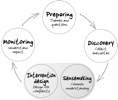
Our approach to staff engagement looks like this:
- Employee engagement surveys often focus on areas such as: do people say positive or negative things about the organisation; their intent to stay with the company; and whether they are motivated to strive to do the best they can for the company. In preparing for the narrative project, the survey data is examined to identify the themes to be explored, the geographic or structural areas to focus on and the people to involve in the project. Key stakeholders are also asked for their views on the survey results and the things that are of most concern or surprise to them.
- We use anecdote circles during the 'discovery phase' of these projects to collect a large number of examples (anecdotes) of how staff at all levels in the organisation experience issues on a day-to-day basis. The anecdote circles are an intervention in themselves as they get groups of people sharing their experiences; people value the opportunity to be listened to and participants learn from each other about how things get done. Recently, during an anecdote circle, a participant related how he received a call early one morning from his manager asking if he’d heard about the severe storm warning for his area (he hadn't). The manager was worried about him driving to work in the storm and requested that he work from home that day. The guy telling the story was really impressed by the phone call. This was a great example of how small actions can really help build employee engagement.
- In the sensemaking phase a significant and diverse groups of influencers are exposed to a cross-section of the collected anecdotes and are facilitated to engage in dialogue with each other to identify issues and themes regarding the current situation. The idea of sensemaking is to develop a rich and common understanding among these influencers of the current situation and its history. Exposure to the anecdotes provides participants with insights into what really goes on in the organisation; this can be quite confronting at times. Nonetheless, sensemaking is a vital step as the individual and collective understand it provides is the springboard for deciding what action to take. The sensemaking workshop takes between 4 hours to a full day and one of its valuable side effects is that individuals will often change (deliberately or sub-consciously) their behaviour back in the workplace as a result of the new understanding they’ve developed. This is an important step as one of the key actions to improve staff engagement is to 'stop doing things that piss staff off.'
- Complex problems cannot be 'solved' in any traditional sense and the way to make progress is to try things and see what happens. Using the deep understanding developed during the sensemaking phase, we involve the influencers in identifying the actions that can be taken to move the situation in a desirable direction. Our approach to this stage (which we call initiative design) is strongly influenced by the characteristics of complex problems meaning we encourage the organisation to identify lots of small scale actions that can be implemented at an individual or team level, based on the knowledge that with complex problems, little things can make a big difference. We also encourage the development of a 'continual improvement process' that aims to get these changes embedded in the fabric of the organisation.
- The final stage is to monitor what happens as a result of the actions taken - reinforcing the patterns that are beneficial and disrupting the ones that aren't. This is achieved through the embedding process developed during sensemaking and by using techniques such as most significant change. A planned monitoring regime is important as it helps detect changes - it also works as an incentive to implement the actions identified during intervention design
Since the initial approach, several other unrelated opportunities have emerged to work with companies to explore their employee engagement outcomes. Our extensive work in leadership/management development also has a strong link to employee engagement (as the main roles of a manager can be summarised as 'driving performance' and 'building engagement'). It looks like employee engagement is a growing area for us to apply narrative approaches.
Permalink | Comments (6) | TrackBack
You can imagine my surprise when on day 1 of the conference I found myself sitting at the same table as Dan Kirsch. I've never met Dan. I've seen some of his posts in ActKM but top-most in my mind was that Dan was the guy who triggered the events that led Yahoogroups to delete the ActKM forum. At first we didn't say too much to each other and then I found myself next to Dan in the line for lunch, so I asked him, "so from your perspective what happened to our YahooGroups forum?" We sat down and he told me the story.
I came away with a different perspective on those events and it reinforced for me the importance of listening to other people's stories to make connections. Stories told and listened were creating new connections throughout the conference. You could feel the energy it was creating among the 150 delegates.
On the first day I started off sitting next to Kerry from CPA. She couldn't believe how small Luna Park was because as a 12 year old she used to think it was an enormous theme park where you could get lost for hours. Context is so important on how we view things. We were blessed with sunny Sydney days and being right on the harbour we looked out over the harbour bridge and the opera house. Spectacular venue.
Rather than give you a blow by blow description of the conference I thought it might be more fun (especially for me) to just recount those things that grabbed my attention.
I enjoyed Frank Connolly's presentation the most. Frank is the co-ordinator for the Victorian Public Sector Continuous Improvement Network. It was like watching a stand up comedian. Not in the sense of delivering funny lines but in just how relaxed he looked and how well he connected with us. I really admired how Frank phrased his ideas, which were focussed on creativity and how we talk to each other. He told us when he was uncertain of what he knew, he spoke directly and plainly, and showed real empathy for the discipline and his place in it. He was creating a space that encouraged conversation. Frank also left us with this enduring image: "KM is like pushing a loose stool up a hill with a toothpick."
When Dale Chatwin from the Australian Bureau of Statistics was presenting I felt myself cheering him on. Dale was one of the few presenters who had the courage to admit their efforts to establish communities of practice were less than successful. It was a warts and all expose describing how ABS mandated CoPs based on IT consultants recommendations and from what I could read between the lines it seemed that CoPs were mainly viewed as online discussion forums. Dale and a few others knew better and are working to turn things around.
You might have seen me tweeting about On the Origin of Stories. One of its themes is just how important play is for animals, such as lions, because it creates a safe way to learn how to fight and hunt and by practising these things strength, agility and speed also improves. With humans we engage in cognitive play through storytelling, dance, painting, singing etc. Somehow however we've managed to kill many of the opportunities in organisations for cognitive play, with the exception of mind games. So it was refreshing to experience Patrick Lambe's session using his KM Method and Culture cards. At each table we played a set of games which got us talking and thinking in new ways. Great fun.
Roberto Evaristo from 3M showed us how they are mapping the skills of their employees using network graphs. I've been involved in a number of skill register projects and most have failed because they require a lot of time to compile and are rarely referred to which in turns diminishes the motivation for anyone to keep them up to date. Roberto's approach seemed different because senior folk were using the network graphs on a regular basis to decide who would be on what team, where learning efforts should be focussed and who might succeed another based on capabilities. You can imagine that these types of decisions matter to people and would give you plenty of motivation to update your details.
I have to admit I'm normally a KM conference-goer who leaves the room when the software vendor sponsoring the event stands up to speak. I know this is disrespectful but as a delegate I've found that I normally gain much more from the discussions with colleagues in the networking lounge than hear what is often merely a sales pitch. But on day 2 of the conference I was the conference chair so there was no skipping out of the room for me. As a result I was pleasantly surprised by Cuneyt Uysal's presentation from Open Text. Cuneyt (pronounced Jenai) gave us a good context for what was happening in social software. This quote sticks in my mind, "young people only use email to communicate with old people." It checks out with my 14 and 16 year old but like all definitive statements it's not the whole story. Most importantly it reminded me of what was happening in the software world and I was chuffed to see that ideas that I blogged about years ago are being incorporated into mainstream products such as social ranking of search, idea crowdsourcing (but I didn't call it that) and easily incorporating video.
Dave Snowden spoke a couple of times during the conference starting with the conference keynote. The idea that got me interested was the concept that it's not that useful to think of tacit knowledge as something that's in your head but that it's contained throughout your body. I was sort of expecting Dave to go the next step and say that tacit knowledge extends beyond your self and incorporates tacit knowledge of those people and things you are connected to or surrounded by. It reminds me of the network controller who couldn't remember what he knew in his lounge room or that classic of anthropology, Cognition in the Wild where each navigator alone was unable to explain or dock an aircraft carrier, but together they could.
During the conference I heard a some speakers recount the meme, "we learn best from failure." I'm not sure this is entirely true. Anecdotally I remember distantly when I read about the Ritz Carlton approach to conveying values using stories and I'm now delivering a similar approach to a client on the topic of innovation. Here I've learned from a good practice. As Bob Dickman once told me, "you remember what you feel." I can imagine memory being a key first step to learning. And some research shows it's more complex than just learning from failure. Take this example. The researchers take two groups who have never done ten pin bowling and get them bowling for a couple of hours. Then one group is taken aside and coached on what they were doing wrong and how they could improve. The other group merely watches an edited video of what they were doing right. The second group did better than the first. However there was no difference with experienced groups.
So I'm hoping we will have many more presentations at KM conferences like Frank's and Dale's which open up the possibilities, speak plainly and directly without jargon and doublespeak.
Thanks to the conference organisers, Ark Group, and especially Valerie and Aimee, for being attentive and putting into practice the ideas for improvements year in year out. It was a worthwhile and enjoyable event.
Permalink | Comments (3) | TrackBack
I discovered this video today which lists 10 questions to help you decide whether a viewpoint, opinion, theory is worth taking on board and believing. Here are the questions that will help you detect bullshit (actually they called it the baloney detector kit but no one says baloney in Australia). Write them down and take them to conferences and see how the speakers fair—ask questions and if you don't really understand what they are saying, pull them up and ask them to say it simply. It's harder to convey your ideas simply than to use jargon. Don't let them baffle you with bullshit.
- How reliable is the source of the claim?
- Does the source make similar claims? (eg. if you are into magic (or evolution), then all your ideas have a magic (or evolution) bent)
- Have the claims been verified by somebody else?
- Does this fit with the way the world works?
- Has anyone tried to disprove the claim?
- Where does the preponderance of evidence point?
- Is the claimant playing by the rules of science
- Is the claimant providing positive evidence? (it's too easy to just bag the other side)
- Does the new theory account for as many phenomena as the old theory?
- Are personal beliefs driving the claim?
Permalink | Comments (3) | TrackBack