anecdote.com.au

« January 2009 | Main | March 2009 »

26/02/09 |

Honest signals

By Shawn. Follow me on Twitter. Filed in Collaboration, Social networks.

Alex Pentland is a Professor at MIT. He's a pioneer in computational social science and Newsweek named him one of the 100 Americans likely to shape this century.

When I saw this video I was reminded of the conversation I witnessed between two engineers and the honest signals (Pentland's term for all those things we do that we do to show we are interested, care, are speaking expertly, etc.) It's 8 minutes and well worth watching, particularly the concept of honest signals. The reality mining ideas, however, gave me the heebie-jeebies. All I could think of was marketers trying to find out more about my buying patterns. But his last idea about how high performing teams oscillate between discovery tasks that are mostly individual and integration tasks that are social and face to face is an important finding for developing collaboration initiatives. This oscillation ideas is described some more here. I need to find out some more.


Thanks to Stephen Bounds on the ActKM list for the pointers to Alex's work.

Permalink | Comments (2) | TrackBack

25/02/09 |

Will the real sponsor please stand up

By Mark. Follow me on Twitter. Filed in Communities of practice.

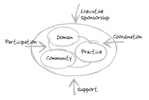
diag DCP coord2This morning I had a conversation with Mark Bennett about Anecdote's CoP Health Check service. The health check focusses on elements of Etienne Wenger's CoP model which includes executive sponsorship. The conversation with Mark highlighted how the issue of executive sponsorship needs to be addressed at numerous levels.

There might be a business line sponsor such as the Chief Engineer who is very interested in the business results delivered by the CoP and the value proposition of having people spend time on CoP activities. These sponsors take an active interest in the CoP and its activities.

You might have a champion high up in the organisation (the CEO or another C-level position) who gives the CoP its 'license to operate' and who might use the CoP as part of a strategic imperative such as creating a more collaborative organisation. These are great sponsors to cultivate and to communicate success stories to.

There might also be a third type of sponsor. One that is easy to overlook in the normal course of events but who becomes critical when times are tough and money is tight. This sponsor is the person in charge of the business unit that pays the wages of the CoP support staff and who funds the technology used by the CoP. This form of sponsor is the one coming to the fore given the current economic climate. Don't fall into the trap of waiting till the axe is ready to fall before engaging with this sponsor group and ensuring they can see how the CoP initiative is adding value. If you haven't been engaging these sponsors, yesterday would be a good time to start.

Permalink | Comments (0) | TrackBack

24/02/09 |

Collaboration presentation in Canberra

By Mark. Follow me on Twitter. Filed in Collaboration, News.

I am giving a presentation at the actKM monthly meeting on Tuesday 3rd March. The location is the National Archives of Australia in Barton. Arrive for drinks from about 5.15 pm with the presentation going from about 5.45 pm till 6.45 pm. Details are on the actKM website.

The title of the presentation is 'Collaboration....takes more than wishful thinking'. It will focus on the practicalities of developing effective collaboration cultures and skills with plenty of illustrations from our work with public and private sector organisations, both large and small, local and international.

I will describe the urgent need to build collaborative cultures and skills. Not just for our success internally, but also to ensure success with stakeholders, clients, suppliers and partners. This is particularly true when times are tough and our focus needs to be on making the most of available resources. 2009 will mark the tipping point where organisations will move from emphasising collaboration tools to placing the effort on people, on their behaviours and capabilities. We mustn’t forget: it’s people who collaborate.

If you are in Canberra next Tuesday then you are welcome to come along. No RSVP required.

Permalink | Comments (0) | TrackBack

23/02/09 |

The power of hobbies in building community

By Shawn. Follow me on Twitter. Filed in Anecdotes, Collaboration, Communities of practice.

On that day when Adelaide's temperature reached 46.7C I was running a workshop for the spatial modelling and drafting community of practice. Their ritual is to have a BBQ for lunch, which seems a little crazy given the heat but that didn't stop us. We all retreated to air condition comfort to chow down on our lamb chops and snags.

Into my third bite I noticed an animated discussion between two of the engineers talking about their love for motor bikes. They'd worked out they both had an interest in German classics and one was describing a fuel tank issue he was having. Mid-conversation one of them jumped up to retrieve a motorcycle magazine to illustrate his point.

Then in an instant the conversation morphed into a description the magazine-wielding engineer was having with a fighter jet he was working on. He was facing an intractable maintenance issue that was causing him technical and political pain. They delved deeply into the issue. You could see that there was trust and respect in the conversation and this trust and respect was at least partially developed while discussing their hobby.

Permalink | Comments (0) | TrackBack

21/02/09 |

KM is change - and how to do it with stories

By Shawn. Follow me on Twitter. Filed in Change management, Narrative.

Here is my presentation from the Ark KM for the Experienced Practitioner. I have to admit that it probably doesn't make too much sense without the commentary and the note are not the best but happy to answer any questions.

The presentation is a case study illustration of our three journey narrative approach to organisational change.

Permalink | Comments (3) | TrackBack

17/02/09 |

How to segue to a story

By Shawn. Follow me on Twitter. Filed in Storytelling.

When I teach storytelling techniques I'm often asked, "So how do I insert my story into the conversation?" The funny thing is we are all doing it all the time. We are mostly telling each other stories about what happened or what will happen. It's only when we become self-conscious of our storytelling efforts that we freeze and it feels abnormal. To get past this paralysis the first step is to forget about stories and only think of examples and experiences. You have an example or you are recounting an experience. It's simple. It's natural.

Today I spent the afternoon with Viv McWaters and had a lovely time talking about ways to get people to experience business storytelling in a workshop environment. More on that later. But we also talked about the ways people segue into a story. Here are some ways people do it:

  • Let me tell you about a time when ...
  • Here's an example that really illustrates my point ...
  • I've seen this work over there ...
  • I remember when ...
  • Let me tell you about a group who ...

Of course an effective way is just to launch into your story but avoid prefacing it with, "I've got this great story to tell you ..."

Can you suggest other ways to move from facts and opinions into a story in a business context?


Permalink | Comments (1) | TrackBack

16/02/09 |

Communities and networks connection

By Shawn. Follow me on Twitter. Filed in Communities of practice, News.

Tomorrow is the big launch. Nancy White has been toiling away with Tony Karrer to develop a dynamic website that aggregates community and network blogs. Tony is the technical wiz behind the site and there are plenty of ways to discover new and interesting information about one of the topics I love: communities of practice. Nancy is the ultimate connector and this effort is a natural extension to all the great work she does with online facilitation and communities. So here is the URL. Have fun.

http://cc.fullcirc.com/

Permalink | Comments (0) | TrackBack

15/02/09 |

Community Orientations

By Shawn. Follow me on Twitter. Filed in Communities of practice.

A couple of weeks ago I ran a workshop for a community of practice, that I helped establish a 18 months ago, to reflect on what had been achieved. One of the exercises was to compare the community's current state with the nine community orientations described in Etienne Wenger, Nancy White and John Smith's forthcoming book Digital Habitats. A community orientation reflects the tendencies the community adopts to learn together. Here they are:

  1. Meetings
  2. Open-ended conversations
  3. Projects
  4. Content
  5. Access to expertise
  6. Relationships
  7. Individual participation
  8. Community cultivation
  9. Serving a context

As I was preparing for the workshop it was clear to me what orientations 1 to 6 meant but I was unclear about 7 to 9, so I left them out of the exercise with a note to self to find out more. So today I gave Nancy a call and got her to explain the last three orientations and I recorded the conversation so you can listen in.

Digital Habitats will be an important book for all community of practice co-ordinators, especially the technology steward who is the focus for the book. To keep an eye on when the book will be published I recommend you keep an eye on the book's blog.

BTW the community orientation exercise simply involved getting the participants of the workshop to plot on a radar chart, which I'd drawn on a whiteboard, where they thought the community was currently and then do this again for where they would like to see the community of 12 months time. It generated a terrific conversation and a feel of mutual purpose. Here is what the result looked like.


Picture 8.png


Permalink | Comments (3) | TrackBack

13/02/09 |

Storytelling in Canberra

By Mark. Follow me on Twitter. Filed in News, Storytelling.

Jack Dalton
Jack Dalton (Raven Feathers) is a professional storyteller from Alaska. I was fortunate to see him perform a traditional Yup'ik story on Wednesday as part of the National Multicultural Festival here in Canberra. The 'Creation Story' was about how Raven (a magical and mischievous character in Yup'ik folklore) created man and tried to show him 'the way': essentially using no more from the environment that he needed, and how man repeatedly failed to heed this message. Very relevant to the sustainability challenges we are currently facing.

Chandni and I had a great conversation with Jack over coffee about the differences and similarities between using story to keep folkloric knowledge alive (Jack) and using storytelling in the world of business (Anecdote).

If you are in Canberra, the festival is hosting the 'Canberra Cares' concert on Saturday to raise funds for the families affected by the devastating bushfires in Victoria. It will be a great afternoon of Latin music and dance, so get on down and enjoy the cool weather and hot acts!

Permalink | Comments (0) | TrackBack

10/02/09 |

Leveraging and Valuing Expertise Workshop in Canberra

By chandni. Follow me on Twitter. Filed in Expertise location, News.

Canberra has an interesting event this month! actKM has invited Patrick Lambe to conduct a workshop on Leveraging and Valuing Expertise. This workshop is part of the open research project "Leveraging and Valuing Expertise" (http://usingexpertise.com). Log in to share your stories!

When: 9:00 am to 3:30 pm on Friday, 13 February
Where: University House Common Room, ANU
Costs: $50, includes morning tea
Registration forms

Workshop outline:
* Introduction: the nature of expertise and experience
* Grounding: Anecdote circles with participants exchanging their stories of how expertise is leveraged and used (or misused) in their organisations
* Sensemaking: we work with the stories to identify patterns and key issues in the participants' situations
* Planning: we work with an expertise transfer framework and the Straits Knowledge KM Method Cards to build outline plans for some of the participants' situations
* Close: closing discussion looking at general patterns and sharing any relevant case examples

Permalink | Comments (1) | TrackBack

8/02/09 |

Toning up your brain

By Shawn. Follow me on Twitter. Filed in Knowledge.

For years the field of neuroscience, much like the field of management, has been held back by a metaphor: the brain is a computer (machine) with each part playing a specific role. If one part of the machine (your brain) is destroyed it's impossible to fix. The Brain That Changes Itself (by Norman Doige) is the remarkable story of how a handful of pioneering neuroscientists challenged and eventually overturned the machine metaphor and clearly showed how the that brain is changeable throughout your life.

One of the featured scientists is Michael Merzenich. He obviously has an entrepreneurial flair because he's started a couple of businesses to apply his research findings. A recent business venture is called Posit Science which focusses on helping elderly people improve and maintain their brain function. And by elderly Merzenich points out that by the time we get to our 40s we have established a pattern of doing things to the point that are thinking is automatic. This autopilot ossifies our brain connections and new ones are less likely to form. To keep our brains nimble we need to keep learning. Apparently crosswords don't do too much for our brains, so forget that as a strategy.

Here are 7 things you can do today to keep your brain in tip top fitness. There are a part of a list of 14 provided on the Posit Science site. Follow the links to find the reasoning for each suggestion.

  1. Visit a museum. Take a guided tour. Listen carefully to what the guide said and when you get home recall what you learned
  2. Memorise a song. Pick a song you don't know. Listen to it enough times to get all the lyrics down. Then learn the song off by heart. Sing it to some friends.
  3. Learn to play a new instrument. Maybe it's a good time for me to take up the harmonica.
  4. Do a jigsaw puzzle. At least 500 pieces.
  5. Step it up a notch. Take something you do regularly and increase the level of difficulty. Yachtmen are now getting their yachts towed to speed far greater than winds will take then so they can speed up their reactions to better cope with normal conditions.
  6. Turn down your TV. Turn down the volume to a point you have to concentrate to hear it. When you can keep track turn it down again.
  7. Eat dark chocolate. This one is for your Nancy White (also known as choconancy)

Permalink | Comments (1) | TrackBack

7/02/09 |

Community of practice paper featured in Insightory

By Shawn. Follow me on Twitter. Filed in Communities of practice, News.

InsightoryLogo.png Just to let you know that my paper on tacit knowledge and communities of practice has been featured on insightory.com.

Permalink | Comments (0) | TrackBack

3/02/09 |

Assessing the health of a community of practice using net promoter score

By Shawn. Follow me on Twitter. Filed in Collaboration, Communities of practice.

It's a simple idea: if you have more promoters than detractors you can expect your business to thrive. This is the basis of the Net Promoter Score, a metric to give you a sense of how well your business is going.

When I first learnt about this single-question metric I was sceptical but then I had a coffee with Jon Smiles who had just finished a role with Orica (Australian chemical and mining services company). Jon told me how they used Net Promoter Score to transform their business unit's culture. Every three months they would survey and calculate their NPS and this would get everyone thinking about how they could make the place more attractive and compelling to their staff so they would not hesitate to recommend their company to colleagues and friends. By having a single score they didn't fall into the typical survey trap of thinking the results directed them towards a particular solution. Instead they were encouraged to use their own judgement and local smarts to develop initiatives. Imagine what they could have done if they combined this approach with using business narrative.

So I thought, "hey, I could use this to assess the health of communities of practice." But I will need to ask the typical Net Promoter Score questions from two perspectives:

  • How likely is it that you would recommend the Acme Community of Practice to a colleague?
  • How likely is it that your manager would recommend the Acme Community of Practice to their staff?

So last week I asked 17 members of a CoP I'm working with these two questions and here are the results.


Picture 2.png  

The NPS for the members was 35%.

The NPS for what the members thought of how likely the managers would recommend the community was -53%. You can see that there is plenty of work to be done getting the managers on board. Our approach in building this community was to get it done under the radar and get some runs on the board. We've done that now so our next step is to tell our stories to the mid level managers and above.

Calculating the Net Promoter Score

Here is how you calculate NPS.

Count the number of respondents who scored 9 or 10. These are your promoters

Work out the percentage of promoters in the whole group.

Count the number of respondents who scored 0 through to 6. These are your detractors.

Work out the percentage of detractors in the whole group.

Subtract the percentage of detractors from the percentage of promoters to calculate your Net Promoter Score.

According to Fredrick Reichheld (2003) the median NPS from over 130,000 surveys across a range of industries is 28%. Yet some of the best businesses have NPS of 70% or more.

It's hard to say that 35% is a good score for this CoP but it would be good for other communities to do a similar activity and see if we can compare. Just from experience of working with lots of different CoPs I would say this group is highly motivated and engaged. Whether we can compare NPS scores between CoPs is not a necessity. Most importantly this will give the leaders of this CoP a way to sample the mood of their community and inspire them to try new and interesting activities.

Reichheld, F. F. (2003). "The one number your need to grow." Harvard Business Review 81(12): 46-54.

Permalink | Comments (3) | TrackBack