« November 2008 | Main | January 2009 »
Merry Christmas
Filed in .
Well
2008 has been a hectic year for most of us. So now is the time to take some well-deserved time off and spend some time with family and friends. We have worked with some great people during the year and to all of our friends, colleagues and clients, we say thank you.
Best wishes for the festive season from all of us at Anecdote. We look forward to connecting with you in the New Year.
Permalink | Comments (0) | TrackBack
...all you need is love
Filed in .
Driving to Sydney yesterday I heard t
he ABC news describe how Justice Michael Kirby had delivered a speech on the topic of love to a bunch of law and commerce graduates. It was one of his last speeches before stepping down from his role as one of our High Court judges.
I guess I was a little surprised to hear him encourage the graduates to think about more than just money, and to highlight to them the importance of empathy and respect for our fellow human beings. He informed them he would share "a precious jewel"
I refer to love. Love for one another. Love for our community. Love for others everywhere in the world," he said. "Love transcends even scholarship, cleverness and university degrees. It is greater than pride and wealth. It endures when worldly vanities fade."
I am pretty sure Justice Kirby would include the workplace as one of the places where love is important. Hmmm, that reminds me I have an unread book titled 'Love @ Work' published by the Australian Institute of Management. Looks like I have found some reading material for the holidays.
Here is a link to the audio of Justice Kirby's speech.
Permalink | Comments (1) | TrackBack
Banning Facebook and the like from corporations

Filed in Collaboration.
On January 16, 1920 the National Prohibition Act came into effect in the United States and all intoxicating liquor was banned, and so began the black market in alcohol. Even before the ban was set in place I'm sure racketeers had plans to take drinking underground and at the same time any chance of the authorities having influence of black market alcohol consumption evaporated.
Like the 1920s US legislators, organisations that are still deciding whether to allow of not allow applications like Facebook are harbouring the misguided belief that they can control the use of these technologies. There is a good chance that for any large organisation that hasn't already sanctioned the use of Facebook (or any of its social networking cousins) there are already a variety of Facebook groups about their company established, hosted and actively engaging their employees.
I had the pleasure of chatting with Kirsty Areki, who is the Global Collaboration Manager for Mars. Kirsty told me about a recent flight she had had and how the person sitting next to her managed a large call centre. The call centre manager felt he had to watch everyone like a hawke and things like Facebook would be just a terrible time waster. Kirsty suggested that for a mundane and stressful job like working in a call centre access to something like Facebook to keep in contact with family and friends would be a tremendous benefit. The most important step, Kirsty said, was to engage the call centre workers in deciding the rules of how Facebook could be used. That way the staff police themselves and pull into line anyone who abuses the benefit. No one would want to lose a perk like Facebook.
Mars support the use of Facebook, Twitter, blogs and wikis. Some are official groups set up by the company. Many are generated as the need has arisen by whoever has the need.
There is one slight worry about the overuse of social software which was brought to my attention by Susan Greenfield this morning (podcast listening), which is encapsulated in the aphorism, "use it or lose it." We get good at what we practice (according to some it takes 10,000 hours of reflective practice to become expert in something) and the more time we spend online the less time we have to practice face-to-face dialogue, reading the emotions, dealing with difficult conversations, dealing with second by second uncertainty without time to craft a considered response. My feeling is that we are a long way off for this to be a problem and for me my online life only creates more opportunities for interesting face to face encounters. But I wonder about our children and how much time they are spending in front of computer and video screens.
Permalink | Comments (0) | TrackBack
What is twitter? And in support of transparent gossip
Filed in Collaboration.
If you haven't discovered Twitter yet, here's a good introduction from the Common Craft show.
I've just started using Tweetdeck to keep track of the Twitterers I'm following. So far it looks great.
A few thoughts on Twitter.
It's a mistake to think Twitter is only for reporting the minute detail of one's life, which by the way is an important activity because it helps up create stronger social bonds. Twitter is also effective for asking questions and getting answers, sharing useful links on the web and getting those frustrations out when things are driving you nuts. But probably the best use of twitter, especially from a social bonding perspective, is for gossip. Now I don't mean malicious gossip but gossip used in its strictest sense of the term which means talking about someone when they are not in the conversation. This is much harder to achieve with Twitter because the convention is to refer to other Twitterers using their @userid, and this enables them to see what you have said. But I think this type of transparent gossip is a healthy practice and one I'm going to apply in my upcoming tweets.
If your looking to follow me on Twitter just follow this link.
Permalink | Comments (1) | TrackBack
Just trying out Scribd
Filed in Changing behaviour.
Permalink | Comments (4) | TrackBack
Building a collaborative workplace
Filed in Collaboration.
Today we've started to convert our whitepapers from pdf to their plain text equivalent so you can see the whole paper without downloaded the pdf version. The first one is Building a Collaborative Workplace .
You can now bookmark it with Delicious, annotate it with Diigo and we have also added the ability for any Anecdote post to be added to your Facebook, just click on the Facebook icon at the bottom of this post.
Permalink | Comments (1) | TrackBack
Saying thanks is important for collaboration

Filed in .
A discussion thread on the Australian Facilitator's Network (AFN) list highlights a collaborative behaviour we don't seem to practice enough of and in a meaningful way: the art of saying thank you.
When it's heartfelt and authentic, saying thanks creates a new level of trust between two people. It opens up the possibility of working together, sharing knowledge and collaborating. The good practice of saying thank you can help you find your next collaborator. The art lies in making a meaningful connection with the person you are saying thanks to. Here are three key behaviours associated with saying thank you.
Say thanks early so that it's more meaningful
Peter Rennie started this excellent discussion and shared this anecdote on the AFN list.
In the early 1990's I was the convener of a small association's national conference. I had some experience of organising conferences previously and on some occasions had received a small honorarium. But this time my work was my gift to the association. The small organising team and I worked extremely hard. Our task was made all the more difficult by an executive that was tearing itself apart. As it turned out the conference was a great success. (Truly it may well have saved the organisation from imploding)
As convenor I had many verbal thank you's. A week Iater I received a thank you note from Antony Williams that I still treasure today (email was rare in those days). And a month later I received a desultory, very formal, thank you letter from the president and committee - I threw that letter in the bin. I left that organisation and haven't been a member since.
Add a personal touch to the way you say thanks
This discussion reminded me of a thank you note I'll never forget.
June 2004 was the stupidest time to fall sick because it was appraisal and bonus time. I thought that's it I'm going to miss having the 'crucial conversation' and be stuck with whatever I get. My boss spoke to me on the phone and told me look let's talk about it when you're back. I was on a long sick leave, nursing a slipped disc and he was skeptical if I'd rejoin etc. The situation felt a bit tragic. I had worked really hard the whole year, I wanted my feedback and to hear about how we did as a company and I would just about to loose out on that moment. Two-three days after the phone conversation, I got a hand delivered envelope at home. When I saw this stuffed envelope with my name scribbled in black pen I thought that's great more stuff for me to review! I was reviewing documents from home lying in bed. My boss suggested I could review using a pencil if pen's didn't work when you held them against gravity. Isn't my boss the most productive guy on earth! Reluctantly, I tore the envelope apart and found a official letter addressed to me. It was the annual bonus announcement, but what caught my eye was this scribble at the bottom which said something like 'Thanks, Chandni. For a great job and for your contribution to our growth. You got the highest bonus! Mathematical proof is enclosed:-)!' And it was signed by my boss. And I thought WOW! This is a good man after all: he could have waited, I was due to get back to work in 2 weeks. I called him to say thanks and acknowledge the letter and for the first time in all those painful weeks I was truly excited. He said something like ' That's good, you sound happy... I thought you would be curious to know how we did.' Then he went on to ask me how I was getting along with the review... but that's another story.
Practice gratitude everyday
In another post on the AFN list, Christo shared an example of some Japanese business people who visited him last year.
They run a very successful business in Japan, and they attribute their success to one primary cause - every morning the entire staff spends an hour or so simply stating their gratitude for whatever/whoever they feel fit. It can be their dog, their mother-in -law, the trees, life, clients, colleagues, love in their lives etc. No planning and goal setting in those sessions, just the connection with heart. Since doing that daily, the business has flourished, the attitudes have been extremely positive, respect within the company has increased, and the culture is one of trust, service and integrity.
Andrew Huffer shared another good practice on the AFN list.
1. Think of & write down a significant achievement of yours.
2. Then identify & write down the people who were key to helping you do this.
3. Share your gratitude with these people. (Andrew delighted these people and felt pretty good himself after sending them postcards!)
Don't loose an opportunity to say thanks and tell people how they or their work made an impact on you.
Permalink | Comments (1) | TrackBack
Business story-listening and storytelling in London
Filed in Business storytelling.
We are running two workshops in London this June:
- Narrative techniques for business (story-listening)--24th June 09
RSA House
8 John Adam Street
London - Storytelling for business leaders (storytelling)--25th June 09
School of Oriental and African Studies
University of London
Thornhaugh Street, Russell Square
London
The cost for each workshop is £350
Email us for a registration form.
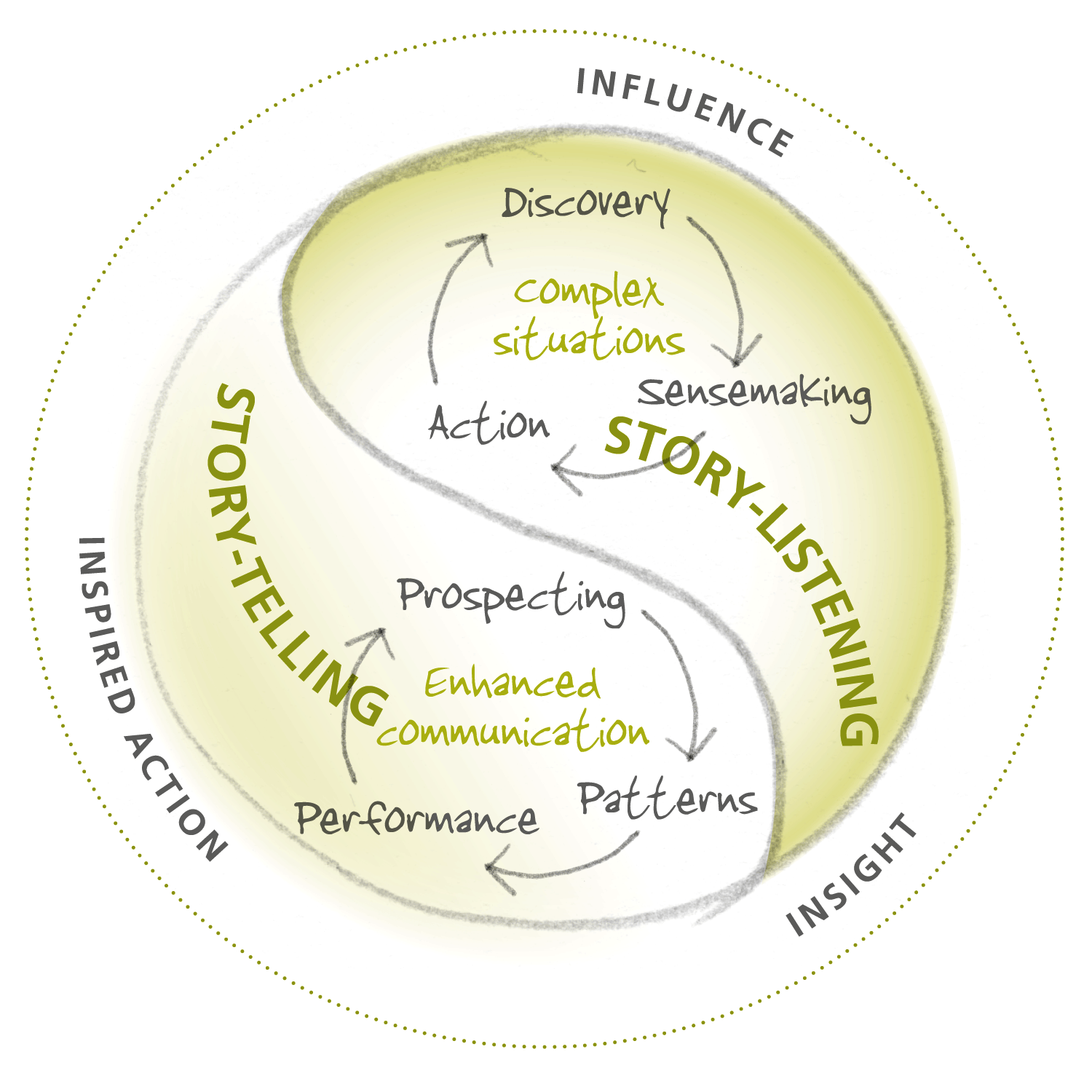
These two methods are inextricably linked, which we've attempted to illustrate in this diagram.

If you want to learn about these methods and you live near London, here's your chance. Just email me and I will send out a registration form.
Below is a full description of each workshop.
Narrative Techniques for Business
- What's really going on in your organisation?
- What are the touch points where small changes can transform behaviour and morale?
- How can you develop a common understanding of what needs to be done and generate the resolve to do it?
Surveys and metrics can uncover trouble in an organisation, but they usually don't help you identify the reasons for dysfunctions, let alone generate the resolve to springboard people into action. Instead, learn to use stories as listening posts and tap into the emotion to spark action. From time immemorial, stories have contained collective lessons in condensed form. When gathered and examined, stories that are told in your organisation reveal important themes and patterns that in turn indicate effective solutions.
This one-day workshop, led by Australia's leading experts in story listening, teaches you to gather and make sense of stories so as to see revealing patterns and use them to gain traction on solving messy organisational problems or reaching complex goals.
After a full day of instruction, practice and feedback, you will have the confidence and knowledge to apply these powerful techniques within your organisation.
Who should attend?
Anyone struggling with thorny human problems or complex goals such as the following will gain value from this workshop:
- creating culture change
- building trust
- making mergers and acquisitions successful
- capturing the knowledge of retiring employees
- extracting lessons from projects
- improving occupational health and safety
- managing risk
The instruction is grounded in insights from organisational development and the science of complexity as well as in years of hands-on work with a wide range of organisations.
Practical, hands-on training
Story listening is not something you can learn from a manual. This workshop teaches how to find and collect stories, how to make sense of the stories and then how to design interventions that improve how things work. Participants practice each step in the process with one another and receive feedback that improves their understanding and ability to work with organisational stories.
Workshop topics covered include:
- when narrative approaches make sense and when to use other techniques
- how many participants to involve in story gathering and the characteristics you should look for in selecting them
- two techniques that effectively elicit stories from just about anyone
- which media to use for preserving and analyzing stories
- ways to extract meaning from a large volume of stories
- how to formulate ways of tackling truly complex problems based on lessons from the stories
By the end of the day, you will be prepared to run a story listening project using the narrative techniques you have learned and practised. This might aim at collecting lessons learned from a large project, improving employee satisfaction, smoothing the way for massive organisational change or enhancing occupational health and safety.
Here's what previous participants have said
"Anecdote is a great concept, and delivered with very high quality. Honest, thoughtful, valuable. The staff are very generous with their expertise and resources. They are open and approachable, acknowledging both their achievements and how they learned from their mistakes. These people are the real thing. You get a strong sense of how these processes can be applied in business settings. A really great workshop." Ian Colley, MakeStuffHappen
"We were looking for a fresh approach to get the business involved in cultural development. So instead of telling employees the results of our cultural survey and getting them to fix it, we wanted it to be owned by the business and have them discover for themselves the underlying reason why things are the way they are, in a new, explorative and interesting way. So we used Anecdote. It's the narrative discovery approach that provided such rich information about our culture. We would have never been able to get these insights without it. Plus the subsequent cultural initiatives would have missed the mark completely." Andrew Petersen, Challenger Financial Services
Storytelling for Business Leaders
We all need better ways to persuade, share what we know and help those around us make sense of the complex world we live in. Developing our innate storytelling skills helps build confidence, convey ideas clearly and effectively, and probably most importantly, present to our colleagues our humanity.
We all want to convey our ideas with impact, yet eyes instantly glaze the moment you beam your PowerPoint presentation laden with slide after slide of dot points. We know informally that stories are engaging; we tell them at dinner parties and people listen and they 'get it'. Yet few leaders systematically harness storytelling to communicate ideas, convey the organisation`s values or inspire and motivate people.
What the one day workshop is all about
Telling business stories is not about concocting events and delivering your tale to an enraptured audience. Rather, it relies on people retelling their own experiences in an authentic and empathetic way. Anecdote has developed a three-step process to guide you.
Prospecting
Everyone has stories to tell, but in many cases we are unaware of them. Prospecting involves creating a conducive environment for people to remember their stories. This might involve one-on-one interview techniques or group processes.
Patterns
We can improve the way we tell our stories by understanding the story structures and patterns appropriate for the task. During the workshop, we will explore a few key patterns and help participants re-craft their stories based on these story patterns.
Performance
Effective storytelling comes from a belief that the story is authentic. People judge authenticity on how the storyteller delivers their story. Participants will learn ways to develop a comfortable delivery style and feel at ease at telling stories regardless of the setting. This workshop is for anyone wanting to improve their ability to find and tell their own stories within a business context.
Who should attend
This workshop is for anyone wanting to improve their ability to find and tell their own stories within a business context. It is also for people wishing to improve their leaders’ ability to communicate ideas and engage staff in developing new behaviours.
You should attend this course if you are interested in:
- communicating your organisation`s mission, vision and values
- helping leaders motivate and inspire
- conveying desirable behaviours
- sharing knowledge
- becoming a more effective leader
- sparking action
- having people really listening to your ideas.
What you will learn and leave with
- a better understanding of what makes an effective story in a business context
- a newly discovered story- re-crafted story from your own experience
- understanding of how to best craft questions to discover stories
- ways to interview people for stories and facilitate anecdote circles
- when to use what story pattern - build confidence in telling your story.
What attendees have said
'Shawn has a most honest, open and engaging approach which is what is shown to work best with this technique and creates an enjoyable workshop.'
'The workshop covered a lot of territory in a way that combined analytical rigour with a clear and informal delivery. I recommend it without reservation.'
'There's loads of value in the Storytelling for Business Leaders workshop, and it's been a useful part of my leadership development activities.
In my role as Chief Sustainability Officer I'm often using stories about how our clients thinking has shifted around sustainability... they're often very powerful. The workshop has given me ideas and tools on how to actively include stories into presentations to give a better sense to people of who I am and what I stand for, as well as to illustrate key messages. I know they're having effect because of the feedback I receive - that they reflect an authenticity that is engaging - and because I hear people sharing these same stories.'
Permalink | Comments (0) | TrackBack
Building an expertise location system for CoPs

Do you have a community of practice with members distributed around the country? Is your community deeply technical and use a suite of technical software tools to get the job done? So how do you keep track of who is doing what, or more importantly, who has done what, so you can get in contact with a fellow community member when you are about to embark on something similar?
A group of engineers I met yesterday had a simple approach. Each month the group's co-ordinator sends an email to all members asking them to write a short paragraph on the simulations they are working on, what parts of the software suite they're using, the type of modelling technique they're employing and when they expected to finish. Most importantly they include their name.
The report is sent to management creating the impetus for everyone to contribute. It's sent to all the members. The members store the reports in their email and when they start a new project they search through the reports to see who's done something similar.
I suggested they might create the report in a wiki and tag each entry with the type of modelling etc. so new members can see the history of reports they day they arrive. This valuable information is currently locked in people's email inboxes. The other advantage of using the wiki is that the co-ordinator can open the new report page in the wiki at the beginning of the month and members can start populating it with what they are doing, and by the end of the month the report is finished. This is also a great way to do newsletters.
Permalink | Comments (2) | TrackBack
The one place to attend our storytelling for business leaders workshop in Australia next year
Filed in Business storytelling.
If you were wondering how you might attend one of our Storytelling for Business Leaders workshops when we've discontinued our public program, I have some good news. I'll be delivering it at Ark's Strategic Internal Communication conference on the 19th of February. The other place you'll be able to attend this course will be in London in the last week of June. Just send me an email if you are interested in attending the London workshop.
I'm also giving a presentation at the conference on communities of practice, based on our CoP projects this year.
Ark is offering a 20% discount for readers of the Anecdote blog. Just quote "AG-ANEC" when you register.
Permalink | Comments (0) | TrackBack
When should we collaborate?
Filed in Collaboration.
Is it collaboration when you’re sent the yearly performance review spreadsheet and instructed to assess your staff’s performance? Absolutely not; it’s an act of co-ordination. Everyone is working separately to achieve the overall goal of conducting the performance reviews. Only a modicum of trust is required (trust in the system) to get the job done.
So, is it collaboration when you meet with your team to work out the performance review process? Not quite. Here we are co-operating with our colleagues to deliver a task that we all know needs to be done. When we co-operate there is often a medium level of trust involved (trust in each other’s competencies and character), the value of the activity tends not to accrue directly to the participants co-operating and, in most cases, someone else is driving you to do it. [1]
So what is collaboration then? It’s when a group of people come together, driven by mutual self–interest, to constructively explore new possibilities and create something that they couldn’t do on their own. Imagine you’re absolutely passionate about the role that performance reviews play in company effectiveness. You team up with two colleagues to re-conceptualise how performance reviews should be done for maximum impact. You trust each other implicitly and share all your good ideas in the effort to create an outstanding result. You and your colleagues share the recognition and praise equally for the innovative work.
The important factor is mutual self-interest. When people create things they really want to create, and it is also good for the company, it energises and engages people like nothing else. Just ask Google, who have institutionalised collaboration by giving every engineer 20 per cent of their work week to spend on any project that takes their fancy.
Today most commentators conflate co-ordination, co-operation and collaboration under the single banner of ‘collaboration’. All three types of working together are important, but creating environments where collaboration (as we have defined it) happens creates a spark that will truly transform an organisation. The important skill is knowing when to collaborate, co-operate and co-ordinate.
When is the best time to collaborate?
When thinking about good times to collaborate, it’s useful to start with a simple model that helps us understand the nature of the types of issues we might encounter in an enterprise. Here I’ve illustrated the Cynefin (pronounced cun-ev-in) framework which categorises organisational activity into four domains [2]:

Simple: this is when there is a clear relationship between cause and effect. When you do X you always get Y, and no matter how many times you do X you get the same Y result. Organising the performance reviews is a good example. You can predict with confidence the end result of the activity. In these cases co-ordination can be used to great effect.
Complicated: this is when there is still a relationship between cause and effect but you have to put effort in working out that relationship and there is often a range of possible answers. This is the realm of experts who put in the effort working out these cause-and-effect relationships. Co-operation is effective in this domain because there is often a clear end goal in mind but you need the combined forces of a range of people to achieve it.
Complex: this domain is characterised by causes and effects that are so intertwined and intricate that things only make sense in hindsight. You hear people saying: “Ah, the reason that happened was because ...”, but if you rewind the tape of what just happened and play it again, you get a different outcome; rewind and play again, and yet another outcome. This phenomenon occurs because in complex situations everything is so interconnected that a small change in one part of the system can have inordinate impact somewhere else, and vice versa. The system is unpredictable in detail, yet we can discern patterns. Designing and implementing a new performance management approach is complex because, regardless of how much analysis we do before putting it into practice, we won’t know how it’s going to work in detail. It is in these complex situations that collaboration comes to the fore.
Collaboration works well for complex situations because the style of working collaboratively matches the nature of the issues that complex situations pose. Complexity is unpredictable, and collaborating is adaptable; complexity is messy – it’s difficult to work out the question, let alone the answer – and collaborating involves bringing together a diversity of people and talents to improvise and test possible approaches, all learning as you go. Complexity offers unique and novel conundrums, and collaboration draws on a deep foundation of trust to that fosters creativity and delivers innovations.
The last domain of the Cynefin framework is chaos. This is where it’s impossible to discern a relationship between cause and effect. The best approach in this domain is simply to take action. Paradoxically it really doesn’t matter which group style is used here, as any way of working will either create opportunities in the complex space where collaboration can take effect, or push the situation into the simple domain where a co-ordination approach is effective.
With the Cynefin framework as a guide, we can better align the type of group work with the nature of the issue at hand. Collaboration is not the best approach in every situation and let’s not fall into the trap of thinking of it as a panacea. Sometimes it’s simply more effective to issue a direction to get the job done when the job is simple or complicated. It’s when things are truly complex that collaboration is most effective, and the reality is that the world is becoming more connected, faster moving and therefore more complex by the minute. Collaboration will have a growing role to play in every organisation.
References
[1] Economist Intelligence Unit (2008). The role of trust in business collaboration.
[2] Snowden, D. J. and M. E. Boone (2007). "A Leader's Framework for Decision Making." Harvard Business Review November.
Permalink | Comments (3) | TrackBack
Getting collaboration-ready from day one
Filed in Collaboration.
Organizational silos can often become one of the biggest barriers to collaboration. You may have all the right intentions, collaboration could even be a strategic goal but something still prevents it from happening. Embedding the idea of collaboration as early as possible can make it really easy to build a collaborative culture. SEI seems to have taken that idea seriously.
When a new employee joins SEI, they are given a map and sent down to a storeroom on the lower floor of the main building. There, the employee is issued a chair and desk, both on wheels, with a computer and phone on the desktop. The map shows where in the complex of nine barn-like buildings on the corporate campus in Oaks, Pennsylvania, the new hire will initially be located. The employee then rolls the desk through the buildings, into the oversized elevators designed for this purpose, and past hallways filled with a provocative (and sometimes shocking) collection of contemporary art. In a large, open room (filled with similar desks on wheels), the employee finds the spot on the map, nudges neighboring desks aside and pulls down a thick, red wire that snakes down from the ceiling, containing computer, phone, and electrical connections. Once this “python” is plugged in, the company computer recognizes the new employee and routes calls or visitors to the location. Welcome to work.
The message from Day One is clear. This is an organization that is flexible, creative, and ready for constant transformation. The company is open and not hierarchical.
Desk-on-wheels is a small thing in workplace design which can have a big impact on how people think about teamwork. This case study identifies two excellent benefits of collaboration:
- Flexible teams can break the traditional silos and bring together the diverse players needed to spark creativity and execute innovations.
- With greater interaction of employees, decisions can be made more quickly, which increases efficiency and effectiveness.
West A., Wind Y., 2007, Putting the Organization on Wheels: Workplace design at SEI, California Management Review; Vol. 49 Issue 2, p138-153.
Permalink | Comments (0) | TrackBack


When a new employee joins SEI, they are given a map and sent down to a storeroom on the lower floor of the main building. There, the employee is issued a chair and desk, both on wheels, with a computer and phone on the desktop. The map shows where in the complex of nine barn-like buildings on the corporate campus in Oaks, Pennsylvania, the new hire will initially be located. The employee then rolls the desk through the buildings, into the oversized elevators designed for this purpose, and past hallways filled with a provocative (and sometimes shocking) collection of contemporary art. In a large, open room (filled with similar desks on wheels), the employee finds the spot on the map, nudges neighboring desks aside and pulls down a thick, red wire that snakes down from the ceiling, containing computer, phone, and electrical connections. Once this “python” is plugged in, the company computer recognizes the new employee and routes calls or visitors to the location. Welcome to work.