« June 2008 | Main | August 2008 »
Blind Men and the Elephant
It was six men of Indostan
To learning much inclined,
Who went to see the Elephant
(Though all of them were blind),
That each by observation Might satisfy his mind.
The First approached the Elephant,
And happening to fall
Against his broad and sturdy side,
At once began to bawl:
"God bless me! but the Elephant
Is very like a wall!"
The Second, feeling of the tusk
Cried, "Ho! what have we here,
So very round and smooth and sharp?
To me 'tis mighty clear
This wonder of an Elephant
Is very like a spear!"
The Third approached the animal,
And happening to take
The squirming trunk within his hands,
Thus boldly up he spake:
"I see," quoth he, "the Elephant
Is very like a snake!"
The Fourth reached out an eager hand,
And felt about the knee:
"What most this wondrous beast is like
Is mighty plain," quoth he;
"'Tis clear enough the Elephant
Is very like a tree!"
The Fifth, who chanced to touch the ear,
Said: "E'en the blindest man
Can tell what this resembles most;
Deny the fact who can,
This marvel of an Elephant
Is very like a fan!"
The Sixth no sooner had begun
About the beast to grope,
Than, seizing on the swinging tail
That fell within his scope.
"I see," quoth he, "the Elephant
Is very like a rope!"
And so these men of Indostan
Disputed loud and long,
Each in his own opinion
Exceeding stiff and strong,
Though each was partly in the right,
And all were in the wrong!
by American poet, John Godfrey Saxe (1816-97)
Permalink | Comments (0) | TrackBack
The stonecutters and the cathedral builder
Here is one of the stories I heard at KM Australia as told by John Girard.
On a foggy autumn day nearly 800 years ago a traveller happened upon a large group of workers adjacent to the River Avon. Despite being tardy for an important rendezvous curiosity convinced the traveller that he should inquire about their work. With a slight detour he moved toward the first of the three tradesmen and said “my dear fellow what is it that you are doing?” The man continued his work and grumbled, “I am cutting stones.” Realising that the mason did not wish to engage in a conversation the traveller moved toward the second of the three and repeated the question. To the traveller’s delight this time the man stopped his work, ever so briefly, and stated that he was a stonecutter. He then added “I came to Salisbury from the north to work but as soon as I earn ten quid I will return home.” The traveller thanked the second mason, wished him a safe journey home and began to head to the third of the trio.
When he reached the third worker he once again asked the original question. This time the worker paused, glanced at the traveller until they made eye contact and then looked skyward drawing the traveller’s eyes upward. The third mason replied, “I am a mason and I am building a cathedral.” He continued, “I have journeyed many miles to be part of the team that is constructing this magnificent cathedral. I have spent many months away from my family and I miss them dearly. However, I know how important Salisbury Cathedral will be one day and I know how many people will find sanctuary and solace here. I know this because the Bishop once told me his vision for this great place. He described how people would come from all parts to worship here. He also told that the Cathedral would not be completed in our days but that the future depends on our hard work.” He paused and then said, “So I am prepared to be away from my family because I know it is the right thing to do. I hope that one day my son will continue in my footsteps and perhaps even his son if need be.”
Girard J.P. and Lambert S (2007) “The Story of Knowledge: Writing Stories that Guide Organisations into the Future” The Electronic Journal of Knowledge Management Volume 5 Issue 2, pp 161-172.
In the topic of writing future stories my personal preference is to help people find real stories that reflect where they would like to be in the future. I find that when people write fictitious future stories there is excitement and engagement while they write them, which is a good thing, but when the stories are revisited weeks later people look at each other askance and wonder what drugs people were on.
This type of story is in another category. It's one that might help to break a mindset and get a group thinking more aspirationally.
Permalink | Comments (3) | TrackBack
What an artist and computer scientist can do with stories
Filed in Business storytelling.
Jonathan Harris loves playing around with stories and in this 20 minute presentation at the 2007 TED he gives three examples of his work. He seems facinated with how you can collect stories and them represent then using computer graphics.
The project I found most interesting, and it was reminiscent of Cognitive Edge's ground-breaking work in graphically representing stories (check out their Sensemaker software), is his Whale Hunt project. Jonathan describes the Whale Hunt 5:50 min from the start of this video. On a 9-day visit to the Arctic he takes a photo every 5 minutes, day and night, and then displays these photos in a variety of ways (http://thewhalehunt.org/).
I'm certain you will enjoy this video. I also loved the third project exploring happiness in Bhutan.
Permalink | Comments (0) | TrackBack
Being a connector has its risks
New research has shown that we notice popular people and don't notice unpopular people. OK, so we probably didn't need research to tell us that but Cameron Anderson and Aiwa Shirako were investigating how reputations form and Dave Munger at Cognitive Daily describe the results this way:
It turns out that your reputation for cooperativeness is only affected by your behavior if you're already popular. If you're not popular, it appears that no one takes notice of your behavior, so it has no impact on your reputation. People with lots of social connections can build a good reputation -- or a bad one -- with much more ease than people with few social connections.
So for those people doing social network analyses spotting all the connectors you should also be providing these hubs with a warning: it's true you are in a great place to build your reputation but also equally good place to tear it apart.
Cameron Anderson, Aiwa Shirako (2008). Are individuals' reputations related to their history of behavior? Journal of Personality and Social Psychology, 94 (2), 320-333 DOI: 10.1037/0022-3514.94.2.320
Permalink | Comments (1) | TrackBack
Trust creating behaviours
Filed in Changing behaviour.
I went to KM Australia this week and the issue of trust was mentioned many times. I noticed, however, that very few people went beyond generic statements like trust is essential for knowledge sharing, trust is the bandwidth of communication etc. I find these high-level statements unhelpful in practice and so I suggested to the conference participants that we come up with some specific trust creating behaviours and then use a dotmocracy to vote on what everyone thought was most important.
Here are the trust creating behaviours I suggested. I also invited others to suggest their own. There were two additions; the last two in this list.
- Being open and honest about your intentions
- Looking after your colleagues when times are tough
- Consistently delivering good work
- Team members are involved in decision-making
- Being able to speak your mind in meetings
- Being generous with what you know
- Giving credit where credit is due
- Making promises and keeping them
- Being prepared to allow the group to come up with "your idea" rather than tell them how you believe it must be
- Creating an environment where positive feedback always comes first and participation is encouraged
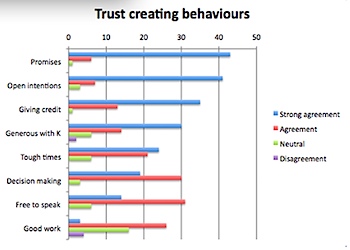
Here are the results. About 50 people participated in the vote.
'Making promises and keeping them' comes out on top followed by 'Being open and honest about your intentions' and 'Giving credit where credit is due.'
There were only two votes cast on the new proposals, the last two listed above, which probably reflected an error in our process. They were added to the dotmocracy after most people had already voted.
What do you think are the essential behaviours for fostering trust? Remember, behaviours are something you can spot, not abstract concepts like dedication, being humble or caring for your colleagues.
Permalink | Comments (8) | TrackBack
A bunch of Robert McKee resources
Filed in Business storytelling.
I think one of the first books I read on storytelling was Story by Robert McKee. It's written from the perspective of a screenwriter and conveys a tremendous understanding of story structure. Today I noticed Presentation Zen blogged a long post reviewing a Harvard Business Review article by McKee, some video interviews and a myriad of other resources you might find interesting.
While Garr is mainly focussed on storytelling in this quote, we have found a similar phenomenon in our story-listening work.
The most common way to persuade people, says McKee, is with conventional rhetoric and an intellectual process that in the business world "...usually consists of a PowerPoint presentation" in which leaders build their case with statistics and quotes, etc. McKee says rhetoric is problematic because while we are making our case others are arguing with us in their heads using their own statistics and sources. Even if you do persuade through argument, says McKee, this is not good enough because "...people are not inspired to act on reason alone." The key, then, is to aim to unite an idea with an emotion, which is best done through story. "In a story, you not only weave a lot of information into the telling but you also arouse your listener's emotion and energy." (emphasis added)
Permalink | Comments (0) | TrackBack
Unfinished business enhances mindfulness
The story goes that Bluma Zeigarnik was sitting in a cafe in Vienna (as all good psychologists do) and noticed that the waiters were able to remember long and complicated orders up to the point where the orders were delivered to the table and placed in front of the correct patron. After this point the order was completely forgotten. This simple observation triggered a series of experiments where Bluma found that if something is left incomplete it creates a psychic tension which makes a person more mindful and open to learning. It's now called the Zeigarnik Effect. Or perhaps more simply, suspense.
I heard a story-based example of the Zeigarnik effect this week. A presenter started their talk with a story and stopped just as it was getting interesting, creating psychic tension and probably some considerable annoyance. He then proceeded with the rest of his talk and completed the story at the end of the presentation. People were on the edge of their seats throughout I'm told. I've gotta give this a go.
This effect reminds me that you can use this desire for completion in other ways:
If you want to come up with a list of ideas write, "There are five things to consider:" and jot down 5 dots points (just the dots) and you will be surprised how easy it is to come up with the 5 ideas.
Thanks to Jay Cross for introducing me to this phenomenon.
Permalink | Comments (3) | TrackBack
Cool blog posts that I don't mention
Filed in .
I'm sure you have plenty of things to read and another stream of information is the last thing you are interested in. But for those who just want more I discovered Google Reader enables me to share posts which I might not ever make a comment about. Here is the link.
Permalink | Comments (0) | TrackBack
Someone has hacked my Skype account
Filed in .
I have had two people now report bizarre messages that appear to be from me but I certainly didn't send. So please let me know if I have skyped you with a comment which seems out of character and I will report it to Skype.
Permalink | Comments (4) | TrackBack
What's real work at your work?
Last week I ran a half day workshop to get a group thinking about their knowledge strategy. We got into a conversation about what things constrain knowledge-related practices such as peer assists, after action reviews, decision games etc., and one of the participants hit the nail on the head, "we have our real work and then everything else is an add on."
So if knowledge practices are not defined as 'real work' then you will face an uphill battle.
How might you turn things around? Here's an approach using Patterson et al's Influencer model.
Identify the vital behaviours you want to encourage. Search for these behaviours by seeking out people and groups who are already great at incorporating knowledge-related practices and observe them, collect stories about how they get things done. Compare these observations with groups who are poor at implementing knowledge-related behaviours.
A vital behaviour might be: Managers ask how the after action review went and what was learned from the process.
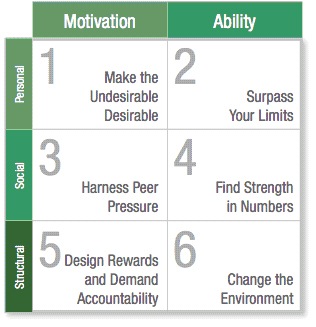
So now you need to encourage this behaviour (and probably 2 or 3 others, not 8 or 10 others). The Influencer model suggests 6 sources of influence to draw on. There are two basic questions that must be answered in the positive for someone to change: Is it worth it? and Can I do it? These two questions are reflected in the two columns in this diagram, motivation and ability.

1. Make the undesirable desirable. This is all about tapping into people's intrinsic motivators. For example, in this case you might focus on what it means to be a professional and the upmost importance of learning.
2. Surpass your limits. You can't expect people to adopt new practices without building new skills. This source of influence is about helping people build their abilities. It's about giving opportunities to try things out, engage in deliberate practice and obtain fast and effective feedback.
3. Harness peer pressure. If people you respect are doing it then it's more likely you will do it. Find the opinion leaders and get them on board first. The rest will follow.
4. Find strength in numbers. Actively build your social networks so you can tap into them when needed.
5. Design rewards and demand accountability. Use rewards carefully and only after the other sources of influence have been exercised. Link the extrinsic rewards to the vital behaviours rather than outcomes.
6. Change the environment. Physical spaces affect the way we work. Give people visual cues, create places to work, use the physical environment to reinforce the behaviours you desire.
Permalink | Comments (1) | TrackBack
Avoiding reinventing the wheel
Filed in Strategic clarity.
When we help organisations develop their knowledge strategies we encourage them to focus their efforts on a few areas. We have listed some of the areas that have emerged in past projects and we tend to use this list as a starting point. One of the focus areas is 'Avoid reinventing the wheel' and I was thinking, what one behaviour could you change that would have a major impact in achieving this objective?
Perhaps this is it. Whenever a proposal is put to a leader they ask these questions:
Have we done this before? What happened then? Please demonstrate to me that you have done a good job looking.
Has anyone else done this before? Can we find out?
I can just imagine what might happen the first few times these questions are asked. The proposer returns to their desk and asks if it is at all possible to find out what has happened in the past. Some solutions will be offered but there will be gaps and new approaches will be required. The business lines will then put pressure on the services lines of the business to provide a solution. Improvements will be made and the organisation will incrementally improve their ability to avoid reinventing the wheel.
Permalink | Comments (2) | TrackBack
Collaboration by design
Filed in Collaboration.
Lend Lease has pretty good lineage when it comes to innovative practices on the KM front. Their iKonnect program started in 2000 and is a great KM success story. I chatted with some of the KM folk at Lend Lease late last week and wasn't surprised to find that they are still coming up with the good ideas. Our whitepaper on collaboration suggests that collaboration can't be left to chance and that someone (a collaboration coordinator?) needs to be responsible for it. It turns out that Lend Lease put in place a role called 'Knowledge and Collaboration Manager' long before we articulated it in the whitepaper. Their building is also pretty cool - featuring a four storey sandstone wall integrated into the building design. The photo shows the ground floor and its meeting areas (more photos here). The Lend Lease floors feature open work spaces, meeting pods that jut out into the atrium for communal activities and shared kitchens, and a chill/meet zone on the perimeter for quieter meetings and activities. The design emphasised sustainability, heritage conservation, energy efficiency and collaboration. There was also really good feel to the place.
Permalink | Comments (0) | TrackBack
The pond metaphor
Filed in .
Here is something I have meant to post about for a while. It is a metaphor in the book 'Dangerous Undertaking' by James Harlow Brown. Shawn has previously blogged about the extensive use of metaphor in the book. The metaphor is in a story about a NASA engineer who discovered something that took him off his 'autopilot' and helped him realised the impact his behaviour and actions have. I have tried to paraphrase the story to capture its essence:
The engineer was sitting by a pond, contemplating. He saw a frog jump into the pond and noticed how the ripples spread right across the pond. He watched intently and realised that there were many other sources of movement on the surface of the pond. Insects would occasionally touch the water causing tiny ripples. A swallow swooped down and lightly touched the surface as it caught a bug. A light breeze came up and created more ripples. All these ripples interacted and caused complex patterns on the surface of the water. The engineer began to get an insight; each event was writing its unique pattern on the water and the ripples lasted long after the event happened. He realised that the whole world was the same way. We make ripples and create the future every moment.
The engineer's insight deepened. He realised he was watching the pond from a distance, as if he were outside watching others make ripples and he couldn't see himself in the picture. Suddenly it hit him that in the real world, there is no bank to sit on. He was right in the pond where the ripples were affecting him, and where he was causing ripples too. This was the insight that had a profound effect on the engineer, getting him to turn off his autopilot. Seeing himself as a part of the pond, not as some external observer.
For me, the pond metaphor has relevance to our work in leadership development. Some managers see themselves as sitting on the bank, carefully choosing where they want to drop a pebble and create patterns. They do so without realising that their every action creates patterns that have a big influence on the pond. Influences that may counteract the effects of their carefully dropped pebbles. 'Sitting on the bank' is a luxury that doesn't exist. We are all creating patterns, and the future, constantly because we are in the pond. Seeing ourselves as 'in the pond' helps change the way we think about the effects of our behaviour.
What ripples are you causing? Will your pebble drop with scarely a ripple in the pond, or will it have lasting effect?
Permalink | Comments (3) | TrackBack
Another little thing....
Filed in Fun.
One of the things we talk about a lot is the power of 'little things' to make a difference
in a complex environment. I saw the sign in the photo on the counter of a cafe earlier this week. If you can't read it, the poem goes like this
Smiling is infectious, you catch it like the flu
When someone smiled at me today I started smiling too;
I passed around the corner, and someone saw my grin;
When he smiled I realised I'd passed it on to him;
I thought about that smile, then I realised its worth;
A single smile, just like mine, could pass around the earth;
So if you feel a smile begin, don't leave it undetected;
Lets start an epidemic quick, and get the world infected
Permalink | Comments (0) | TrackBack
Matt Moore facilitates a discussion on story work with Madelyn Blair and me
Filed in Business storytelling.
This morning Madelyn and I met Matt Moore on Skype to chat about story work. Matt's a fast worker and has already posted the podcast. Here are the show notes:
00:00 - Introductions: Madelyn & Shawn's first introduction to storywork.
04:00 - Stories that stick in your mind: Madelyn's story of the Swedish ambassador, the mosque & the stone.
06:00 - Shawn distinguishes between storylistening & storytelling.
08:30 - "Storytelling" as a bit overwhelming vs things that you do everyday.
11:15 - The use of objects in storytelling - Madelyn applies this to mission statements.
13:00 - The importance of context & duckus duckus.
16:00 - Getting different groups to talk.
18:10 - Scientific papers as mystery stories.
And if you are interested in how to use mystery story format to write scientific papers (or any persuasive communication) then check out this post.
Permalink | Comments (1) | TrackBack
Immediate feedback in the moment
Filed in Knowledge.
The best way to learn a practical skill is to receive immediate, helpful feedback while you are performing the task. I was reminded of this fact this morning at our junior basketball competition. Next to each referee was an apprentice referee in a green shirt, whistle in mouth ready to make the call. They get six weeks of working with an experienced ref but only get their stripes when they can demonstrate their ability to confidently and accurately blow their whistle and do what a ref needs to do.

So why don't we employ a similar approach in the workplace? Managing staff, conducting performance reviews, facilitating sales meetings, leading teams, co-ordinating communities of practice, and I'm sure you can think of a heap of others, are practical skills you need to learn which you just can't read from a book.
I suspect workplace cultures make these types of apprenticeship initiatives embarrassing. "I've been employed to do this job and I can't let anyone know I have a lot to learn. Plus I don't want to bother anyone else." Organisations that make an apprenticeship approach just part of the norm are going reap the rewards.
Permalink | Comments (1) | TrackBack