« May 2008 | Main | July 2008 »
Employee engagement interest in storytelling
Filed in Business storytelling.
A few weeks back, Alex Manchester from Melcrum interviewed me on various issues around storytelling. He approached me following the large amount of interest in storytelling shown at the Employee Engagement conference in late May. The interview is available as a podcast if you are interested.
The use of narrative for exploring issues around employee engagement has been expanding of late, with several organisations approaching us to help get a deeper understanding of what the results of their employee engagement surveys really mean and what they can do to positively influence engagement. I will post a longer piece on this in the coming days.
Permalink | Comments (0) | TrackBack
Recognition, praise, credit
"Credit is infinitely divisible. Give it away every chance you get, and there's always plenty left for you."
Don Berwick, Head if Institute of Healthcare Improvement 100,000 lives campaign (I see it is now 5 million lives), quoted in Influencer p 164.
Permalink | Comments (0) | TrackBack
Leaders need to listen
Deborah May provided the following account in her recent newsletter.
Most leaders want to engage their team in planning processes but don't always do so effectively.Recently I facilitated a session with a group of executives. The conversation was lively, the questions were thought provoking and we ultimately developed a decent plan for the future. Unfortunately, the CEO's need to control the outcome limited the value of the session and dampened his team's enthusiasm and confidence in the future. The CEO was well intentioned. He asked his team to come up with ideas and told them that he would just listen. This was welcomed. Too frequently he dominated the meetings and limited the contribution of his team. Ideas began to flow, discussion was animated and there was a sense of possibility and excitement in the room. The conversation was still lively when the CEO somewhat petulantly ended the meeting when he said that he'd heard most of it before, they didn't come up with anything new and the meeting had been a waste of time. The animation ceased, the mood changed, energy dissipated and people looked embarrassed. I was bemused, however, and gathered the notes from the meeting, confident that there'd been many good ideas generated that could be harnessed and used. I later found out that the CEO had wanted his team to adopt a particular strategy he'd articulated at a prior meeting. He was so focused on his own idea he had failed to listen to others. When I shared the outcomes of the meeting with him later, he was decent enough to admit he'd been too rash in dismissing the meeting as a waste of time. Unfortunately he was not quite able to articulate his error of judgement to his team. Your role as a leader is to enlist followers and engage the hearts, minds and resources of the whole organisation to achieve something compelling - and then get out of the way. Leaders who are too directive and don't let go, lose not only great ideas but eventually the people as well.I am sure I have been to that same meeting. The one where the convenor purports to listen but in reality only wants to convince people to do something they have already decided. Professor Brenda Dervin said "anger dissipates when people are listened to". I think the converse is also true. We need to learn from examples such as the one above. If only we could apply the 'law of two feet' from Open Space Technology when we find ourselves in sessions like this.
Permalink | Comments (2) | TrackBack
Vital behaviours for communities of practice
Filed in Communities of practice.
Over at the Influencer blog David Maxfield has written a four post series on improving teamwork based on one of the key insights from his co-authored book, also called Influencer, which is simply changing a few behaviours can drive a lot of change. David calls them vital behaviours.
For example, the two vital behaviours David believes are essential for effective teams are:
- Whenever anyone has a concern, he or she speaks up and explains the concern in a complete, frank, and respectful way
- Everyone holds everyone accountable for meeting expectations, for commitments, and for bad behaviour—regardless of role or position
This got me thinking. What are the vital behaviours for communities of practice?
This morning I was talking to Matt Moore about this and he suggested these two:
- When someone asks a question members provide answers. No one is left hanging.
- Before you ask a question you put some effort finding the answer and in doing so respect the everyone's time
Both have a tragedy of the commons feel about them in that to continue to get value from the common (the community) you don't just milk the system dry (ask questions but never answer).
Last night I gave a talk to the KMLF on Building a collaborative workplace and posed two vital behaviours for communities of practice:
- community leaders meet regularly to shape and improve the community
- community members band together in small groups to create things that are valuable to themselves and the entire community
While I think these vital behaviours are important I think we need to be mindful of the variety of orientations a community of practice might adopt of just find the orientation has emerged because there are likely to be vital behaviours for each one. The idea of community orientations was introduced to me by Nancy White. It's an idea she has been working on with John Smith and Etienne Wenger in preparation for their new book on technology for CoPs. John has a good graphic on slideshare that lists the orientations as:
- meetings
- projects
- access to expertise
- relationships
- context
- community cultivation
- individual participation
- content publishing
- open-ended conversation
I suspect my second vital behaviour about members banding together only makes sense in project orientations. The other three might be universal. What do you think? What are the vital behaviours for successful CoPs?
Before you answer it's worth considering what David says about what is a vital behaviour:
Here are some "vital behaviors" that aren't really behaviors at all: "Respect all team members," "Achieve all team targets." The first is a quality, while the second is a result. The vital behaviors describe actions people can perform. A good test is to ask yourself, "If I told 10 people to demonstrate this vital behavior, would they all perform the same actions?"
Permalink | Comments (1) | TrackBack
Guide to anecdote circles
Filed in .
I've just realised that our Guide to Anecdote Circles has been kind of hidden on our website so I have popped a copy of the guide in the Whitepapers section of the site.
Update: Jenny Murray just pointed out to me that I put a draft version up in the first instance and this note is to let you know I have now replaced it with the final version. Thanks Jenny for letting me know.
Permalink | Comments (1) | TrackBack
Innovators are a bad choice for change
I'm thoroughly enjoying reading Influencer at the moment and the story of Dr Everett Rogers grabbed my attention. After finishing his PhD his first job was to help Iowa farmers adopt a new strain of corn which promised much higher yields. He spoke to many farmers and couldn't get a single one to try out the new strain. They just didn't trust this researcher who was so different from the farmers. He was a city slicker who was naive about farming practice, so what would he know.
Dr Rogers persisted thinking, if only he could get one farmer to try it out and then they could influence everyone else. After a time he did find someone to try out the new corn, a hipster dude who wore Bermuda shorts and fancy sunglasses. He enjoyed a bumper crop but the other farmers were unimpressed. This maverick farmer derided their way of life, he was an outsider and there was no way they were going to adopt anything from a Bermuda short wearing weirdo.
This failure springboarded Dr Rogers into a career of studying why good ideas are not adopted.
"Rogers learned that the first people to latch onto a new idea are unlike the masses in many ways. He called these people innovators. They're the guys and gals in Bermuda shorts. They tend to be open to new ideas and smarter than average. But here's the important point. The key to getting the majority of any population to a adopt a vital behavior is to find out who these innovators are and avoid them like the plague. If they embrace your new ideas, it will surely die."
It turns out it is a much better strategy to get on board the early adopters, the opinion leaders (about 14% of the population). Mind you if the opinion leaders don't like your idea, then you are sunk.
The book suggests the best way to find the opinion leaders is to ask everyone to list the people who they believe are most influential and trusted. When the same names keep being suggested (perhaps 10 times) they are the opinion leaders. I wonder about the practicality of getting this list made. Would it be done as a survey? A social network analysis survey would find this information as well as uncover those people who are most connected.
Permalink | Comments (2) | TrackBack
Indexing books with stories
Filed in Book reviews.
I've started a new practice of jotting down, inside the front cover of a book, the anecdotes it contains. It seems to work best for modern business books that have a liberal smattering of stories throughout. It is a useful practice because, like most people, I can remember a story much better that facts and reasoning and the story index is a quick reminder of the key ideas. Here's an example from Clay Shirkey's book, Here Comes Everybody.
It would be terrific if publishers created a story index as a matter of good book publishing practice. Mind you, the act of creating your own story index is a tremendous way to crystallise your learning.
Permalink | Comments (4) | TrackBack
A column in The Sydney Morning Herald on collaboration
Filed in Collaboration.
Today I have a short column in SMH on the theme of team and community collaboration for small to medium enterprises.
Permalink | Comments (0) | TrackBack
Storytelling and leadership
It's obvious to most people that good leaders are good storytellers. Stories help inspire action because they transport the listener to experience the events recounted in the story in a way that conveys emotion, context and a picture of what happened, and why is happened. We remember these stories. They help change our minds and in doing so, change our behaviours. Storytelling is an important skill for leaders.
But it's not the only way to use stories to help leaders improve their capabilities.
18 months ago we started a narrative-based leadership development program for a global pharmaceutical company. We collected 150 stories of good and bad management behaviour from the staff and then use these stories in a two day program. Twelve managers attend every month and one of the activities we do with them is to facilitate a conversation around the question, which stories are most significant?
One of the stories often selected as significant is a seemingly simple account of a woman whose manager stops whatever he was doing whenever she visited his office, moves to a table in the middle of the room and invites her to sit down and then totally focusses on her. She felt that she was being listened to and her ideas were important. It was remarkable for this woman because other managers didn't do that. The leaders in the program often choose this story as significant because they feel that if only they could get more managers doing this it would create a groundswell of change.
A few weeks ago we refreshed the stories for this company in preparation for a new phase of leadership development, and lo and behold, staff told stories of how their manager, whenever they knock on their office door, he or she stops what they’re doing, comes out from behind their desk and… you guessed it… focuses totally on them and their issues.
Imagine if we conducted the leadership development program by listing the behaviours a good leader displays and then tried to persuade them with logic and reasoning. Change is unlikely. But in this case the leaders worked things out for themselves and inspired themselves to change.
Both approaches to using stories to enhance leadership capabilities are important.
If you want to help your leaders be better storytellers, then get them along to our Storytelling for Business Leaders workshop or we can bring it to your organisation.
If you want to learn how to collect and make sense of stories as a way to change behaviours them come along to our Business Narrative workshop.
We run these workshops in Melbourne, Canberra, Sydney, Brisbane and Perth, or anywhere else in Australia or the world for that matter :-)
Permalink | Comments (1) | TrackBack
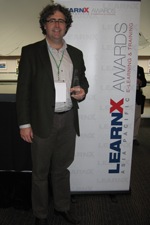
Anecdote receive award for best learning website in Asia Pacific
Filed in .
We were the very last award to be handed out at last week's LearnX conference and Robyn and I walked up to the podium to receive the crystal pyramid from Jay Cross. Thanks again to all our blog readers and the readers of Training Magazine.

Permalink | Comments (1) | TrackBack
Internal blogging builds trust in leadership
Filed in Changing behaviour.
In a blog post of 9 June over on The Melcrum Blog, Abi Signorelli describes how leaders in her organisation were blogging internally and how trust in the leadership has increased tremendously as a result. Apparently some of them are even twittering.
We posted previously about the contribution of internal blogging to organisational culture change. Good to see more examples emerging. Are there any others out there?
Permalink | Comments (0) | TrackBack
Some books you might find useful
Filed in Book reviews.
As you can probably guess I like to read and manage to get through quite a few books in the year. I noticed Amazon allows you to list books in a set of categories, so I've put together a preliminary list of books I recommend on the following topics:
- change
- collaboration
- communities of practice
- complexity
- storytelling
Are there obvious ones I've missed?
Permalink | Comments (1) | TrackBack
Collaboration paper generating interest
Filed in Collaboration.
Our recent whitepaper ' Building a Collaborative Workplace' is generating some interest. An edited version was published in BRW last week and last night I had a new experience when interviewed live on Sky Business Channel 'Money Makers' program. I haven't seen the interview yet (other than experiencing it live) and am looking forward to finding someone who taped it.
.
Permalink | Comments (1) | TrackBack
Intentional communities and designing for emergence
A couple of years ago we helped the Australian Army establish three communities of practice around these domains: doctrine, urban warfare and air manoeuvre. In the process of intentionally helping these communities get established we created the conditions for an unexpected community to arise: a community of spatial modellers.
The spatial modellers created massive simulations of combat forces and were a group of people distributed around Australia. It was difficult to share their models however because of restrictions places on the Defence email system. So when we made available a Lotus-based collaboration environment available they discovered they could use it to share their models. It started with model sharing and then online discussions started and before we knew it they were an active community of practice.
I was reminded of this experience reading Clay's book and his story of how Meetup (something I have been using for a number of years) works to create new Meetup groups. Members can search for a topic, such as storytelling, and express an interest in joining a group when it exists. When enough members show an interest someone might be inspired to create a new group.
Organisations should take a similar approach. Yes, keep developing intentional communities of practice and use them to also create the conditions for new communities to emerge on their own. You might be surprised to find that the emergent ones being more successful, but of course in a complex space there is no way of knowing which ones will succeed of fail. Just don't kill off the opportunity of good things happening under their own steam.
Permalink | Comments (0) | TrackBack
Your brain and presentations
Garr Reynolds is the presentation guru and he's developed a series of book reviews done in an engaging and informative way using, you guessed it, presentations (search slideshare for Garr's presentations). Here's one on, Brain Rules.
Permalink | Comments (0) | TrackBack
Collaboration featured in BRW
Filed in Collaboration.
Today a modified version of our paper on collaboration appears in the BRW (Business Review Weekly). I'm pleased to see the mainstream business press is taking collaboration, in all its forms, seriously.
If you have discovered Anecdote for the first time and want to learn more about our views on collaboration take a look at the following:
- our expanded paper on collaboration
- a paper on community collaboration
- a plethora of links to things we have written on collaboration
- how we tackle change--getting collaboration happening in an organisation is a change project
Permalink | Comments (0) | TrackBack
Conversation is king
Filed in Collaboration.
Cory Doctorow made the observation,
Conversation is king. Content is just something to talk about.
I was reminded of this insight, which I gleaned from Clay Shirky's new book, on this morning's conference call with my CPSquare pals. We were talking about the Web2.0 and Communities workshop we just delivered and towards the end of the conversation I suggested we should pose the question, "What would our workshop be like if we didn't use teleconferences?" with the thought that a provocative question might generate conversation. It did. Bev Trayner jumped in straight away making it clear that asking a question like that was old thinking. Bev had previously made the excellent point that the tools we use to design the workshop would be most likely be the tools we would get the participants to use but somehow this segued into thinking I was being overly focussed on getting the design right rather than jumping in and just doing it (I didn't think I was being prescriptive). Hopefully Bev will see this post and eleborate on her perspective because I'm sure I didn't understand fully and I sense Bev was making a tremendously important point.
I agree with Cory and Clay, content such as questions, video, pictures, opinions, stories are both triggers for conversation and part of the conversation and it's the conversations that create value. That's where the new ideas emerge, the improvements are made and relationships are forged. Conversations create capacities. So that's why I get frustrated when companies latch on to the idea of capturing content but are unwilling to foster conversations around it. It's not like we don't know how to do it. There are some terrific models on the web such as Channel 9.
Last year I posted about Channel 9, which is a site for Microsoft technologist to watch videos featuring Microsoft employees talking about their products and then thousands of community members conversing online about the videos. Just having a look this morning this site has grown and now offers other community tools such as a wiki, forums and places for members to try things out.
And of course, we can even have conversations without technology.
Permalink | Comments (2) | TrackBack
Howard Rheingold on collaboration
Filed in Collaboration.
I've mentioned Howard's work before but I thought you might enjoy his TED video.
It is worth noting that one of our commenters, Cathy Wilkinson, points to some research that shows that the tragedy of the commons scenario (a topic in Howard's talk) is not the inevitable result multiple parties using the same resource without rules to share it.
Permalink | Comments (0) | TrackBack
Looking for Melbourne KM news
Filed in .
We are getting the KMLF active again. KMLF is the Melbourne knowledge management community of practice. Check out the KMLF website for details.
I would like to publish Melbourne KM news on the KMLF website so if you have any news you would like to share please send me an email.
Permalink | Comments (0) | TrackBack