anecdote.com.au

« December 2007 | Main | February 2008 »

31/01/08 |

Seven ways to get more from your teleconferences

By Shawn. Filed in Collaboration, Communities of practice, Facilitation.

Your teleconference system is one of your most important KM technologies.

Here are 7 things a facilitator can do to improve teleconference experience.

  1. Encourage everyone to be on time . Unlike f2f meetings where people can sneek in and catch up, arriving late at a teleconference meeting seems to be doubly disruptive.
  2. Introduce everyone. When you walk into a room you can do a quick scan of who's there. That's not so easy on a teleconference so ask each person to announce themselves on arrival (some systems automatically provide announcements) and when everyone is ready to start do a quick whip around of names starting from the person closest to Greenwich then move west. OK, you don't need to do the Greenwich thing but it's quite fun in a global group getting people to work out their longitude.
  3. Remind everyone of who's speaking. When you have a dozen or more disembodied voices on the line it can be hard to work out who's talking. Get people into the habit of prefacing what they say with their name, for example, "Shawn here, to get our community of practice going ..."
  4. Reduce background noise. The more people you add to a teleconference the more likely someone will have a noisy background, noisy typing as they take notes or some other annoyance for the rest of the participants. Point out the mute functionality of the system or the handset they are using and asked people to turn off any other device that might interfere with the call (such as mobile phones).
  5. Rotate start times to be fair to all timezones. If you plan a regular get together on the phone and your participants are scattered around the world, don't leave one geography to do the graveyard shift.
  6. Use IM or a chat room to increase richness. This is probably the most important suggestion. Encourage everyone to join a chat room of group instant messaging (such as Skype) and as the call proceeds urge everyone to jot down what they are hearing, share urls, and create an artefact of the meeting. You can use it to jog your memory latter and during the call see what people are getting from the session. I was introduced to this approach by my colleagues at CPSquare and John Smith and I have written a practice note on how to do it.
  7. Record the call. For those who can't make the meeting simply record the call and share the audio file.

There are a range of other practices you might want to include such as employing additional technology to share screens (I was part of a fascinating teleconference today where one participant shared his screen and showed us how to design sheet metal components using engineering drafting software), share presentations, online voting, whiteboards. You might also want to practice ensuring everyone can be heard especially when there are a group of people in a room sharing a teleconference phone.

So I would love to hear the tips and tricks you've seen work. I'm sure we are going to see and be part of many more teleconferences.

Permalink | Comments (3)

31/01/08 |

BHP Billiton axes its Knowledge Networks

By Shawn. Filed in Anecdotes, Communities of practice.

BHP Billiton axed their division called Operational Excellence last year. This was the group that, among other services, supported the organisations Knowledge Networks (also called communities of practice but language matters in this story). BHPB had developed the networks over the last 10 years but when the new CEO arrived he thought that if the business lines thought these networks were valuable then they should support them. Operational Excellence was a corporate service and while I don't know the exact numbers there might have been 30 or more people supporting their knowledge networks program.

Knowledge networks in BHPB were formal affairs. There was a defined process for creating one. Senior sponsorship was required. There were funded extremely well. And each one had one or more support people helping to run the network. In the case of their Global Maintenance Network there were at least a handful of support people. At the same time groups of people could informally come together without corporate support and these groups were communities of practice. Ironically it's a career limiting move at BHPB to mention knowledge networks because they connote corporate, bureaucratic and expensive. But calling gatherings of professionals 'communities of practice' is OK and perhaps even applauded. Language matters. History matters.

Permalink | Comments (2)

29/01/08 |

Etienne Wenger's Online CoP Workshop

By Shawn. Filed in Communities of practice, News.

Just to let you know that Etienne Wenger and his collaborators at CPSquare are running their 4 week online workshop shortly (starts the 28th of January so you had better hurry). If you are interested go to:

http://www.cpsquare.org/edu/foundations/index.htm

Let them know you found out about the course via the Anecdote blog and they will provide you with a discount.

Permalink | Comments (0)

28/01/08 |

Learning how to learn

By Daryl. Filed in Knowledge.

After listening to a podcast recently -- an interesting conversation between Dave Pollard and Chris Corrigan -- I am now even more convinced of the importance that we know HOW to learn. (To be honest I probably didn't need all that much convincing!).

This skill will be so important in the future due to the exponential growth of information and the sheer volume of knowledge. We just don't have the capacity to absorb it all.

It's not particular knowledge you need, it's just the ability to know how to learn. Because we're not going to know what's going to be needed in the future. You need to be able to learn and adapt to new environments and new knowledge.

This reminds me of the story about a university professor went to visit a famous Zen master. While the master quietly served tea, the professor talked about wanting to learn Zen. The master poured the visitor's cup to the brim, and then kept pouring. The professor watched the overflowing cup until he could no longer restrain himself. "It's overfill! No more will go in!" the professor blurted. "You are like this cup," said the master.

The ability to be open -- to first unlearn what we already know to allow us to accept new knowledge is perhaps the first step. What other competencies or skills are required to learn how to learn?

Permalink | Comments (3) | TrackBack

25/01/08 |

Organic Communities of Practice

By krista. Filed in Communities of practice.

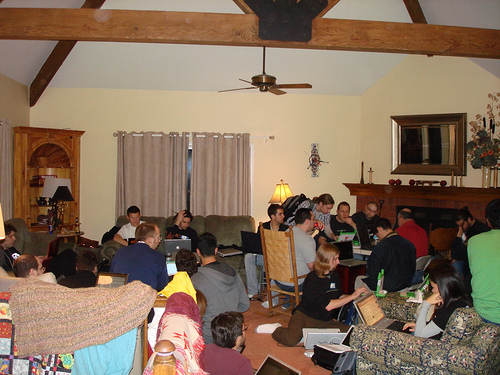
DevHouse.jpg

I recently picked up a copy of Fast Thinking magazine (summer 2007 issue), and found an interesting article on a group of software developers who organically-formed a community of practice. They call themselves SuperHappyDevHouse, and although they started off in California’s Silicon Valley, they have attracted interest from other places in the world, including New Zealand, which now has its own ‘devhouse’ as an offshoot.

What I found interesting about this is their community, although formed online, is nurtured through regular get-togethers (what they actually call ‘parties’). It doesn’t seem uncommon for software developers to create a natural communication conduit online – this is what they do, right? But what they realised is how important it is to have face to face contact that allows for people to get to know each other and have informal conversations to establish relationships. When conversations start in this more organic way, topics have more spontaneity, and although they may meander, stories emerge and ideas are sparked in a way that isn’t always allowed for in an online forum. Of course, the online forum is emerging as essential in communities of practice, but face-to-face relationship building is something that will never lose its importance in human relationships.

The SuperHappyDevHouse ‘parties’, which are replete with innovation-minded, lap-top toting developers young and old, last around 12 hours, and result in knowledge sharing, collaborative explorations and what they fully expect to roll into innovation.

Permalink | Comments (2) | TrackBack

22/01/08 |

Adding storytelling to the employee engagement agenda

By chandni. Filed in Culture, Intervention design, Storytelling.

I was pleased to read the findings of a recent survey on employee engagement.

▪ 81% of organizations surveyed worldwide have an employee
engagement practice
▪ 49% use storytelling techniques to engage their employees

Although only a few organizations have employee engagement formally defined on their agenda, the survey suggests an increasing trend in the number of programs introduced over the past three years. It's great to see organizations sharpening the people focus to their business and using the power of narratives to assess their health. We have noticed that trend in our work too, with more organizations wanting to use stories to encourage the right leadership and knowledge–sharing behaviors. It’s strategic and becoming imperative.

If you’re thinking of ways to engage your employees using stories, here are two simple ways to get started:

1. Story wall – create spaces for employees to put up pictures of major team events or just their time at work. It helps to reinforce what’s good about the workplace and works as a great trigger for an interesting story.

2. Story booklet – run an anecdote circle with staff to collect stories about their most enjoyable time at work or things (events) that improved the way they work. You can then compile these stories into a storytelling booklet that you can share with new employees.

The most important thing is to start somewhere.

Permalink | Comments (0) | TrackBack

22/01/08 |

World Trade Center and emergency services mis-coordination

By Shawn. Filed in Anecdotes, Collaboration.

One tragic example [of mis-coordination] is recounted in Peter Denning’s article about HFN [hastily formed networks], in which he describes analysis of the disaster response efforts after the attack on the World Trade Center: New York Police Department (NYPD) helicopters that had been monitoring conditions by circling the towers had observed signs of structural collapse in the north tower and immediately issued an emergency evacuation order to all police; however, they failed to inform the firefighters, who, having had no warning, were not evacuated.

Huston, Tracey. "Enabling Adaptability & Innovation through Hastily Formed Networks." Reflections 7, no. 1 (2006): 9-29.


Permalink | Comments (2)

22/01/08 |

The role of a story in lessons learning

By Shawn. Filed in Anecdotes, Knowledge, Narrative.

Chris Collison is pondering the usefulness of the Kolb learning cycle as the basis for many of the lessons learning activities organisations conduct. I agree with Chris' observation that most organisations don't build in reflection and therefore are unable to reformulate what they have learned to change behaviour. And like Chris I'm not sure of the effectiveness of write-ups to achieve this last point. In fact I think we create our abstract conceptualisations (Kolb's language) by telling ourselves and others a story of what happen. Ironically the abstract comes from the specific of a story. Something like this happened to me just last week.

I got a friendly email from someone who has been a long-time subscriber to our newsletter. After mentioning that she had gained many useful tips and ideas from it she went on to say that she had only just realised we provided consulting services. I was nearly knocked off my chair—were we that poor at telling people what we do?. So I rang Mark and told him the story. He was gobsmacked. We obviously weren't letting people know in our newsletter we provided consulting services. What shall we do? Our first idea was to put a line at the top of our newsletter that said, in effect, 'we provide consulting services.' Actually we wordsmithed it a bit more than that. Then I called up our graphic designer, Kerenza, and told her the story and shared our plan for the oneliner. 'Ahhrg, that oneliner is awful,' she said. 'Before you were sending useful tips and information to me, now you are selling to me.' It was immediately clear that the one-liner approach was wrong and Kerenza and I came up with a new way forward.

So on reflection it was the story of the original email, told a number of times to different people that created new conversations that helped me learn about our brand, how we communicate to our newsletter subscribers and how we keep what we do authentic, fun and useful. And it changed my behaviour. To me, that's learning.

[thanks to Patrick Lambe for putting me on to Chris' post]

Permalink | Comments (2)

21/01/08 |

The Anecdote Team

By Shawn. Filed in Fun, News.

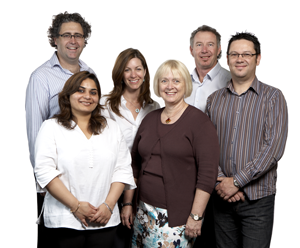
anecdote1-000138.png

In case you haven't seen the faces of Anecdote, here's our Christmas 07 photo. You can read our short bios or take a look at our updated company profile.

And here is what the Christmas party really looked like. Suggested captions are welcomed (what were Mark and Robyn illustrating?)


anecdote-239.png


anecdote-107.png

Permalink | Comments (2)

21/01/08 |

Masters of Collaboration

By Shawn. Filed in Collaboration.

BusinessWeek picks up on the move to collaboration in the creative and sometimes ego-driven world of product design.

"Just as forward-thinking engineering firms have worked to team up with design partners to offer a holistic output to clients, many design consultancies have responded to the seismic shifts in technology and culture by adopting a radical, collaborative approach—in stark contrast with the magician/know-it-all designer type of old."

I did pick up one of the common misconceptions about collaboration in this article. That is, collaboration means big teams. But at the same time collaboration is not universally good. This quote sums up both ideas.

The process-driven, collaborative approach does have its detractors. "The danger is that it becomes very flat and very unemotional," says Yves Béhar, founder of Fuseproject in San Francisco. "You need personalities and points of view, and points of view come from people, not processes," Sapper adds: "You do not need big teams to create innovation; as a matter of fact, big teams often act as brakes to innovation."

[via CPH127]


Permalink | Comments (0)

20/01/08 |

Collaboration's resurgence

By Shawn. Filed in Collaboration.

Everywhere I turn recently and I hear people talking about the need to collaborate as if the idea was new. Why has collaboration become the capability organisations must have? And why now? I think I have an inkling.

About 20 years ago a lot was being written about collaboration (this was just the growing snowball crunched together and bowled down a hill by Emery and Trist in 1965). People were getting interested in new organisational forms, talking about flattening organisations and linking firms. The issue of how firms might collaborate arose and we had a flurry of academics and practitioners proposing how it might be done. One of the most cited authors of that time on collaboration is Barbara Gray, who defines collaboration as a, "a process through which parties who see different aspects of a problem can constructively explore their differences and search for solutions that go beyond their own limited vision of what is possible." [1] I like it.

Emery and Trist sparked the idea from an organisational perspective and made the vital observation that collaboration is essential in turbulent times. Gray elaborates and also states that collaboration is most useful when we face complex and seemingly intractable problems. Now think of what we face today in the 21st century. Information volumes are exploding (by one estimation it's doubling every 4 years [2]), decisions are faster, things are more connected. No wonder people are screaming for collaboration now. It 's a way to progress in today's complex environment. The problem is that most organisations don't know how to do it.

Unfortunately, about 10 years ago, we were led up the garden path a bit in our search for collaboration solutions. And I have to admit I was part of the problem because over the years I've worked for the large IT corporations like IBM, Oracle and Sybase who promised us new collaboration technologies assuring to deliver a new way of working. Actually, some of the technologies were great stuff and today there are many useful technologies we can use. But the technology alone doesn't give us collaboration. You would be forgiven for thinking it does. Today if you search on the term 'collaboration' the majority of results will point to technology solutions.

Thankfully, back in 1989, Barbara Gray offers us some ideas which take us beyond the technological and in particular she proposes a process describing how collaboration happens. This is important because it gets us thinking about the types of things we can do in an organisation to foster collaboration. Gray's process has 4 phases (updated more recently from the original three):

  1. problem setting phase: "getting people to the table"
  2. negotiation phase: "reaching agreement on what to do"
  3. implementation phase: "ensuring the agreement is carried out"
  4. Institutionalisation phase: "building a long-term relationship"

Getting people to the table

Sad as it might sound, when I was in IBM, a common first question I 'd ask a colleague whom I was seeking a collaboration with was, "so what do you need to achieve this year?" If our objectives were interdependent I knew we had a chance of successfully collaborating. Then we could sit down and really nut out the purpose of our collaboration and make the commitment to work together to deliver something useful. On larger collaborations one or more leaders emerged. The best collaborations were when the leader was the natural selection based on their capabilities rather than the ordained choice based on organisational hierarchy.

Reaching agreement on what to do

The gentle art of conversation is the starting point (personally I disagree with the adversarial approaches, such as debate, as a useful approach to collaboration). Bohm called it dialogue and it involves listening, suspending judgement, being open and honest and working together to build on ideas. These types of conversations then lead to questions of what will be the next actions of the group, how do we divide up the effort, what will good look like and when we deliver our bits? We also need to work out how to reach agreements and ways to solve problems. There are many techniques that are useful at this phase including world cafe, pre-mortems, open space, story-spines, most significant change, and the bevy of ideas in Getting Things Done. It's also important to agree the ground rules for your group and most importantly decide what will happen when the ground rules are transgressed.

Ensuring the agreement is carried out

The most powerful way to ensure agreements are kept is to get everyone to commit openly and clearly to the whole group but in the full knowledge that the world does change and adaptations will be required. Public commitments need to be revisited on a regular basis not left for months and months only to find that an important commitment has slipped away. Keeping seeking feedback from those you serve through your collaboration and continue to seek good ideas and good practices as a standard way of working.

Building a long-term relationship

The best collaborations result in long-term relationships and I'm certain the strongest relationships go through the hardest times. The difference between and strong relationship and a broken one is what happens when the times are tough. One of the best set of techniques I've seen to handle the tough times is in a book called Crucial Conversations. It guides you through what to do when things turn dark and shows how you can keep adding to the pool of meaning as a way to work things out. Essentially these means keep talking and making it safe to talk.

Collaboration is important more than ever because of the nature of the world we live in. The problem, however, is that we not taught collaboration in organisations. It happens through necessity and success is mostly by chance and experience. Organisations wishing to develop a collaboration capability more systematically will need to thinking clearly about the process of collaboration and how they can support that process.

[1] Gray, Barbara. Collaborating: Finding Common Ground for Multiparty Problems. San Francisco: Jossey-Bass, 1989.

[2] Lyman, Peter, Hal R. Varian, K. Swearingen, P. Charles, N. Good, L.L. Jordan, and J. Pal. "How Much Information 2003?" http://www2.sims.berkeley.edu/research/projects/how-much-info-2003/.


Permalink | Comments (3)

17/01/08 |

An exciting storytelling event in Copenhagen - the movie

By Shawn. Filed in Storytelling.

Late last year I teamed up with Madelyn Blair, Terrence Gargiulo, Michael Margolis, Limor Shiponi, and Karen Dietz to start a new community of practice called Worldwide Story Work. We created a Ning workspace to conduct our online conversations and I see we now have 88 members. If you care about story work in organisations please come and join us. It's still the early days and there are many unanswered questions, but if you are willing to be helpful and supportive this group is a welcoming one.

I also wanted to show you this video (6 minutes) which documents a story event in Copenhagan run by GoldenFleece. It features my good friend Mary Alice Arthur who helped facilitate the event. You will also see short interviews with Madelyn Blair and Steve Denning. I'm not sure if you need to become a member of Worldwide Story Work to see the video, but give it a try.

Permalink | Comments (2)

17/01/08 |

Storytelling, Business Narrative and Community of Practice Workshops

By Shawn. Filed in Communities of practice, Narrative, Storytelling.

2008-Workshop-Schedule.png

2008 marks a busy year for Anecdote and this graphic gives you an idea of our workshop schedule. Storytelling is represented with bears, business narrative with fish and communities of practice with balloons. As you can see we are running workshops in Sydney, Melbourne, Canberra, Brisbane and Perth. Here is the full, printable version of the schedule you can download and put on your wall. Alternatively, pop over to our workshops page and register your interest in attending via the web.

By the way, we can also run these workshops internally within your organisation.

Permalink | Comments (2)

17/01/08 |

Starting a community of practice - fostering relationships

By Shawn. Filed in Communities of practice.

In starting any community of practice, the first objective is to help the members recognise the value they will get from being and working together. Often we will help organisations kick their communities off with a work shop that has a number of objectives but perhaps the most important is to foster deeper connections among the potential members. Here are some of the activities I've used to do that. Would love to hear about activities you have found useful.

  • asking participants to bring to the workshop one thing that other participants might value. It might be the description of a tool, tips, data, stories. We would pin this to a wall encouraging people to ask questions and talk about their artefacts—great triggers for conversation
  • interviewing key members before the workshop to better understand key issues, potential hot topics and what they feel are the enablers and blockers for the community
  • run a sociometry exercise where you arrange people physically in a room according to a set of questions ranging from, How far did you travel to get to this meeting? How much experience do you have as a HR professional? to Who do you collaborate with? or Who do you go to to solve difficult problems? With these latter questions the participants place their hand on the shoulder of the person they identify as their answer. An instant social network forms. A terrific exercise to help people get a sense of the knowledge and social networks already in place.
  • conduct appreciative interviews with people you don’t know well. This process is a one-on-one interview where each person talks about three highlights in their career and the listener retells their stories back to them. Then they swap places. This is always a memorable and impactful experience.
  • build a social network diagram on a wall of the participants with post-its and string. Another way to see what networks already exist and for the group to see where the potential is for the community.
  • take photos of each person to be displayed on the online directory. If an online directory doesn’t already exist for the community then it's a good idea to build one. People find it easier to remember facts about a person if they have a picture of their face. With a digital camera we can snap everyone’s photo to provide the basis for the directory. You have to make this a fun exercise so as not to scare people off and best to tell everyone of the plan before they arrive—no surprises when it comes to photos.
  • Good conversations around topics that matter. We like to use the World Café technique to facilitate a set of conversations around the hot topics. We encourage people to retell their stories in these small group conversations as this also helps to foster relationships.

Permalink | Comments (6)

14/01/08 |

Why sensemaking is vital

By Shawn. Filed in Sensemaking.

I was listening to Melvyn Bragg's radio program, In Our Time , this morning on my iPod. The topic was Albert Camus. In discussing his novel, The Stranger, one of the distinguished panellists felt that Camus was suggesting that meaning is not pre-inscribed in the world around us and we are continuously seeking meaning in an inherently meaningless world. I almost toppled off the step machine. Do we live in an inherently meaningless world? On first thought I think the answer is yes. The onus is on us to make sense of our world.

By the way, Melvyn's podcast is a joy. I particularly like its eclectic nature. Today it's Camus, last week The Four Humours, and before that we had The Sassanian Empire, Discovery of Oxygen, Mutation and The Fibonacci Series.

Permalink | Comments (7)

14/01/08 |

Thoughts to actions

By chandni. Filed in Anecdotes.

The best thing we could do for ourselves is reflect on the way we think. I read that in a book once (as a wisdom tip!)

Our thoughts affect the way we feel about something (emotions) and the way we react to situations (our behavior) and that chain reaction determines the outcome (results). At Anecdote, the sense-making activities we facilitate aim to invoke the right knowledge-sharing behaviors within an organization, and we start by asking people to reflect and share their emotional experiences. The anecdote circles help to subconsciously re-tune our thinking and thereby our actions and the results we achieve.

Here's an interesting anecdote that illustrates this chain reaction quite well.

We associate Alexander Graham Bell with the invention of the telephone, but it was actually Elisha Gray who invented it first. Gray was criticised by academia for an invention they found 'had no direct application,' and he let the criticism stump his creativity. Graham Bell, on the other hand, showed stronger self-belief. He walked into the Patent Office and secured a patent for his invention. Gray walked in two hours later, but it was obviously too late then.

You can read the full story here.

Permalink | Comments (0) | TrackBack

11/01/08 |

Using a story spine for a reflection activity

By Daryl. Filed in Facilitation, Fun, Narrative.

During a workshop I was recently involved in, I introduced the story spine to a couple of participants to help them to tell a story using the simple framework.

Not only did they embrace it enthusiastically and use it to great effect, unexpectedly the framework was adapted for a different purpose. A small group of onlookers decided to use it as the basis of a reflection activity. They did a great job, and I think it worked really well.

Here's a quick summary of how it might work for you:

  1. All participants of the group sit in a large circle
  2. The facilitator asks participants to reflect on an activity (in our case, we were reflecting on our involvement in a year-long training course)
  3. The facilitator begins by reading out the first part of the story spine, 'Once upon a time...' or 'Way back when ...'
  4. The person to the left of the facilitator is then asked--without rehearsal or preparation--to develop the story further by providing a brief sentence or sound-byte
  5. This continues around the circle with each person adding to the story until the facilitator feels that it's time to intervene with additional structure from the story spine. When they feel it is time the facilitator will add the next line i.e. 'Everyday...'
  6. This goes on until the story (as defined by the structure) is complete.

I recommend that you record the story so that you have an artefact or keepsake, or for transcription purposes. Because of the impromptu nature of the activity this was a bit of an after-thought for us. We did try to record the story using a mobile phone, but I'm not sure that it worked very well. I haven't heard anything!

The 'story' that we ended up with didn't make too much sense in the end, but that is unimportant. What is important is that the improvisations made it a lot of fun, and it also elicited lots of memories and anecdotes. It was also nice to reflect back on our shared experiences and to make sense of what happened as a group, as a collaborative activity.

Permalink | Comments (2) | TrackBack

10/01/08 |

The Beams of New College, Oxford

By Shawn. Filed in Anecdotes, Knowledge.

Another find from the filing cabinet clean up. This time an anecdote from Stewart Brand's How Buildings Learn.

This story was recorded by Brand from the anthropologist Gregory Bateson.

New College, Oxford, is of rather late foundation, hence the name. It was founded around the late 14th century. It has, like other colleges, a great dining hall with big oak beams across the top. These might be two feet square and forty-five feet long.

A century ago, so I am told, some busy entomologist went up into the roof of the dining hall with a penknife and poked at the beams and found that they were full of beetles. This was reported to the College Council, who met in some dismay, because they had no idea where they would get beams of that calibre nowadays.

One of the Junior Fellows stuck his neck out and suggested that there might be some oak on College lands. These colleges are endowed with pieces of land scattered across the country. So they called in the College Forester, who of course had not been near the college itself for some years, and asked about oaks. And he pulled his forelock and said, "Well sirs, we was wonderin' when you'd be askin'."

Upon further inquiry it was discovered that when the College was founded, a grove of oaks has been planted to replace the beams in the dining hall when they became beetly, because oak beams always become beetly in the end. This plan had been passed down from one Forester to the next for five hundred years. "You don't cut them oaks. Them's for the College Hall."

Permalink | Comments (0)

9/01/08 |

The intuitive mind

By Shawn. Filed in Quotes.

I'm in the process of cleaning out my filing cabinets today—what joy—and discovered this quote:

The intuitive mind is a sacred gift
And the rational mind is a faithful servant.
We have created a society that honours the servant
And has forgotten the gift—Albert Einstein

Permalink | Comments (4)

3/01/08 |

Conference call practices to generate knowledge and record learning

By Shawn. Filed in Collaboration.

John Smith and I worked together last year using Google Docs to create this practice note on ways to get the most from conference calls.

Permalink | Comments (0)

3/01/08 |

My friends confirm my huntch that knowledge work is dead

By Shawn. Filed in Knowledge.

Yesterday I arrived home from a relaxing trip to Jervis Bay to enjoy Christmas with my family (sans computer). So today I couldn't help myself to have a peek at Google Reader to see what was happening on the blogosphere when I noticed my little post about knowledge work has raised the hackles of two friends, Dave Snowden and Matthew Hodgson.

So let me respond in the relax way I'm feeling at the moment without a point by point refutation because most of what they say is right on. The main problem we face in this dialogue is the limitation of the written word and what can be said in three paragraphs (my original post length). Imagine the terrific conversation we could have which, if we weren't in the mode of one-upmanship and scoring points, we could increase our pool of meaning (a phrase I've recently learnt from a fabulous book, Crucial Conversations). Sadly, the three of us rarely get the opportunity to sit and talk.

Matt says I miss the point about knowledge workers because the phrase is still useful for communication. Matt seems to saying there is something else that this phrase can be used for other than communication but in my book the term 'knowledge worker' can only be used to communicate and the communication is misleading. As soon as you say someone is a knowledge worker and someone is not you create a false dichotomy. It's easy to make the distinctions at the edges but try making them in the middle of the distribution and you find that you are making stuff up. Matt also says he knows what the term 'knowledge worker' means but at the same time wont tell us because a definition will be messy and do little to progress the objective of helping organisations make the most of people's knowledge.

Both Dave and Matt latched on to the point I made about technology and how it is becoming ubiquitous and even those jobs which Drucker might have excluded from 'knowledge worker' status are now being affected. This observation became even more apparent to me last year as I travelled around regional Australia talking to farmers, pastoralists, conversations and natural resource managers and it became clear that in our global economy everyone is forcing people to up-skill and use whatever technology available to gain or maintain a competitive edge. But technology is just one factor—a point I make in the original post but ignored by Matt and Dave. Increasing speed, increasing complexity, abundance of products and services, rampant consumerism and out-sourcing are just some of the other factors forcing everyone in the first world to be a knowledge worker.

Dave thinks I have fallen foul in three areas: The confusion of knowledge artifact use, with knowledge work; Failure to understand the impact of time & experience in knowledge capability; Ethical naiveté or the moral red herring. I'll dismiss the first two points because I can't believe Dave really things I don't understand these distinctions. It's the third point that requires a response while I know it's Dave's style to stir the pot but he also has the habit of muddying the waters with his own sophisticated arguments.

My position on knowledge work is actually a practical one, not one bound in idealism. If you avoid categorising your staff as 'knowledge workers' or 'not knowledge workers' you move to a more practical conversation about what knowledge our people use and how can we help them create, share and use it better (yes, I know this statement suggests that knowledge is a thing and ignores knowledge as a flow, but the wording gets quite difficult when you need to cover off on every statement). It's quite a useful approach Dave.

Permalink | Comments (5)