« July 2007 | Main | September 2007 »
“Yellow Pages” is a registered trademark of Telstra
Filed in .
Just a warning to everyone out there who is using the term “Yellow Pages” to describe the people directories you might develop to implement knowledge management. Today I received this letter from Telstra's lawyers telling me that I have probably unintentionally infringed their trademark and I must remove the reference from one of our whitepapers. I will make the changes they request, as it is not a biggie, but you should be aware if you are using this terminology that you might have Telstra's lawyers knocking at your door.
Permalink | Comments (9) | TrackBack
Mooers' law
Filed in Quotes.
I was reading Ambient Findability this morning at breakfast and found this law posited by Calvin Mooers in 1959.
An information retrieval system will tend not to be used whenever it is more painful and troublesome for a customer to have information than for him not to have it.
Technorati Tags: calvin mooers, usability
Permalink | Comments (0) | TrackBack
Last year I wrote this short paper arguing that communities of practice were an effective strategy to transfer tacit knowledge. This week we gave the old look and feel a makeover and updated the pdf.
This paper therefore provides guidance on how to identify and foster such communities of practice in your organisation. It explains why communities of practice are effective in managing tacit knowledge, describes how to ‘map’ communities, and provides suggestions for garnering management support. Finally, the paper describes three common traps to avoid.
Permalink | Comments (3) | TrackBack
IBM software - social software for the enterprise
Filed in .
I used to work with Jimmy Kwang at IBM. He was a terrific supporter of the Cynefin Centre and I must say a terrific host. We always had a great time when we visited Malaysia or Singapore.
Jimmy sent me an email yesterday to let me know that IBM is getting into the social software field and said we could get a look at some of the capabilities by visiting a new blog IBM Singapore set up. www.blog4biz.sg
I had a quick look and while the content is just starting to grow it was good to see the features you would expect in a social software environment.
Technorati Tags: social software, web 2.0
Permalink | Comments (0) | TrackBack
Knowledge retention seminars
Filed in .
We are running a series of breakfast seminars in the coming weeks, exploring the use of narrative techniques for knowledge retention. It will be a mini 'road-trip' for us that takes in Melbourne, Canberra and Sydney, and we're all looking forward to sharing our experiences, good coffee and great conversations.
There's been an overwhelming response to these events with most being booked out well in advance. We do however, still have just a few places available for our Sydney breakfast, which will take place on Tuesday, 4th September 2007 from 07:00am to 09:00am at a convenient city location. There is no cost to attend, and breakfast is provided.
This seminar is an opportunity to explore how to best use narrative techniques to minimise the impact of knowledgeable people leaving your organisation. And because we know that learning is ineffective with someone just up front talking at you, we've designed the seminar to be a combination of some talking by us, and some talking in small groups by you. We will also feature a case study from Cadbury Schweppes' expert knowledge retention activity.
This will be an opportunity to hear some of our experiences; but more importantly you will leave the seminar with our rough guide to getting started on your first narrative-based knowledge retention project.
If you're interested in joining us, drop me a note! - daryl@anecdote.com.au.
On the weekend I created this presentation about how we got started and I describe some of the projects we've done.
There are five parts. Here are the other links:
http://www.youtube.com/watch?v=TOAtwhgSTf8
http://www.youtube.com/watch?v=FYuwumeWn_E
http://www.youtube.com/watch?v=BweLmKlTbnI
http://www.youtube.com/watch?v=Hd7WVri5aCI
Permalink | Comments (1) | TrackBack
I've been keeping my eyes open for something entertaining to read on a long plane journey. I'm a fast reader and easily bored so the usual fare at airports barely lasts until I am flying over the West Australian coast. That leaves about another 20 hours of flying time to fill. So wandering past the Socrates store in Eastland last Sunday afternoon the cover on this book in the window display caught my eye. After a quick browse through the pages I decided I had found my travel companion.
I don't mind admitting I am an absolute Leonardo-phile. And I am not deluding myself into thinking any book can turn me into a Da Vinci equivalent. Since I took up scrapbooking in earnest in 2002 I have expanded my creative endeavours into book-making and mixed media art. But I have been continually frustrated by that little voice that tells me I can't draw and and I can't paint. I know when I was teaching, I never met a prep class child who could not draw, paint, sing or dance. Seek out a four or five year old of your acquaintance and ask them. Not only can they do it but they are more than willing to demonstrate it to you right there and then. And look at you oddly for asking such a silly question.
No, this is more about studying Da Vinci and learning from his work in order to utilise our potential to the best of our ability. And Leonardo's 500 year old techniques still work. Finding metaphors in nature was one of his favourites. Velcro was invented by someone who took a close look at a burr hooked to his trousers after a walk outdoors. The ease with which you can "open" a banana inspired the inventors of the ring pull tab on aluminum cans.
The book is centred around the seven fundamental principles (named in Italian) that Michael Gelb has drawn from his study of the man and his work. I'm struck by how they reflect much of what we at Anecdote believe and do.
- Curiosita - an insatiably curious approach to life and an unrelenting quest for continuous learning
- Dimonstrazione - a commitment to test knowledge through experience, persistence and a willingness to learn from mistakes
- Sensazione- the continual refinement of the senses as the means to enliven experience
- Sfumato (literally "going up in smoke") - a willingness to embrace ambiguity, paradox and uncertainty
- Arte/Scienza - - the development of balance between science and art, logic and imagination. Whole-brain thinking
- Corporalita - the cultivation of grace, ambidexterity, fitness and poise
- Connessione - a recognition and appreciation for the interconnectedness of all things and phenomena. Systems thinking.
Leonardo had the ability to see and live with paradox. Relentless hard work was not the solution. Taking time with a problem, sleeping on it and letting the solution incubate gave better results. As Michael Gelb points out - the ability to trust your gut when dealing with ambiguity is still critical even in the age of information overload.
I'm looking forward to reading more about these principles and the examples that Gelb provides, following along with, and doing the activities. I may even return from my holiday able to draw.
Naturally incorporating stories in your conversations
Filed in Business storytelling.
Annette Simmons, in her excellent book The Story Factor, warns us from adopting 'the story voice.' You know the one. The narrator starts by saying something like “I've got this great story” and then proceeds to adopt a kind of sing-song voice as they tell their story. You can tell it's a performance.
But it doesn't need to be this way. You can incorporate your anecdotes in your conversation in a natural way that doesn't draw attention to the fact that you are relating a story. Quite frankly your listener couldn't care less whether you are telling a story or not. They care whether what your saying is meaningful. And it was while I was thinking about this issue that I happened to pick up Victor Frankl's essay/book, Man's Search for Meaning. I couldn't put it down. Frankl relates his experiences as a prisoner in concentration camps during WWII. It's a harrowing account yet throughout Frankl leaves the reader with hope.
One of the reasons why Man's Search for Meaning is so readable is that it is jammed packed with stories. But you don't really notice them because of the natural way they are introduced. Here are some examples.
Rewards were given in camp not only for entertainment, but also for applause. I, for example, could have found protection (how lucky I was never in need of it!) from the camp's most dreaded Capo, who for more than one good reason was known as “The Murderous Capo.” This is how it happened. One evening ...
Generally speaking, of course, any pursuit of art in camp was somewhat grotesque. I would say that the real impression made by anything connected with art arose only from the ghostlike contrast between the performance and the background of desolate camp life. I shall never forget how I awoke from the deep sleep of exhaustion ...
It also follows that a very trifling thing can cause the greatest of joys. Take as an example something that happened on our journey from Auschwitz ...
Frankl often starts a paragraph with a point or an observation then moves seamlessly to a story. It reminded me of the improvisation technique I was taught in Toastmasters many years ago to respond quickly and coherently in a one minute speech. Make a Point, give a Reason for the point, provide an Example, then restate the Point (PREP). But the art of Frankl's writing is how he moves from his point to the example.
This is how it happened ...
I shall never forget how ...
Take as an example ...
Permalink | Comments (2) | TrackBack
When quantitative analysis just wont cut it
Filed in Business storytelling.
I read Bob Sutton and Jeff Pfeffer's book, Hard Facts: Dangerous Half-thruths & Total Nonsense, and I was concerned managers would think that you could only make decisions based on data and analysis.
So I was delighted to see this post from Bob Sutton setting out three times when data and analysis wont help.
- When you don’t know what to count
- When you can count it, but it doesn’t stick
- When What You Can Count Doesn’t Count
I recommend you read Bob's post. He elaborates on each point and mentions the importance of ethnographic approaches, storytelling, images, and tells some good stories too.
Technorati Tags: bob sutton, decision-making
Permalink | Comments (1) | TrackBack
Wiki Patterns
Filed in .
We're currently working on a knowledge project with a client, part of which involves setting up a collaborative environment for managing and editing content - in this instance a wiki.
As part of the initial setup, I've been looking at 'best practices' for wiki implementation and adoption and I quickly came across wiki patterns , which is such a fantastic resource.
But that in itself is not all that I find interesting about the site. For me, it was the observation of the structure and language of 'patterns' used on the site and my association of that with the process of sense-making that I find intriguing.
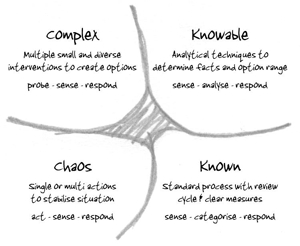
Now, being the new guy here at Anecdote, I'm still immersing myself in the use of narrative and complexity theory, but my current understanding using the Cynefin framework -- is that 'best practices' belong in the known domain ... when things are prescriptive, can be reduced to binary decisions; black and white, yes and no answers. There is a known solution.
On the other hand navigating complexity requires us to detect new and emerging patterns. Humans are good at seeing patterns, making sense from them and then acting on them. Deciding on courses of action or 'solutions' in this domain are about influencing these patterns and behaviours, reinforcing the positives and discouraging the negatives.
The wikipatterns site is doing exactly this - putting wiki adoption squarely into the complex camp, and using patterns to help people make sense of what to do and not what to do, rather than trying to lay out prescriptive answers on how-to implement wikis, because it's just not that simple when humans are involved!!
I flew from Newcastle to Melbourne last night and had a fantastic two-hour chat with the lady in the next seat. By the end of the journey I felt like I had a new friend. She posed three questions to me that helped us build a relationship in a very short time. Give these questions a try and I suspect you will surprised at what happens. I was.
What is the best piece of advice you can give me?
What has been your most profound experience?
What is the greatest gift you have ever received?
Permalink | Comments (0) | TrackBack
What do we mean by tacit knowledge?
Filed in Knowledge.
Most of our work here at Anecdote involves working with tacit knowledge. But it is clear that there is a broad understanding about what's meant by the phrase. In the knowledge management world there are two camps: one that believes tacit knowledge can be captured, translated, converted; and the other that highlights its ineffable characteristics. I must admit I was for a long time firmly ensconced in the latter category and our white paper on “How we talk about knowledge management” reflects this view. But I realise now it is simply impractical to adopt an either/or perspective and so I would like to propose a way forward that focusses on why knowledge is tacit (remaining unspoken, unsaid, implied, unexpressed) and then based on these reasons we can start thinking about the appropriate approach to capturing or transferring tacit knowledge.
I think the iceberg metaphor is useful. Below the waterline lies an organisation's tacit knowledge. Near the water surface lies tacit knowledge that's easier to work with but as we go deeper the nature of the tacit knowledge changes, it becomes murkier and harder to see and grasp. As we increase in depth we can think of the different reasons why our knowledge is unspoken.
Hasn't been recorded. Most organisations put their efforts in in dealing with this type of tacit knowledge. Probably because it's easy. “Let's find out what we know and then document it.” As a result wikis are popping up everywhere. Creating more explicit knowledge then creates a new problem of findability And as Peter Morville says, “what we find changes who we become.”
Will never be recorded. There are some things you know, that you could quite easily tell someone else, that you would never want to write down or be widely known. Imagine a diplomat who has an intimate knowledge of their counterpart's peccadillos in an allied government. Perhaps not the type of thing that would be written down. More benign examples include stuff ups and when people are breaking the rules for the right reasons (or even for the wrong reasons).
Too many resources required to record. Sometimes it just takes too much time and effort to write down what you know. For one thing, when you write it down you have to assume a broad audience (not like a conversation where you are assessing whether the person you are taking to is getting it), which makes the task even harder. Imagine Einstein walking in the room and someone without advanced physics knowledge asking him to explain the general theory of relativity. It would be impossible for Einstein to provide a comprehensive answer because his knowledge requires stimulation in order to be forthcoming. Dave Snowden encapsulates this idea in his aphorism, “you only know what you know when you need to know it.”
Everyone knows it (taken for granted). Now we are getting into the type of tacit knowledge that's more difficult to identify. This knowledge often represents the core values and beliefs in an organisation. It can manifest as metaphors. For example, I visited a investment bank in Sydney and their language revolved around gambling: “We can take a bet on that.” “Let's roll the dice and see what happens.” “Everyone was poker faced.” Another organisation was fixated with traffic metaphors: “It's a real roadblock.” “We got the green light.” “We have a clear roadmap now.” No one noticed how they were using these metaphors yet it guided their actions every day. I guess we call these things 'culture.'
Individuals don't know but groups do. Have you ever read Cognition in the Wild? It tells the story of the bridge crew of the aircraft carrier USS Palau and how together they can dock this enormous ship yet no single individual could describe how it is done. Many teams have this underrated and generally unrecognised this group-based ability.
Can't be recorded. Much of our tacit knowledge falls into this category. The effects of this type of tacit knowledge (some would say the only true tacit knowledge) are displayed in our action and therefore it's impossible to capture or convert it. The approach here is to become mindful and reflect of what is displayed—conversations, coaching, shadowing. Sure, we can video tape people undertaking tasks but time and time again practitioners have discovered there are qualities that are not captured and the task cannot be completed successfully. My favourite example is those white-coated gentlemen in France who test whether those humungous wheels of cheese have ripened. Using a little hammer they tap each one and know instantly which ones are ready to eat. How do they know? Is it the sounds, the bounciness, the smell? I recall a group of scientists set about to measure all these characteristics in order to create an automatic cheese ripeness testing machine but as hard as they might try they paled in comparison to the experience of the practised cheesemaker.
Technorati Tags: tacit knowledge
Permalink | Comments (9) | TrackBack
Narrative helps us use history appropriately
Filed in .
Matt Moore picks up on Shawn's recent post about the relevance of history and gives some good guidelines for appropriate use of history. Matt's post reminded me of a HBR IdeaCast with Paul Saffo about effective forecasting. He says one of the big mistakes forecasters make is to use history for support (justification) rather than for illumination (understanding). He uses the example of the Iraq War, where the Bush administration and senior Pentagon officials studiously avoided looking at the Vietnam War by their own admission: "we lost that one - there is nothing to learn from it". In effect, they cherry-picked history for the things that matched their preconceptions and desired results. This is the road to ruin. I loved this quote in the podcast:
Too often we use history like a drunk uses a lamp-post - for support rather than illumination.
As Matt points out, appropriate use of narrative helps us to avoid these issues because it focuses on the concrete and the particular, rather than the idealistic.
Permalink | Comments (0) | TrackBack
How a transcript can enhance listening
Filed in Anecdotes.
I've just returned from a couple of days in New Zealand working with my old colleagues from IBM. It was a fun to spend two days thinking and talking about knowledge strategy.
I had lunch with Ross Pearce from IBM and he told me how he helped two parts of a company resolve their communications difficulties using an anecdote circle. He got both parties in the room and encouraged them to tell their stories about what was happening. The session went for three hours! One participant came up to Ross at the end of the session and thanked him because it was one of the very few times they have had a conversation without the pressure of delivering a specific output. A good start but the interesting insight came later.
Ross recorded and transcribed the meeting and sent the 100 page transcript to all the attendees asking them to read it. At first they resisted—“it's so long, we don't have time”. they lamented—but after some gentle persuasion they all agreed. In fact it was quite easy to read because it was in their language, it was their words.
A week later they all met again and many of the participants said the same thing about reading the transcript: “I can't believe how much I missed at our first meeting. I guess I was too busy thinking about the next thing I was going to say and failed to listen properly.”
This second meeting was the watershed for the relationship between the two groups. And while Ross never provided me with the details I got the sense that there now existed a foundation to rebuild the rapport between the two groups.
Permalink | Comments (0) | TrackBack
Just getting by...
Filed in Fun.
I rushed out of the house at 'oh-dark-hundred' on Monday morning for a three and a half hour drive to run a workshop for the day, followed by a two and a half hour drive in the evening to be in location for Tuesday. About 20 minutes from home I realised that my mobile phone was sitting safely on my bedside table - D'Oh! It was too late to go back and get it so I resigned myself to missing the long drive as an opportunity to make a heap of phone calls.
During the drive I realised that I already had a cool communications solution in the car with me. I pulled over and connected to the internet through my laptop using mobile broadband. By using a hands-free headset and Skype Out I was then able to call people and talk to them while driving. It worked surprisingly well.
Permalink | Comments (1) | TrackBack
History matters
Filed in Anecdotes.
I just received this comment from AJ which I thought you would enjoy. I will let her comment speak for itself.
I'm an anthropologist who's just finished a study of a small government department. After reading your story above, I thought I'd share the value of understanding corporate histories, corporate kinship & traditions I learned during my doctoral fieldwork.
This particular agency had a culture of purposely obfuscating exact budget expenditure amongst the executives and reporting incorrectly to Treasury. Don't interpret this the wrong way - no one was taking any public money, rather, they were shuffling it about so that money given for one purpose but not spent was being used elsewhere within the agency. Lower ranked managers and field staff widely condemned this practice, and simply couldn't understand why it happened.
When I examined the agency's history, it turned out for the first three years of its existence (1955-1958) it had been legislatively created *without* a budget. Thus, the original directors had to fight, lie and cajole to get money just to employ staff and maintain public infrastructure etc. Also, this agency had its own powers to employ staff directly rather than via usual public sector channels. This upset the mandarins in the public sector and they gave the agency a really hard time for more than 20 years by consistently withholding funds ... this was around the same time the executives who I dealt with were first being employed as junior officers. It was stated quite openly to me by people now retired that they didn't tell Treasury anything truthful because the buggers would cut their budget if they did ...!
Of course, this habit of 'shuffling' money and not telling Treasury everything became a tradition passed from one group of senior managers to the next - even when the organisation became large and powerful during the 1980s & 1990s.
The senior execs all drank with each other, went bush with each other, played golf etc etc. and inducted newly promoted members into their ranks in this way... thus the tradition was passed on until last year when a director from outside was hired, came in, took one look at the annual report and the figures on the computer and went HUH?!?!
So just a short tale about the role of history, tradition & kinship in g'ment ... from an ethnographer living in her tent (like Malinoswki) studying natives in the field.
By the way, Anectdote is a great resource. Thank you so much for your work and sharing.
Some people say to me, “why are we worrying about the past? What's done is done. We need to keep focussed on the future.” These categories of past, present and future can lead us astray. Time is a continuum not a category.
Permalink | Comments (0) | TrackBack
Getting On With It
Filed in Fun.
Scott McCloud ...
Traditional Western art and literature don't wander much. On the whole we're a pretty goal-oriented culture. But in the East, there's a rich tradition of cyclical and labyrinthine works of art ... they (Japanese comics) so often emphasis being there over getting there.
As facilitators, that's what we need to encourage -- being there over getting there!
Far too often does the “get on with it” ghost appear out of nowhere, demanding that we 'cut to the chase'. After all, 'time is money'. These types of messages are also reinforced by the mass media, suggesting that successful people “just do it” and that the frantic pace of modern life requires us to be efficient and economical.
But efficient and effective are two entirely different things.
It never ceases to amaze me, how -- in this quest for efficiency -- we (I say we, as I too have been guilty of this) lose sight of our humanity, attending meetings or working in groups without ever really connecting with others in the room as human beings. Instead, we tend to go about our 'business' like robots or machines: mechanical and routine. Rarely -- one could argue -- is this effective. In this Dilbertesque world how do we achieve anything meaningful?
Well, we need to learn how to wander more, individually and collectively. So, when planning meetings or events for effective collaboration, don't underestimate the need for people to feel 'safe', to explore and to have a sense of belonging before they are really willing to share and contribute.
That's why good facilitators use appropriate icebreakers, warmups, energizers, or whatever you might like to call them -- those activities for getting groups going. Whilst a lot of people might cringe at the thought of doing something 'silly', it is really important to do. People need time to connect, relate, to understand each other, and these types of activities can kick-start that process, as long as the activity is appropriate for the context. For example: a group of alpha males in a business setting is going to require a different approach to a mother's support group!
If the group has assembled with the ultimate goal of solving a problem, or getting something done -- then by all means it should get on with that task -- but only after some time to enjoy fellowship in order to bind their experience.
Remember, it's all about the journey, not the destination. So enjoy the ride!
Permalink | Comments (1) | TrackBack
Watching Andrew Denton interview Michael Parkinson on More Than Enough Rope on ABC television recently was a lesson in good interviewing techniques. Denton even admitted he only needed to turn up, say something to get started and then sit back and let Michael just tell his stories.
Parkinson was relating how difficult it was way back when he was trying get his interview show up and running and he credited the late Orson Welles with its successful beginning. Because Parkinson was not as yet an established name it was difficult to get people to come on the show. The producer went all out to get a big name, one that would smooth the way for others and flew to Spain where Welles was making the eventually uncompleted Don Quixote. The successful deal negotiated meant persuading British Airways to knock out the front two rows of seats on the aircraft out so that Welles could sleep on a mattress on the floor.
“And he walked on the aeroplane and he looked at the mattress on the floor and smiled and went and sat in the seat. It jumped the hurdle. And then he came to my room and I’d been working on this interview for, like, all my life, and I opened the door and he was dressed entirely in black, black sombrero, black tie, black shirt, black cloak and he swept into the room. Incredibly dramatic.
“My name’s Orson Welles”, he said “And you would be?”
And I said, “Er Parkinson.”
“Yes”, he said.
And he looked around and he saw this scrap of paper on my desk and he said, “That?”
I said, “My questions.”
“Do you mind if I look?”
I said, “No.”
And he picked them up and he turned to me and he said, “How many of these shows have you done?”
I said, “Two.”
“I’ve done many more”, he said. “Will you take my advice?”
I said, “Certainly”.
And he ripped up the questions and he said, “Let’s talk”. And walked away.
And he sat down and he did two one hours that night, that were majestic.”
Tearing up the questions might run counter to our instincts of wanting to be well prepared for what comes next. Sometimes the best stories arise from our letting go of the process and just having a conversation.
Rick Davies, the creator of the Most Significant Change techniques, has posted a description of a story-based technique he experimented with that's designed to help a group of people imagine a set of future possibilities or, as Rick puts it, when embarking on a project we need “... a theory of change, and a theory of change when spelled out in detail can be seen as a story.”
Rick's experiment was conducted with a group of secondary students but it's clear this participatory process could be used in organisations. I'm particularly interested in how it might be used in our First Journey process. Here's my rewriting of Rick's process based on how it might work with a group of ten senior managers in the first journey.
- Give the ten participants some small filing cards, and asked them each to write the beginning of a story on one card about how the project we are about the embark will unfold. When completed, these ten cards are then posted, as a column of cards, on the left side of a whiteboard. This provided some initial variation
- Then ask the same participants to read all ten cards on the board, and for each of them to identify the story beginning they most liked. This involved selection
- Ask the participants to each use a second card to write a continuation of the one story beginning they most liked. These story segments are then posted next to the one story beginning they most liked. As a result, some stories beginnings will gain multiple new segments, others none. This step involves retention of the selected story beginnings, and introduction of further variation.
- Then ask participants to look at all the stories again, now they had been extended. Ask them to write a third generation story segment, which they add to the emerging storyline they most liked so far. This process is re-iterated for four generations or longer.
Rick then analyses the results of his experiment and explores different ways people could use the technique.
For me this approach would be ideal to get people talking about the possibilities of a project. It could be then followed by a pre-mortem to provide a reality check.
Technorati Tags: rick davies
Permalink | Comments (2) | TrackBack