« April 2007 | Main | June 2007 »

Getting your anecdote circle started

Posted by Mark Schenk - 30/05/07
Filed in .

There are several aspects to this posting. The first is that it can be good to start anecdote circles with something familiar and non-threatening. The second is about the additional meaning you get when you hear an anecdote rather to reading it.

Last week we were in an anecdote circle examining collaboration and I started by relating the story below (to give example of an anecdote) provided in an earlier anecdote circle.

“I work in Wing 5 of the building. For a long time I would walk all the way to the kitchen in Wing 3 to make my coffee because I would bump into all sorts of people along the way and find out what was going on…” Another participant then chimed in, saying, “We just thought you were stealing our milk”.

Another participant then described how he had inadvertently started ‘the milk wars’ in one office by using milk that didn’t belong to him.

In the spirit of good ditting (as Dave Snowden describes it) the two anecdotes in this piece of audio were then provided. One of the points, especially about the first anecdote in the audio, is that the story was told with passion, timing and humour, things that are absent when the anecdote is transcribed into the written word. Now, we just need a way to use large numbers of audio anecdotes in workshops…

Everyone seems to have a 'tea-room story'. Using something simple like this can help get an anecdote circle off to a flying start.

Send this entry to:  Share on Twitter Share on Facebook    Clip to Evernote   | Email to a friend

Permalink | Comments (0) | TrackBack


The Swiss Agency for Development and Cooperation's Story Guide in now online

Posted by Shawn Callahan - 30/05/07
Filed in Questions.

Great news. The Story Guide: Building Bridges Using Narrative Techniques is now available online. Our reader, Jon Revelos, just posted the link today as a comment to this post. Thanks John.

Send this entry to:  Share on Twitter Share on Facebook    Clip to Evernote   | Email to a friend

Permalink | Comments (0) | TrackBack


Knowledge strategy - from the bottom up

Posted by Shawn Callahan - 29/05/07
Filed in Knowledge, Strategic clarity.

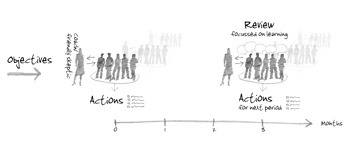
diag_action3

For a few months now I have been proposing a new way to do knowledge strategy that involves everyone in the organisation. There are three journeys involved and in the last journey you help establish a process (described here and illustrated above) that encourages lots of people to make incremental improvements towards a set of common objectives. We have mentioned here that organisations have similar objectives so you don't need to create these from scratch.

This post is here to pull these threads together.

Send this entry to:  Share on Twitter Share on Facebook    Clip to Evernote   | Email to a friend

Permalink | Comments (5) | TrackBack


Organisations not really doing Most Significant Change—the selection process
Posted by Shawn Callahan - 28/05/07
Filed in .

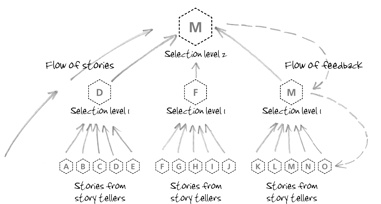
6-MSC

Yesterday I discovered another large organisation who think they are using the Most Significant Change technique to evaluate their programs but they don't do the selections. All they are doing is collecting stories of significance and then using those stories to illustrate the program's effectiveness. This is giving the technique a bad name because the astute observer can see that collecting positive stories is little more than marketing PR for the initiatives.

The value of most significant chance comes during the selection process. This is when the learning occurs. Here is how I described the selection process over at the Zahmoo blog with some adjustments to account for reader feedback.

MSC Selection Process

Remember that the aim of the selection process is to generate conversation, discussion, debate so that participants learn about the topic under consideration and about one another—what they see as important and what as a group they see as important.

Try to work with five or six stories per domain.

Use a whiteboard with five columns: Story Title, Facts, Opinions, Voting, Why Selected.

1. Ask each participant to take turns reading a story. Remind them that the selection process works best if the stories are heard because we are dealing with oral stories.

2. After each story is read ask the participants about the essence of the story, key words, facts they heard. The facilitator writes this in the Facts column. Eliciting facts help everyone really hear and remember the story. Try and avoid eliciting opinions at this stage but if opinions are forthcoming, move to the next column and ask for reactions and opinions, both positive and negative, about the story. But don’t compare to the other stories. You might divide the Opinions column into +ve and -ve.

Read the next story.

Repeat steps 1 and 2 until all stories are done.

When all the stories are read, and facts and opinions have been elicited, the facilitator should then read back all the notes in the Facts and Opinions columns. This gives participants some thinking time before voting starts.

The next step is to pose the question for the selection process. This question needs to reflect the purpose of the inquiry. For example, if you are interested in how well a new branding exercise was implemented, you might ask:

“Looking back over the last (x period), what do you think was the most significant change in … (particular domain of change that is of interest]” In fact you don’t need to add the last bit …“in (particular domain of change that is of interest]” if you want to keep a very wide perspective on what is happening. You can sort the reports MSCs in to domains of interest later on, after they have been collated.

Then, with a show of hands, ask people to vote. Write up the number of votes for each story in the Voting column.

Then start with the lowest vote (hear the minority voice first because they might have a radically different perspective the others should hear) and ask why these people chose these stories. Record why they chose these stories. Documenting the reason for selection is an important important part of the process and should be done carefully and fully. Get all the reasons why people made their votes.

Once all the reasons why people have voted the way they have has been drawn out, the facilitator encourages debate and dialogue among the participants about which story best represents the impact of the branding initiatives.

Then re-vote.

After the re-vote, negotiate which stories will be chosen. Ideally a single story is selected but this is not always possible. And because the aim is to generate discussion, it’s not vitally important how many stories are selected. Here it is important to gain agreement from the group, even if it is to agree to disagree, which stories will be selected. If someone disagrees with a story that is chosen by the majority, document that a person disagrees strongly. Include any caveats with each story and document clearly why the story was selected.

After the main selection process set aside some time for reflection and ask the following types of questions:

* What was not in the stories that you thought might have been there?
* What are some of the provocative questions you could ask? For example, why such pathetic stories?
* What actions should occur? What should be dropped, kept or created?
* Are there any lessons for practice?

The selection process for one domain might take 45 minutes or more depending on the length of conversation generated. The first domain will take longer than subsequent domains as people get used to the process.

IF YOU AREN'T DOING SELECTION, YOU AREN'T DOING MSC.

Send this entry to:  Share on Twitter Share on Facebook    Clip to Evernote   | Email to a friend

Permalink | Comments (0) | TrackBack


Communicating is tough

Posted by Mark Schenk - 28/05/07
Filed in .

We all know how tough it can be to get our message across at times. I vividly remember an occasion several years where I had a very heated argument in front of a whiteboard, fighting for access to the 'pen of power', for about half a day with a colleague (who I respected and had been working closely with for several years). We finally realised that the conflict was caused by a misinterpretation of a word I had used in a document - and also realised we were in a state of 'violent agreement'. There were some valuable lessons from the 'debate' and we had a deeper understanding of each other's views and assumptions as a result. But, boy was it hard! And frustrating for the both of us.

A recent post to the actKM list by Neil Lynch highlights one of the reasons such miscommunication is commonplace:

A couple of years back, research conducted by Craig McDonald (now at the University of Canberra) looked in detail at 1700 terms he identified as being in use in viticulture - by industry, by academics teaching it, by librarians classifying resources for use by students, etc. The results showed there were just 6 (!!) terms that were used consistantly across the sub-domains within viticulture.

Send this entry to:  Share on Twitter Share on Facebook    Clip to Evernote   | Email to a friend

Permalink | Comments (1) | TrackBack


Staff induction - it's just learning

Posted by Shawn Callahan - 27/05/07
Filed in Changing behaviour, Knowledge.

The way you enter an organisation has a big impact on how you perceive the place you work. The recruitment process (really part of staff induction) creates a range of expectations and if these expectations are unmet a subtle erosion of trust occurs—not what you want on day 1. A common view of staff induction is that it all happens the day you start and mostly over within a week. A typical induction involves being taken around the floor by you manager to meet your new colleagues and shown the places to eat, then the new employee sits through a session with a group of other new starters where senior people tell what they think you should know—strategy, policies, who's who in the zoo. Invariably there is too much information to take in on day 1.

I have been asking people, “How long after starting here did you feel you really knew the organisation and job you were doing?” Most people said it took them 12-18 months in a large organisation to really feel on top on things. Staff induction, therefore, needs to be more gradual and unfold over time as we experience the organisation we've joined. We need a slower and longer-term approach, one that better balances intellectual and emotional learning.

Here's how I reckon this might work.

Day 1—the basics of survival, security passes, floor plan, toilets, colleagues, managers, colleagues sitting down for coffee to let you know of the gotchas to avoid

Week 1—why you are here and how your work fits into the big picture, cycles of activities, people you need to know, show how to elicit stories from people, meet some of the people you need to know and get them to tell a story or two, where to find information such as policies and processes and the staff directory, team lunch

Month 1—how to get your expenses paid, stuff about pays, people you need to know, conversation about how to get ahead around here, know what managers to avoid, conversation with your manager about what you need to do to make a good contribution, understand the wider network (check out the social network charts)

Quarter 1—reflect of what you have achieved so far and discuss with your manager, ask “where do things happen here?”, understand your purpose and how it links to what the organisation is trying achieve, know who you can trust, have lunch and coffees with people, ask questions and stay curious.

Year 1—sit back and think about what you learnt, help a new employee get up and running, tell them your stories of how you started, wonder what you don't know,

Staff induction is simply learning how you fit in and learning is social. Each step of the way conversations are necessary. Here are some more things I believe about learning. If you think about staff induction as a learning process we immediately understand why relying solely on a classroom approach is ineffective.

The job of HR professionals is to provide the formal induction activities and then support the informal methods in the full knowledge that induction occurs primarily informally over a period of a year of so.

Technorati Tags: ,

Send this entry to:  Share on Twitter Share on Facebook    Clip to Evernote   | Email to a friend

Permalink | Comments (1) | TrackBack


You can't predict anything

Posted by Shawn Callahan - 25/05/07
Filed in .

Chris Anderson has listed his 5 top business books and I was struck by this explanation of why you must read Fooled by Randomness: The Hidden Role of Chance in Life and in the Markets by Nassim Taleb.

Why it's a must-read: “The book says that you can't predict anything—that when things happen, you try to construct a narrative around what happened, and that narrative is almost always wrong. Why is the market up today? Because home sales did such and such. It's almost never why, but we need to have an explanation. If managers can check themselves from making those all-too-tempting efforts to construct narratives, fundamentally they will have an advantage over the rest of us.”

This thinking is flawed. The idea that we can consciously put a stopper in our habit of creating stories to explain what is happening is as impossible as the ability to predict the future in detail in a complex system. Here's an alternative, why don't we work to understand how stories create meaning and insight and then look to ways of harnessing our innate storytelling nature.

Send this entry to:  Share on Twitter Share on Facebook    Clip to Evernote   | Email to a friend

Permalink | Comments (1) | TrackBack


Stories of the past reflect what's happening today

Posted by Shawn Callahan - 23/05/07
Filed in Business storytelling.

Les Posen sent me this article (“This Is Your Life (and How You Tell It)” by Benedict Carey) from the New York Times (might require a login) about how we construct our life stories. One of the question I often get asked is “by collecting stories aren't you just finding out what happened in the past? How does that relate to what's happening now?” This paragraph from the article helps us understand that whatever story we tell about the past is a reflection of what's happening now.

In analyzing the texts, the researchers found strong correlations between the content of people's current lives and the stories they tell. Those with mood problems have many good memories, but these scenes are usually tainted by some dark detail. The pride of college graduation is spoiled when a friend makes a cutting remark. The wedding party was wonderful until the best man collapsed from drink. A note of disappointment seems to close each narrative phrase.

Send this entry to:  Share on Twitter Share on Facebook    Clip to Evernote   | Email to a friend

Permalink | Comments (0) | TrackBack


How Gehry designs—the full story

Posted by Shawn Callahan - 22/05/07
Filed in Anecdotes, Book reviews.

iStock_000002336293Small
On the recommendation of Johnnie Moore, I read A Perfect Mess by Eric Abrahamson and David Freedman. I was really looking forward to this book because it held the promise of providing an interesting view of issues dear to my heart: chaos, complexity and messiness (I also hoped it might give me good reasons for maintaining my messy desk). Sadly I was disappointed with the book because the authors spent too much time trying to categorise mess and messy people (The archaeologist, the order prig, the mess distractor), relying on a single source for major arguments (see Corporation's Big Plan and their use of Starbuck's 1992 journal article), and relying heavily on newspaper sources (more that a 1/3 of the 50 sources).

Despite all these flaws I found one story about the renowned architect Frank Gehry and his firm which got me excited, but again I was let down.

Gehry Partners were engaged to design and build the new business school at Case Western Reserve University in Ohio. Gehry is renowned for using models to convey how the building will look and feel. As told in A Perfect Mess, Gehry is mindful of how difficult it is to translate the emotion impact of the building when you collapse the model into a two-dimensional blueprint. Abrahamson and Freedman write:

“The school approved the design and brought in a small army of contractors to build it. The contractors duly admired, in a shocked and fretful way, the model of the God-awfully complex structure they were about to undertake, and then asked for the blueprints, to which Gehry's team replied that there weren't any. The contractors thought the group was joking, but Gehry and his associates assured the contractors they were serious. ... Gehry's group maintained that the contractors could derive the measurements they needed by studying the model of the building ...” pp. 87-88

The story continues and the contractors work together with Gehry Partners to co-create the building. The building in delivered on time, on budget and everyone is thrilled with the result. Furthermore, the contractors develop a multitude of new skills and techniques such as new ways to bend steel beams, survey sites, affix unconventional materials. Wow! I was impressed. This was very similar to our three journey approach. The first journey was Gehry and Partners creating the scale models, the second journey was involving the contractors in co-designing the building, and the third journey was its construction.

But something bugged me about the story, so I started surfing the web to see if I could find the source referred to in the book's end notes. I learnt that as the building was designed and constructed the academics from the Case Western Reserve Business School, lead by Professor Richard Boland, were studying the process. There were a number of papers written as a result and I read this one called Design Matters for Management. The first thing I was struck by was how Gehry Partners makes extensive use of computer models in their work. Hmmm, don't you need measurements to make computer models?

So I emailed Richard Boland and he seemed as surprised as I was. It turns out that Gehry does use models in lieu of blueprints a long time before a blueprint is created. The firm works with speciality contractors who are crucial to the success of the project early in the design phase and works with them to create the design. Gehry avoids the traditional approach of drawing something up and saying “here is the blueprint, go build it.”

I think Abrahamson and Freedman failed the plausibility test because that's what we listen for when we hear a story; is it plausible? You can see from the picture I included just how complex (and I think this is complex and not merely complicated) his building are. To think they were built without blueprints seem implausible.

Send this entry to:  Share on Twitter Share on Facebook    Clip to Evernote   | Email to a friend

Permalink | Comments (2) | TrackBack


10,000 hours to mastery

Posted by Shawn Callahan - 20/05/07
Filed in Collaboration, Expertise location.

Just watched Malcolm Gladwell give a talk to the New Yorker Conference—2012: Stories From the Near Future (lots of interesting videos to watch). The topic of Malcolm's talk is 'genius' and he contrasts two extraordinary men: Michael Ventris, who deciphered the ancient Mycenaean script know as Linear B, and Andrew Wiles, the mathematician who developed a proof for Fermat's Last Theorem (If you are interested to learn about the story of how Wiles accomplished his proof I recommend you read Simon Singh's Fermat's Last Theorem).

Gladwell makes two good points in his talk:

  1. persistence and collaboration might be more important personal traits than lone genius in a complex and changing world; and
  2. a person needs to invest 10,000 hours of concentrated and reflective practice to achieve mastery—this amounts to about 10 years.

I was also impressed with how Gladwell told his stories from the point of view of the level of detail he provides—i.e., lots. He's not an emotional storyteller but one who is effective in sparking interest in an intellectual idea.

Send this entry to:  Share on Twitter Share on Facebook    Clip to Evernote   | Email to a friend

Permalink | Comments (0) | TrackBack


Anecdote News - May 2007

Posted by Shawn Callahan - 19/05/07
Filed in .

** Anecdote News **
Brought to you by Anecdote - Putting Stories to Work
http://www.anecdote.com.au

Discovering lost knowledge

Clients often ask us to suggest tangible ways to minimise
the impact of people leaving their organisation. The exodus
might be due to people retiring or in the case of one
organisation, people leave because the culture says
“you need to move positions to show your career is progressing.”

In one case everyone in a regional outpost was new to the job
leaving the team of 16 without a good understanding of the
work that has been done in the 15 years their group has been
operating. To be effective this regional group needs to know
about the scientific studies that have occurred in their region.

To re-find this knowledge the group is planning to invite past
employees to a world cafe. But because the current team is
new and they only know some of the past employees, they are going
to ask the people they know to name others they should invite and so
on until they get as many names as possible.

The event will be part reunion and part world cafe where
small tables will be manned by a person from the current team
and past employees will join each table and talk about the projects
they remember were done in the region. All the ideas are captured
on butcher's paper tablecloth and the visitors rotate to the next table
where their table facilitator fills them in on the conversation that's
happened so far prompting people to remember new projects.

Questions that elicit stories

We've written quite a bit on how to elicit stories and the questions you
should ask, and the ones to avoid.

One of the things we said is, “use 'when' and 'where' questions and
avoid 'how' and 'what' questions.” Questions like “When have you
been inspired at work?” tend to elicit stories. While questions like,
“What do you think about your work?” tends to elicit abstract opinions.

There is an exception that always bothered me. The simple question,
“What happened?” This is a great story collecting question. Well it hit me
yesterday while listening to a talkback radio host, Richard Stubbs. His
show is all about eliciting stories from his listeners and yesterday he
wanted stories about the things people achieved this week and he
simply asked, “What did you do?”

So 'what' questions that focus on actions elicit stories. Other 'what'
questions such as “What do you think?” or “What do you feel?” will
likely result in opinions.

========

If you enjoy Anecdote News, please forward it to
friends and colleagues. It comes to you every Month
from learning and change consultants and corporate
anthropologist Anecdote. You can sign up for this newsletter at:
http://www.anecdote.com.au/subscribe.php

Send this entry to:  Share on Twitter Share on Facebook    Clip to Evernote   | Email to a friend

Permalink | Comments (0) | TrackBack


More on sensemaking

Posted by Mark Schenk - 18/05/07
Filed in .

We recently blogged about the benefits of making sense of stories. Last week we needed to explain to a client why participation in the sensemaking process was important, both from a collective and an individual perspective. Some of our thoughts are shared below.

Sensemaking is a process designed to enable groups of people to see patterns that were once hidden to them and develop a common understanding of what is required to address an issue. While the sensemaking (and subsequent intervention design) process will result in the production of artefacts (reports, lists of action items, descriptions of the current situation etc) much of the value is derived through participation in the process. It is not a process where you say 'make sense of this and tell me the answer'. Much of the benefit comes from determining 'what it means' for yourself. Sensemaking is beneficial at an individual level as our values and assumptions are tested and either confirmed or found wanting. Either way, participants are more effective in the workplace through the insights provided by participating in the sensemaking workshop.

One of the critical inputs to the sensemaking process is the experience, knowledge and perspectives of the various stakeholders. It provides an opportunity for an unhindered look at the experiences of participants and the gaining of new and valuable insights into the state of the system under examination; what is working and what isn’t, and the implications moving forward.

Send this entry to:  Share on Twitter Share on Facebook    Clip to Evernote   | Email to a friend

Permalink | Comments (0) | TrackBack


Our information diets are killing us

Posted by Shawn Callahan - 16/05/07
Filed in Knowledge.

I have just finished marking a bunch of assignments. Not surprising the topic was narrative techniques in knowledge management. The students are masters level and I have to say I was depressed by what I received. The majority of the students were relying on Google and wikipedia to support their claims and arguments. The only journal articles referred to where the ones I made available in the shared online space.

What's happening here? I was reading Jay Cross' blog and he mentioned Peter Morville’s Ambient Findability: What we find changes who we become. What a fabulous title. I agree, we definitely become what we find, just like we become what we find to eat. Our information diets are becoming junk food because we are unwilling to put the effort in finding something more satisfying than what you can get from a browser in one or two clicks. Or is it simply a case that most people don't know how to find the journals online or can't get access?

Of course there are at least two sides to this issue (probably many more actually). In the case of our students are we setting the right standards for what we expect? If the the standards are lax, then merely satisficing will remain unsatisfying.

Jay has added 'findability' to his list of essential 21st Century skills. I agree. The problem we face right at this moment is like 5-10 years ago when fast food was entirely junk food. Slowly but surely people started to demand healthy eating options from these same fast food outlets. Today new healthy fast food joints have appeared and new choices added to the menu. In the meantime will we be creating an information obescity epidemic? Where are the fast and healthy outlets on the web today?

Technorati Tags:

Send this entry to:  Share on Twitter Share on Facebook    Clip to Evernote   | Email to a friend

Permalink | Comments (3) | TrackBack


A sensemaking story

Posted by Shawn Callahan - 16/05/07
Filed in Anecdotes.

Here's an interesting story Bob Sutton recently received from a US Marine in relation to his excellent book, The No Asshole Rule. It's a terrific sensemaking story because I can imagine people will have strong opinions about what the Marine did and so the story will easily start a conversation that will help the participants better understand how they might act if they ever encountered such an asshole.

I'm reminded of a story of my own which I'd like to share with you. I was part of a special project for the Marine Corps. I was in a leadership role actively playing a part in the physical military operations and the academic/management part ruled by civilian contractors. Because of my education, I was tasked to play a liaison role which often meant bearing ill will from both parties as I tried to explain their intentions to the others. Right off the bat, a member of the civilian management team rubbed me the wrong way. I wasn't sure what it was until he severely berated one of my senior Marines, telling him at one point that “we had all taken a oath to defend this Nation.” I was offended by that. I knew for a fact he took no such oath. But more importantly, I believed that he was acting in a manner in which he thought was consistent with military leadership-- an assumption he developed from watching too many movies.

I held my tongue at the moment but that evening during our After Action Review, I brought the issue up. We were seated across from each other at a conference table. As soon as I aired my complaints, he puffed up in his chair, put both hands on the table and started looking at me menacingly. He was a large man-- about six and a half feet and easily 250 pounds. At that moment, I realized that he was trying to physically intimidate me. I'm much smaller-- about 5'10“ and 190 pounds. I could tell that this was a natural reaction to him and he did this often. For a moment I was amused. When he continued to glare at me, I finally drew my sidearm, placed it on the table and said to him, ”Calm down. I deal in real violence.“ He settled down and walked out of the office a couple of minutes later. I hoped that this encounter would shift his behavior but it didn't. He was a senior member of the team and he started treating everybody else worse. Me-- he mostly left alone. I think I made my life better but I sure didn't do anything to make my teammates lives easier. Eventually, the most senior member of the civilian team removed him but not before I threatened to ”accidentally“ hurt him in training. I'm not proud I had to resort to that.

This was my first contact with the civilian management world and I was not impressed. Unfortunately, my experiences after haven't been much better. We certainly have our share of lousy leaders in the military world but I was surprised to see how much backstabbing and political in-fighting existed in civilian leadership circle.

Technorati Tags: ,

Send this entry to:  Share on Twitter Share on Facebook    Clip to Evernote   | Email to a friend

Permalink | Comments (1) | TrackBack


Last.fm - social software for music

Posted by Shawn Callahan - 15/05/07
Filed in Expertise location.

I've been having a blast the last couple of days. I signed up for last.fm after hearing Euan and Johnnie Moore talk about it. Last.fm keeps a track of the music you listen to (Here you can play the music I've been listening to, http://www.last.fm/user/Unorder/) and then you can hear a bunch of recommendations streamed directly to you. It's just like listening to the radio without commercials or radio announcers. There is a heap of other connections you can make, such as finding the people who listen to similar music etc.

Technorati Tags:

Send this entry to:  Share on Twitter Share on Facebook    Clip to Evernote   | Email to a friend

Permalink | Comments (0) | TrackBack


The story of a map - Massimo Vignelli's 1972 NYC Subway Map

Posted by Shawn Callahan - 14/05/07
Filed in Anecdotes.

Istock 000003018991Xsmall

Imagine if you could get people to talk on camera about their achievements and mistakes. The result could be a powerful, especially if you use these stories to get people talking. Here's a tiny example on a topic dear to my heart: how to convey complex information simply. In this clip Massimo Vignelli talks about his 1972 information design masterpiece, the New York City Subway map. There are a couple of things I noticed in this four minute video, which is an out-take for the documentary Helvetica.

  • the actual map was a powerful reminder device
  • enough time had elapsed for Massimo to be comfortable to talk about his mistakes (just one) - mind you, you could imagine his self confidence soaring
  • the beauty of the map comes from knowing what to leave out--and if Massimo could do it again he would have left out even more

Mr Vignelli was inspired by Henry Beck's 1933 legendary map of the London Underground. You can take a look at London's current versions here. Michael Bierut has written an essay called Mr Vignelli's Map which you might enjoy.

Thanks to 37 Signals for the pointer

Technorati Tags: ,

Send this entry to:  Share on Twitter Share on Facebook    Clip to Evernote   | Email to a friend

Permalink | Comments (3) | TrackBack


Learning about Cynefin and Cognitive Edge tools in Melbourne, Sydney and Canberra (Australia)

Posted by Shawn Callahan - 11/05/07
Filed in .

Many of you might not know that I got my start in business narrative working with Dave Snowden in IBM's Cynefin Centre in. It was an exhilarating experience. We spent four years creating a range of new tools and techniques for helping companies thrive in complexity, and story-based techniques were at the core of our approach.

Dave and I left IBM about the same time and Dave set up Cognitive Edge to create software tools to support sensemaking techniques. We are proud to say that Anecdote is a partner of Cognitive Edge and offers the Cognitive Edge software and related services to our clients.

Technorati Tags: , ,

Send this entry to:  Share on Twitter Share on Facebook    Clip to Evernote   | Email to a friend

Permalink | Comments (0) | TrackBack


Redundancy in storytelling

Posted by Shawn Callahan - 10/05/07
Filed in Business storytelling, Knowledge, Strategic clarity.

I found a new blog this morning and while it's a newie I'm hoping it will have some more good posts like this one about Walter Ong and the issue of redundancy in storytelling. The blog authors are Jim Stahl and Nemola Kalo.

I found this quote Jim posted from Walter Ong very interesting:

“Since redundancy characterizes oral thought and speech, it is in a profound sense more natural to thought and speech than is sparse linearity. Sparse linear or analytic thought and speech are artificial creations, structured by the technology of writing.... With writing, the mind is forced into a slowed-down pattern that affords it the opportunity to interfere with and recognize its more normal, redundant processes.”

A while back I wrote a piece about the difference between storytelling and story writing and while I didn't recognize the issue of redundancy there I was quite aware of the reduced speed and second guessing that was introduced when a story is written.

Perhaps more importantly, redundancy is an important feature in a complex environment where contexts are continuously changing. Mark and I are in the middle of a knowledge strategy assignment and we are conducting some interviews to help the organisation choose the knowledge objectives they would like to focus on for the next 12 months. During those interviews I have been telling the same story about how we propose the conduct the 3rd journey (the continuous improvement process). On the forth telling of the story I get this confused look on Mark's face. It turns out that up until that point I was not conveying what I meant so this disconnect triggered a good conversation and we got our story straight. There was something different in the forth context and telling that triggered something for Mark. Redundancy is important.

Technorati Tags:

Send this entry to:  Share on Twitter Share on Facebook    Clip to Evernote   | Email to a friend

Permalink | Comments (2) | TrackBack


Focussing your knowledge strategy

Posted by Mark Schenk - 9/05/07
Filed in Knowledge, Strategic clarity.

We have noticed that knowledge strategies tend to have a recurring set of objectives. We listed an initial set of core objectives here and have developed a longer set over a series of conversations over the past few days. The list is shown below. Unfortunately a strategy cannot tackle everything without losing focus - the 'boiling the ocean' effect.

During the 1st journey of knowledge strategy development we encourage the leadership team to identify a 3 or 4 of the areas on the list below to focus on as part of the project. These then guide the 2nd journey and the first 12 months of the 3rd journey. The three journeys are described here.

Our list of generic knowledge strategy objectives includes:

  1. Attract and retain the best people
  2. Minimise the impact of people leaving – or better retain our knowledge
  3. Build better relationships
  4. Enhance collaboration
  5. Build skills and know-how
  6. Improve innovation
  7. Improve how we learn from mistakes and successes
  8. Improve ability to find relevant expertise
  9. Better deal with complex situations
  10. Improve ability to search for and find information
  11. Avoiding reinventing the wheel
  12. Finding and applying good practice
  13. Encouraging people to call for help

Send this entry to:  Share on Twitter Share on Facebook    Clip to Evernote   | Email to a friend

Permalink | Comments (0) | TrackBack


Stories of failure

Posted by Shawn Callahan - 7/05/07
Filed in Knowledge.

Ford Harding over at Harding & Company is planning to blog some anecdotes of his and others failures under the title of sadder and wiser. His first anecdote post has two good stories with strong lessons. Dave Snowden has often said that worst practices are more important in complex, unpredictable situations because it is better to know what to avoid than to attempt to replay a 'best practice' that worked in an entirely different context. And it is certainly true that people remember and retell stories of failure. So I'm looking forward to seeing Ford's anecdote posts.

Send this entry to:  Share on Twitter Share on Facebook    Clip to Evernote   | Email to a friend

Permalink | Comments (2) | TrackBack


Leaders blogging

Posted by Shawn Callahan - 5/05/07
Filed in .

I'm starting to see more leaders blogging. While working for a construction company at the moment I discovered that one of their general managers is posting a video to the division's blog every month. This is not a highly produced effort. More like a 6 minute talking head with a hand held handy cam. By all accounts people love it.

Rob Vertessy was, until recently, the Chief Scientist at CSIRO's Land and Water Division and is now the Chief Scientist - Hydrology at the Bureau of Meteorology. While at CSIRO he published a blog which you can take a look at here until someone decides to take it down. Rob had a clear policy for how he used the blog. Anything that was blogged represented an informal view and he wouldn't be held to account for anything that he wrote on the blog. Rob delivered official statements via email. The blog enabled Rob to talk about what he was doing and thinking. I hope he continues the practice at the Bureau of Met. As an aside, Rob was finishing his PhD when I was completing my honours. We both were working on geomorphological topics, Rob on tidal rivers in Northern Territory while I was working on the macro-tidal Ord River in Western Australia. Rob helped me make sense of all the mud I collected.

Technorati Tags:

Send this entry to:  Share on Twitter Share on Facebook    Clip to Evernote   | Email to a friend

Permalink | Comments (2) | TrackBack


New blogging environment

Posted by Shawn Callahan - 4/05/07
Filed in .

I have now migrated over to a Mac and this is my first post as a bit of a test. I'm using Ecto as my blogging client, which seems to have all the functionality I was used to in BlogJet.

Technorati Tags: ,

Send this entry to:  Share on Twitter Share on Facebook    Clip to Evernote   | Email to a friend

Permalink | Comments (2) | TrackBack


« April 2007 | Main | June 2007 »