Knowledge strategy – three journeys
Strategies should result in a set of actions making the organisation more valuable to whoever it serves. I learned this from David Maister Knowledge strategies are no different. The objectives of the knowledge strategy activity are fourfold:
- develop a common understanding among leaders and staff of where and how they should enhance their capability to create, share and use knowledge
- understand where to focus efforts and when to say ‘no’ to suggested activities
- inspire people to take action and work differently
- work out the actions needed to make a difference and get acting
We’ve learned that top down strategies don’t work. For one thing they typically rely on extrinsic motivations (rewards—do this and you’ll get that) which I’m learning from Alfie Kohn is an intrinsic motivator killer (I’ve got to share some of the experiments Alfie talks about in a future post). So our approach to knowledge strategy is to first view the activity more as a verb than a noun. That is, it is better to strategize that the develop a strategy. The get things moving in an organisation we’ve developed what we call the three journeys approach.
The first journey is designed to help the organisation’s leaders develop a common understanding of what they would like to achieve and defining this end-state in broad terms, while knowing that detailed plans are unlikely to be achieved (the world is too unpredictable for a simple, linear view). We encourage the leadership group to develop a rough mud map of the journey from the current situation to this desired end state while resisting the urge to fill in the details. The staff fill in the details as part of the second journey.
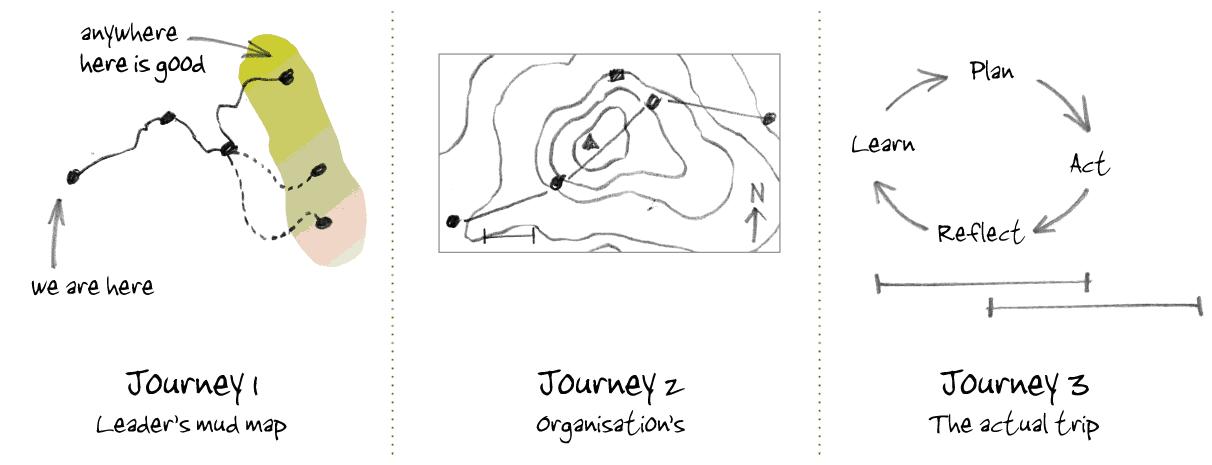
The second journey involves the rest of the organisation (or a representative subset) planning how they will get to the desired state. This involves understanding the current knowledge environment—who’s connected to whom, where are the important knowledge assets, where are the blockers, what are the enablers—and developing the best possible map based on current information and resources available that can be made to guide the third journey.
The third journey is when the organisation actually embarks on implementing the ideas developed in the first two imaginary journeys. Most importantly in the third journey, the organisation implements an iterative process they designed in the second journey that embeds new knowledge-related behaviours and provides opportunities for new ideas to be injected in how things are done. For an example of what this might look like please refer to our recent blog post on the topic (https://www.anecdote.com.au/archives/2007/02/redressing_the.html).

Shawn, author of Putting Stories to Work, is one of the world's leading business storytelling consultants. He helps executive teams find and tell the story of their strategy. When he is not working on strategy communication, Shawn is helping leaders find and tell business stories to engage, to influence and to inspire. Shawn works with Global 1000 companies including Shell, IBM, SAP, Bayer, Microsoft & Danone. Connect with Shawn on:
Comments
Comments are closed.
Knowledge strategy – three journeys
Shawn Callahan has written an entry on knowledge strategy, consisting of three separate journeys. To quote: We’ve learned that top down strategies don’t work. For one thing they typically rely on extrinsic motivations (rewards — do this and you値l get…
Shawn – the three journey idea has given me a real insight into how best to use some of the workshop games I’ve been developing with Drew Mackie. The first run of the game is the mud map. More at the link. Thanks … larger image would be nice:-)
That’s great David. Send me an email and I will send you a higher res picture.
Shawn, I adapted your three step approach in order to implement it in the transformation my organisation currently undergoes.
I committed myself to implementing a KM-approach within 3 years. Your approach was easily adaptible to our situation. Next week I present the approach to my board. I will keep you posted on the result off course.
Could I please receive your image hi res? I find it very communicable….
Regards
Ruud Smit
Shawn,
i would just like to thank you, Mark and Daryl for joining us at the KMRt in the Zoo yesterday to share your approach to Strategy. The feedback from the members of the KMRt was great, they found the approach helped many of them “make sense” of what they could do differently within their own organisations. Many reflected that it really added value to the day and more importantly to their thinking in this space.
thanks once again
Michelle Lambert
Conveynor KMRt
Thanks Michelle. We enjoyed the day at the zoo talking about knowledge strategy.