« March 2007 | Main | May 2007 »

A couple of weeks ago I was helping to run a management development program. It was based on the collection and interpretation of stories of good and bad management behaviour. Every time we run this program (which happens every month for this organisation) I’m always impressed with the conversations people have and the level of understanding that develops. Stories have many possible interpretations and the story-listerners hear different things depending on their own history and interests. I think participants of these story-based processes gain four benefits:

  1. They recognise their own behaviour in the stories and become more self aware. Self wareness is the pre-condition for change. I had one manager say to me, “this story is just like me and I’m not proud of it.”
  2. They develop an appreciation of how their colleagues view the world and just how different that view can be to their own.
  3. They learn stories that they can retell. The stories that really resonate will be retold and will affect the organisation’s culture.
  4. It helps adjust what people believe is possible. One participant said he was unaware of how the company dealt with a particular personal tragedy until he heard the story and he now felt he had a understanding of how he might respond to a similar incident if it happens

Using stories to trigger conversations and interpretations of behaviours is powerful. David Maister gives us a good example in a recent podcast. In this case David recounts how he received advice from a manager when he was a young professor at Harvard. What’s interesting about this story is the conversation David facilitates after its telling. Even without being there I was thinking of my own interpretations of the story which helps me remember what happened and some of the lessons. Managers everywhere should adopt this strategy of presenting a story and then getting the team to talk and make sense of it.

You might be thinking, “yeh, but isn’t that the same as case studies? We’ve been doing that for years.” The problem with case studies is they typically suck the life out of whatever they are describing by removing specifics which we all love to hear in a story (I’ve talked about case studies before here). On Friday I was in at the National Australia Bank getting a coffee at the staff kitchen and on the wall were eight one-page case studies of how the bank helped a range of unnamed customers. I read the first one and immediately felt my skeptometer rising. I’m sure they are all true but all the details were missing (real people’s names, names of organisations, dates) that would help me ascertain their plausibility (a key element of a story). I suspect they are rarely referred to.

Are managers in your organisation recounting stories and asking people for their interpretation?

Permalink | Comments (1) | TrackBack


As I mentioned a couple of days ago, I’m reading Punished by Rewards by Alfie Kohn. It’s a terrific book. This story struck my funny bone so I thought I’d share it with you.

Each day an elderly man endured the insults of a crowd of ten-year-olds as they passed his house on their way home from school. One afternoon, after listening to another round of jeers about how stupid and ugly and bald he was, the man came up with a plan. He met the children on his lawn the following Monday and announced that anyone who came back the next day and yelled rude comments about him would receive a dollar. Amazed and excited, they showed up even earlier on Tuesday, hollering epithets for all they were worth. True to his word, the old man ambled out and paid everyone. “Do the same tomorrow,” he told them, “and you’ll get twenty-five cents for your trouble.” The kids thought that was still pretty good and turned out again on Wednesday to taunt him. At the first catcall, he walked over with a roll of quarters and again paid off his hecklers. “From now on,” he announced, “I can give you only a penny for doing this.” The kids looked at each other in disbelief. “A penny?” they repeated scornfully. “Forget it!” And they never came back again.

Tags:

Permalink | Comments (3) | TrackBack


Corporate or business anthropologist?

Posted by Shawn Callahan - 26/04/07
Filed in .

People are intrigued by the work we do at Anecdote. When they hear how we use stories in a business setting they often mistakenly think we are helping leaders tell better stories. Most of the time we leave that side of the discipline of business narrative to the Steve Dennings of this world. We help organisations collect and make sense of their stories. We’ve called this story-listening.

When people ask, “so what do you call yourself then Shawn?” I sometimes respond, half jokingly, by saying I’m a corporate anthropologist. Some people laugh, others love the idea.  As with any title, it’s not entirely accurate. The traditional anthropologist or ethnographer makes observations and then interprets them. This interpretation becomes an expert’s opinion. This article is a good example of the expert ethnographer at work in a business setting.

We also observe but more often than not we coach the organisation to observe things for themselves, and more importantly we help a group of people, representing the stakeholders that might be affected by any planned improvements, interpret these observations. Of course the observations are collected in the form of stories.

Permalink | Comments (4) | TrackBack


Strategies should result in a set of actions making the organisation more valuable to whoever it serves. I learned this from David Maister Knowledge strategies are no different. The objectives of the knowledge strategy activity are fourfold:

  • develop a common understanding among leaders and staff of where and how they should enhance their capability to create, share and use knowledge
  • understand where to focus efforts and when to say 'no' to suggested activities
  • inspire people to take action and work differently
  • work out the actions needed to make a difference and get acting

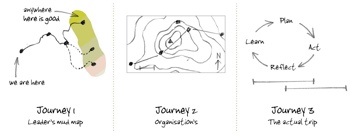
We've learned that top down strategies don't work. For one thing they typically rely on extrinsic motivations (rewards—do this and you'll get that) which I'm learning from Alfie Kohn is an intrinsic motivator killer (I've got to share some of the experiments Alfie talks about in a future post). So our approach to knowledge strategy is to first view the activity more as a verb than a noun. That is, it is better to strategize that the develop a strategy. The get things moving in an organisation we've developed what we call the three journeys approach.

The first journey is designed to help the organisation's leaders develop a common understanding of what they would like to achieve and defining this end-state in broad terms, while knowing that detailed plans are unlikely to be achieved (the world is too unpredictable for a simple, linear view). We encourage the leadership group to develop a rough mud map of the journey from the current situation to this desired end state while resisting the urge to fill in the details. The staff fill in the details as part of the second journey.

three journeys

The second journey involves the rest of the organisation (or a representative subset) planning how they will get to the desired state. This involves understanding the current knowledge environment—who's connected to whom, where are the important knowledge assets, where are the blockers, what are the enablers—and developing the best possible map based on current information and resources available that can be made to guide the third journey.

The third journey is when the organisation actually embarks on implementing the ideas developed in the first two imaginary journeys. Most importantly in the third journey, the organisation implements an iterative process they designed in the second journey that embeds new knowledge-related behaviours and provides opportunities for new ideas to be injected in how things are done. For an example of what this might look like please refer to our recent blog post on the topic (http://www.anecdote.com.au/archives/2007/02/redressing_the.html).

Permalink | Comments (5) | TrackBack


I was pulled up short last week. A new book arrived from Amazon called Punished by Rewards by Alfie Kohn and I was delighted to see it. I’d heard about the title from one of David Maister’s podcasts (actually I get most of my book recommendations from bloggers I respect). I flicked through the table of contents nodding at chapter titles like “The Trouble with Carrots” and “Pay for Performance: Why Behaviorism Doesn’t Work in the Workforce.” Then it struck me: “I’m only reading things that confirm my current beliefs.” I quickly looked at my lists of regular blog reads—the same! Dang! “Note to self: actively seek out alternative views.”

So perhaps you can help me out. After I read Punished by Rewards, what is the best alternative view?

I think my strategy will be simple. Contact the best known proponent for an idea that I agree with and ask them who they think mounts the most robust arguments against their view (I’m always amazed at how many of these intellectual super stars reply to my emails). Hmmm. They’ll probably dislike this person and reject their point of view outright. It will be more difficult than I first thought.

How do you seek out the alternative view? Do you do it systematically?

Here are a few opposing ideologies (probably too strong a word and too simplistic) that I’m aware of that are relevant to my interests.

complexity — rationalism
Polanyi — Popper
constructivism – cognitive science
behaviourism — (still learning about this one)

Permalink | Comments (5) | TrackBack


Computer problems

Posted by Shawn Callahan - 21/04/07
Filed in .

Both Mark and I are having a world of problems with our PCs. So if you have been emailing us and not getting a reply can we ask you try again. Hey Dave, looks like we will need to move to Apple :-)

Permalink | Comments (2) | TrackBack


Why managers shun management books

Posted by Shawn Callahan - 14/04/07
Filed in .

Have you ever noticed that experienced managers rarely read management books? At first I though this might be because they don’t have the time or just don’t like reading. Yet many are voracious newspaper readers. They will get up early in the morning to get through one or more newspapers.

Here’s one explanation. Most management books provide a set of rules in the form, “for this type of behaviour, involving these types of people, in this type of situation, do this.” The problem with these types of rules is they can only be generalisations and when things move fast, and they’re complex, progress can only be effectively made with knowledge of specific situations. In the moment these specific situations (experience) help the manager create new generalisations made for the current situation. This context-specific knowledge is a combination of understanding what happened to get here, what’s happening now and what the manager (and the group) would like to see happen. This specific and detailed understanding comes from stories. Stories from the manager’s experience, from her colleagues, the people involved in the situation and those who want to make progress.

So why do managers read papers and avoid management books? Because newspapers contain stories of what’s happening now, in the past and in the future. They are detailed and specific and help build a manager’s situational awareness, their repertoire and their ability to act.

Management authors are beginning to wake up to what practitioners want and are now writing books replete with stories and even advocating the need to understand and work with stories in business. A quick browse in Amazon’s top selling management books and I can see four books that illustrate this point: Blink, Made to Stick, A Whole New Mind, The No Asshole Rule.

Permalink | Comments (5) | TrackBack


The need for walls?

Posted by Shawn Callahan - 13/04/07
Filed in .

Dave Snowden is puzzled with one of my posts that mentions Frost’s poem, Mending Wall, when I say:

“when you read the entire poem (in context) you realise Frost is questioning the need for fences"

Dave responds categorically saying: “I cannot see any reading (my emphasis) that would support such a statement. The poem is about the dynamics and social process of mending, not the static nature of the wall.”

I understand the metaphor Dave. Give me a break. I’m surprised that someone with such a deep understanding of sensemaking and the need for multiple interpretations can only see one interpretation of a poem. Have a read of this part of the poem and hopefully you can see that the narrator is questioning the need for walls. Of course it is ironic that we are arguing over this particular poem.

Oh, just another kind of out-door game,
One on a side. It comes to little more:
There where it is we do not need the wall:
He is all pine and I am apple orchard.
My apple trees will never get across
And eat the cones under his pines, I tell him.
He only says, 'Good fences make good neighbors'.
Spring is the mischief in me, and I wonder
If I could put a notion in his head:
'Why do they make good neighbors? Isn't it
Where there are cows?
But here there are no cows.
Before I built a wall I'd ask to know
What I was walling in or walling out,
And to whom I was like to give offence.

I suspect you hadn’t seen this part of the poem because you were using other parts to make a point about barriers in complex systems. I think it’s a classic example of seeing what you are looking for.

Permalink | Comments (9) | TrackBack


One of the best ways to share knowledge in an organisation is to put people who wouldn’t normally work together on the same project. On projects people have time to get to know one another, have real problems to apply their knowledge and see their colleague’s knowledge in action. Learning (which is the same as knowledge sharing) occurs when there is time (or you make time) for reflection, when you and colleagues have time to discuss what happened. The project approach to knowledge sharing is the basis for the action-oriented community of practice model.

Despite the time we spend with our colleagues on projects, we waste the opportunity to learn from them. We rarely ask them about their experiences and elicit their stories. “Just give me the facts,” seems to be the project mantra. But hearing someone else’s story is the next best thing to experiencing something for ourselves. If we don’t seek our our colleague’s experiences we are missing a huge opportunity.

There’s one good reason why we don’t typically hear our colleagues stories: as a general rule we don’t ask the type of questions that prompts stories.

Everyone should develop a story eliciting competency. Organisational learning would sky-rocket if we all had it. It’s simple really. When your experienced colleague suggests a way forward, makes a decision, starts to apply their knowledge, simply ask them: you look like you’ve done something like this before. What happened last time?

If you’re lucky they will tell you a story of how they tackled a similar problem but I’ve found that really experienced people tend to encapsulate their experience into pithy aphorisms, rules of thumb and principles and will likely tell you these in the first instance. You must be persistent. “Can you recall a specific moment from your experience that would help me visualise the situation?”  Here are a bunch of questions (and here, and here) you should have up your sleeve in preparation for encourage storytelling.

Sometimes the experienced practitioner will be a reluctant storyteller because that’s not the way we talk at work. You need to show you’re interested in her experiences. Genuine interest will also help them feel comfortable in telling you the whole story and perhaps even the things went badly that they would never do again.

I’m certain that the skill to elicit stories from colleagues, especially colleagues more experienced than yourself, will become an essential lessons learning competency as the world becomes even more complex. Stories provide the details from which we extract and remember principles and principles help us deal with totally new situations.

Permalink | Comments (2) | TrackBack


Lessons learning: context matters

Posted by Shawn Callahan - 9/04/07
Filed in .

Yesterday I posted a piece on how taking a story out of context is unlikely to help lessons learning. One of my regular commenters, Ken (I would love to know who you are), posted this link to a beautiful article in the Washington Post that sums up this issue of context. You will love it.

Permalink | Comments (0) | TrackBack


This morning (Happy Easter!) I started writing a paper on a narrative approach to lessons learning. I’m at the point of gathering my thoughts and had the idea of sharing some of them as they occur to me. I hope it’s not too ill-informed but if that’s the case I’m hoping you’ll help me correct my wayward thinking.

The paper I’m writing argues against merely capturing stories as a way to share lessons. I thought I would start the paper by reflecting on the nature of narrative in order to build a case against the database-only approach (notice how I qualify these statements about capturing and databases because I do believe they play a role).

Stories are told in context

Stories are told in context to illustrate a point. No one wants to tell a story to have the listeners cock they heads and say , “huh?” The story makes sense in relation to what came before and what is likely to follow. It also makes sense in terms of who is in the conversation and the collective identity of the group. A story in isolation is likely to require active interpretation—what did she mean here? A story in context is hardly noticed and usually makes sense immediately. Perhaps the real danger of an isolated story is that its original intention can be misunderstood. Perhaps even reversed. For example, people often quote Robert Frost’s Mending Wall advocating for barriers, saying “Good fences make good neighbors”, yet when you read the entire poem (in context) you realise Frost is questioning the need for fences.

Here is an anecdote I told last week—without context.

When we started ActKM each person on the organising committee had a title: president, secretary, treasurer, etc. After a while we heard that members felt obliged to seek our permission to kick off any new initiative and there was also some suspicion about what this group was doing. The members felt it was a closed shop. Once we realised what was happening we discarded the formal titles and called everyone in the organising group a coordinator and the group became known as the coordinator’s group.

Take a moment to reflect on what this story means for you and see how close that meaning matches my intent when I told it.

So here’s the context. Last week I was at a meeting with John Smith, Etienne Wenger and the members of a new group of people invited to work with John and Etienne to re-energise CP2. We were talking about what this new group should be called. Before the meeting the group was called the oversight committee but intuitively John and Etienne felt that the name didn’t reflect the intent of the group. At the end of the meeting we agreed to call the group the coordination group.

Did you have a different meaning for the original story?

Now you might be thinking “gee, Shawn is really getting hung up with the meaning of the story. Surely stories are powerful because they have multiple meanings?” I agree, the multiple meanings are an important feature of narratives. Please bear with me while I take you though the next point.

There are many versions of the story I told John and the gang last week. For example if we were talking about how not to setup a community of practice I might have told a version that emphasised how we ended up with the formal titles in the first place and how our dalliances with KMCI were misguided. A different meaning.

There is more to the story than in its telling. The story listeners recreate the story as it unfolds and imbue it with their own meaning which is dependent on the way it’s told, the context of its telling and the history of the listener. The story becomes a catalyst for a group of people to make sense of a situation and choose their next steps (action).

Last week I had the pleasure of meeting David Boje. In our meeting, which was attended by 15 or so people, I made the statement that “the magic is not in the story, it’s in the interaction among people who are prompted to relate by hearing the story.” David was uncomfortable with this statement because he felt there is magic in stories. In reflection I think my wording was inaccurate. What I should have said was that “the answer is not in the story but is contained in the sensemaking that’s prompted by stories.” Storytelling is a social phenomena and we need to seek opportunities to tell one another stories, perhaps prompted by stories the have already been collected.

So hopefully I will have more for you on this topic over the coming weeks. Love to hear your thoughts.

Permalink | Comments (9) | TrackBack


Occasionally, anecdote circles don’t work. Sometimes, people don’t get a lot out of them.

In the feedback session for the leadership program mentioned on Wednesday one of the participants had this to say:

I attended one of the anecdote circles and, no offense meant Mark, but I thought it was a bit of a waste of time. But now, when I see all these stories assembled and how we can use them and how powerful they are…well I have changed my mind – I get it now.

Yesterday I ran anecdote circles in Brisbane involving people providing services and support for the homeless. Despite them being desperately over worked and it being the last day before the Easter break, the feedback from both circles was really positive. So, while anecdote circles might not work for everyone, they seem to really work for most.

I also was to acknowledge the incredible contribution these people make. In a resource-poor sector they make a difference every day in a very confronting, emotionally demanding and sometimes dangerous job that they get paid peanuts to do.


Permalink | Comments (1) | TrackBack


Have you ever had the experience of someone telling you something that’s quite interesting while also showing you something that’s quite interesting and you didn’t know where to focus? Should you look at the picture and understand it, or should you listen? Les Posen points to some new research that says this is a big problem with presentation software like PowerPoint and Keynote. Actually, Les doesn’t mention Keynote as a culprit because he loves Keynote, but I’m guessing you can make the same errors using any presentation software.

I understood the research to say that if we present two or more sources of information simultaneously we overload our audience’s minds and they get confused. I’m sure this is mainly the case when the speaker says one thing and the slide also has plenty of text to consume (probably saying the same thing). But I’m sure the problem exists is the information presented is rich and dense. It’s much less an issue, of course, if the slide just has a simple picture that didn’t require interpretation while the presenter spoke, but is there to evoke a feeling.

I witnessed a good example of how we can easily confuse our audience by overloading the audiences senses. Last weekend I attended the Narrative and Complexity workshop convened by David Boje and his colleagues in Las Vegas. As part of our time together we were invited to attend a presentation by one of David’s students. The PhD student presented a graph using PowerPoint that was complicated and took some time to understand. Unfortunately the graph was poorly labelled and while the student continued to present his ideas no one could concentrate on what he was saying. We were all stuck on the graph we didn’t understand. Eventually the audience became aggressive and attacked his presentation. Poor guy. It wasn’t a pretty sight.

I can understand why people provide lots of text on their slides. They believe they have some really important things to convey and they don’t want the audience to miss the key points (or should I say, the key notes and powerful points).  It looks like our logical, rational minds fails us here because in an attempt to ensure we convey our points, our audiences get confused and miss the point. Perhaps there is a narrative alternative.

Would you put text on slides if we were telling a story? For me it doesn’t make much sense. What would you write? You wouldn’t attempt to summarise the story because it would ruin it for everyone. Including stories helps you break the habit of having too much text on your slides. You could use a combination (in any order) of these presentation patterns to effectively communicate your ideas:

  • tell a story while showing a picture that evokes a feeling that supports the story
  • show a graph while telling them what the graph means
  • tell them ideas, concepts, opinions while showing simple graphics (like a single image covering the whole screen) that help them connect the ideas to a picture
  • hand out the detailed information at the end of the presentation so people can read the facts etc.

You can see an example of one of my presentations that uses this approach. 

Permalink | Comments (9) | TrackBack


I am in a plane to Brisbane reflecting on the second delivery of a 2.5 day leadership program we have helped develop for the Australian arm of an international company. A large part of the program used anecdotes collected from within the organisation on leadership behaviours and their impact. The feedback from the participants was great and so were they.

One of the participants reflected on an occasion when she was frustrated that the majority of her team were consistently late for meetings. Faced with many possible ways to handle the problem, what she chose to do was to send an email to the one person who was consistently on time and thanked them for always being punctual and told them how much she valued this.

Permalink | Comments (2) | TrackBack


I’m sitting in the LA airport getting ready to fly home to Melbourne. It’s given me time to reflect on our workshop in Boston. Thanks John for helping me organise this event. It was great to meet face to face. And thanks to all our workshop participants. You were a fun group.

We’ve made some tremendous advances in our workshop since we ran it for the first time in 2004. We’ll run in Australia again this year. Just send me an email if you are interested in attending.


Permalink | Comments (0) | TrackBack


A New York Times/CBS News poll from July 1999 revealed that 63% of people interviewed believe that in dealing with “most people” you “can’t be too careful” and 37% believed that “most people would try to take advantage of you if they got the chance”. If you assume that this is representative of the people you wish to influence, your first job is to let people see that you can be trusted. How? The same study gives us a hint. Respondents also revealed that of the people that they “know personally,” they would expect 85% of them to “try to be fair.”  Hmmmmm. Could it be that simple? Let people see who you are, help them to feel like they know you personally, and your trust ratio automatically triples? Think about our language: “he’s okay, I know him” or “it’s not that I don’t trust her, I just don’t know her.”1

Our blogs regularly mention the issues of trust and relationships and their importance in the workplace (examples are here and here). The quote above reflects the importance of relationships and why people who are connectors and hubs in social networks are more effective: they have more relationships and more people ‘trust’ them.

1. Annette Simmons, The Story Factor, Basic Books 2006, page 7.

Tags:

Permalink | Comments (3) | TrackBack


« March 2007 | Main | May 2007 »