« December 2006 | Main | February 2007 »

Upcoming Practical Social Network Analysis Workshop

Posted by - 31/01/07
Filed in .

SNA The BeesWith Social Network Analysis (SNA), the technique of analysing and exploring social networks, experiencing a resurgence. I’m pleased to announce that I will be running a 2 day workshop titled "Practical Social Network Analysis: Skills and techniques for facilitating organisational change". This workshop will be held in Melbourne on the 22nd and 23rd March. This practice based workshop will provide you with the skills and tools to be effective with the use of Social Network Analysis in your organization.

This workshop is for those who want to:

  • Build their confidence and expertise in applying the theory and practice of social network analysis for facilitating change within their organisation
  • Gain an understanding of the key concepts and models which inform the practice of social network analysis and sensemaking for change in organisations
  • Gain enhanced understanding and capability to use and apply the specific software tools for conducting social network investigations within your organisation

As a special offer, the first 5 participants to register for this course will receive a free copy of Rob Cross' book "The Hidden Power of Social Networks: Understanding How Work Really Gets Done in Organizations ". Regarded as one of the most practical and comprehensive guides written to the application of social network analysis within organisations.

To find out more about this course including how to register simply download the registration brochure here: http://www.anecdote.com.au/files/Social_network_analysis.pdf

Send this entry to:  Share on Twitter Share on Facebook    Clip to Evernote   | Email to a friend

Permalink | Comments (0) | TrackBack


Peer assist animation

Posted by Shawn Callahan - 31/01/07
Filed in Knowledge.

When you’re steeped in a discipline like knowledge management you start to assume that everyone knows about techniques like After Action Reviews and Peer Assists. Of course this is untrue. Steve Dale over at Dissident has discovered this neat Flash animation that describes the peer assist process. I particular like the idea of rotating peer assists.

Send this entry to:  Share on Twitter Share on Facebook    Clip to Evernote   | Email to a friend

Permalink | Comments (0) | TrackBack


Managing your boss

Posted by Shawn Callahan - 30/01/07
Filed in Collaboration.

I was over at David Maister’s blog the other day and he was requesting tips on how to better manage your boss. I made a suggestion: match your boss’s communication style. I see David has expanded on this idea in his latest podcast: Managing Your Boss - new careers podcast episode

Send this entry to:  Share on Twitter Share on Facebook    Clip to Evernote   | Email to a friend

Permalink | Comments (0) | TrackBack


Defining intent in a change management program
Posted by Shawn Callahan - 30/01/07
Filed in Changing behaviour, Strategic clarity.

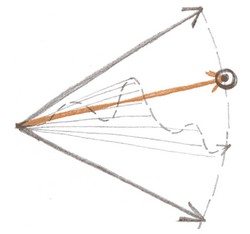
A while ago I argued that the target metaphor was inappropriate for change projects. The idea that anyone could accurately define a change target, aim at it, and then hit it with a well shot arrow was, at best, an illusion. In most cases the possible, beneficial end states are wide and varied.

Picture1

So the question is, how do you define an intent that provides direction, inspires action yet is not overly prescriptive? John F. Kennedy provides a good example.

In his now famous ‘man on the moon’ speech, Kennedy kicked off the US entry to the space race with the following goal:

First, I believe that this nation should commit itself to achieving the goal, before this decade is out, of landing a man on the moon and returning him safely to the earth.

This statement of intent is concrete (landing a man on the moon), active (landing, returning, achieving), simple, time bound (before this decade is out), and is in the form of a mini story (land the man and get him home safely).

The military are well versed in providing strategic intents for missions because they know that No plan survives contact with the enemy. Chip and Dan Health explain the military’s use of commanders intent (CI).

CI is a crisp, plain-talk statement that appears at the top, of every order, specifying the plan’s goal, the desired end-state of an operation. At high levels of the Army the CI may be relatively abstract: “Break the will of the enemy in the Southwest region.”

Gary Hamel and C.K. Prahalad suggest three key aspects of an effective strategic intent:

  1. Sense of Direction. "Strategic intent (...) implies a particular point of view about the long-term market or competitive position that a firm hopes to build over the coming decade or so". It should be a view of the future – conveying a unifying and personalising sense of direction.
  2. Sense of Discovery. A strategic intent is differentiated; it implies a competitively unique point of view about the future. It holds out to employees the promise of exploring new competitive territory.
  3. Sense of Destiny. Strategic intent has an emotional edge to it; it is a goal that employees perceive as inherently worthwhile.

These examples provide a sense of what a change management team needs to achieve, but we still need a way to develop a useful intent. As you might guess, my suggestion is largely participative, using stories and question-based. But I have run out of time to finish this post so I will write another making some suggestions on how you can create your strategic intent for a change management program. In the meantime any other examples or descriptions of how you do it would be appreciated.

Send this entry to:  Share on Twitter Share on Facebook    Clip to Evernote   | Email to a friend

Permalink | Comments (0) | TrackBack


Exploring the language of facilitation

Posted by - 29/01/07
Filed in .

Last week Johnnie Moore, Tom Guarriello and I connected (3 world times uniting) and had a great conversation exploring language of facilitation. Johnnie summed it up well with:

It's a suitably non-linear conversation touching on lots of themes - the power of metaphor, the role of narrative, and the impact of body language and silence. We talk about how in using language we often miss how it shapes our experience and how easily it can both unite and divide us. Is there something going on in groups of people that is beyond language? How does the institutional language of organisations constrain their behaviour? I also get to sound off about the dangers of premature encapsulation.

Thanks to Johnnie, he has compiled our conversation into a podcast. You can download it from here. Enjoy!

Send this entry to:  Share on Twitter Share on Facebook    Clip to Evernote   | Email to a friend

Permalink | Comments (2) | TrackBack


Using small rituals to switch roles and behaviour

Posted by Shawn Callahan - 28/01/07
Filed in Communities of practice.

Our behaviour changes with the roles we play, and sometimes we need a trigger to remind us to move from one role to another to ensure our behaviour suits the context. The TV series, The West Wing, provides many good examples of where this switch falters. For example, President Bartlett will have an intense meeting with his advisors, Josh and Toby, and then receive a surprise visit by one of his daughters. In most cases the President fails to make the switch from leader to father and deals with his daughters in an inappropriate presidential fashion.

Dave Snowden brought this concept of an identity switch to my attention last week when Mark and I spent the day together in Canberra. He told the story of a project he was involved in helping lorry drivers reduce back injuries. At the end of a trip, a lorry driver changed roles from ‘lorry driver’ to ‘lorry unloader’ and in this role switch many drivers don’t change their mind-set to remember safe lifting practices.

To help the identity switch occur, Dave suggested the company introduce a ritual so that upon reaching the destination, and before unloading the truck, the driver must fasten a weight-lifting belt around his waist signifying the switch in roles from driver to unloader, and in the process helping him become aware of safe lifting practices.

We saw a similar identity switch occur for managers who need to switch roles from spreadsheet jockey to coach. For example, a manager might be working intensely on her computer when a staff member knocks at the door. A good manager can switch roles from being focussed on the computer to being focussed on the person. A useful ritual might be to stand up and move to another chair when someone arrives at your office, clearly signifying the change in roles. 

Send this entry to:  Share on Twitter Share on Facebook    Clip to Evernote   | Email to a friend

Permalink | Comments (0) | TrackBack


Organisational stories

Posted by Shawn Callahan - 28/01/07
Filed in Anecdotes, Business storytelling.

A friend of a friend of our is a frequent business traveller. Let’s call him Dave. Dave was recently in Atlantic City for an important meeting with clients. Afterward, he had some time to kill before his flight, so he went to a local bar for a drink.

He’d just finished one drink when an attractive woman approached and asked if she could buy him another. He was surprised but flattered. Sure, he said. The woman walked to the bar and brought back two more drinks—one for her and one for him. He thanked her and took a sip. And that was the last thing he remembered.

Rather, that was the last think he remembered until he woke up, disoriented, lying in a hotel bathtub, his body submerged in ice.

He looked around frantically, trying to figure out where he was and how he got there. Then he spotted the note:

DON’T MOVE. CALL 911.

A cell phone rested in a small table beside the bathtub. He picked it up and called 911, his fingers numb and clumsy from the ice. The operator seemed oddly familiar with this situation. She said, “Sir, I want you to reach behind you, slowly and carefully. Is there a tube protruding from your lower back?”

Anxious , he felt around behind him. Sure enough, there was a tube.

The operator said, “Sir, don’t panic, but one of your kidneys has been harvested. There’s a ring of organ thieves operating in this city, and they got to you. Paramedics are on their way. Don’t move until they arrive.”

According to Chip and Dan Heath, this is one of the most successful urban myths. I hadn’t heard it before but I found myself retelling the story to my wife that afternoon. Chip and Dan use this story as an example of why some ideas travel and others don’t in their excellent book, Made to Stick: Why Some Ideas Survive and Others Die. One of the reason this myth’s success is the simple fact that the information is conveyed as a story. It’s embedded with emotion. It’s surprising.

This got me thinking about the myths I hear in organisations. By myths I mean stories of larger than life characters that convey beliefs. They might be creation stories (how the organisation or community got started), heroic acts, tragedies, or amusing anecdotes that are frequently recounted.

Here’s one I heard the other day.

Our company has just done the mission, vision, values thing. The CEO, who came to us from one of our competitors, did most of the work. He went home on Friday, dug out the mission, vision and values statement from his old job, photocopied them on A3 sheets of paper and stuck them all over the wall on levels 22, 23 and 24.

Finding an organisation’s myths helps you understand the boundaries and constraints for any new interventions you might have planned. I’ve discovered that myth discovery is simply a matter of asking for stories that lots of people know. I was chatting to Dave Snowden about this last week and he suggested that you could also discover myths using his Sensemaker software by looking our for clusters of stories around particular archetypes. More on Sensemaker in a following post.

Let me leave you with one more myth from an organisation.

A new sales guys, Mike, starts at a Sydney company and he’s eager to make an impact. His boss says that the sales team in meeting in Jervis Bay (a coastal holiday spot about 3 hours drive from Sydney) on Monday morning at 9am. Mike gets up at 4am on Monday and drives down to Jervis Bay and on arrival calls his boss to get the specific location of the meeting.

On getting the call the boss says, “No, no, we are meeting in the Sydney office in a meeting room called Jervis Bay.”

What’s interesting about this seemingly innocuous story was how often we heard it told. I think it was an important story for the organisation that reminded people to ask questions and not just leap into things.

What myths are you aware of being told in your organisation?

Send this entry to:  Share on Twitter Share on Facebook    Clip to Evernote   | Email to a friend

Permalink | Comments (5) | TrackBack


Carnival of the Capitalists on David Maister's blog

Posted by Shawn Callahan - 24/01/07
Filed in .

Last week David Maister invited his blog readers to participate in the Carnival of the Capitalist and submit a blog post that his readers might enjoy. David organised the posts into six categories and I was thrilled to see our post (The Hierarchy of Explanation) topped his list in the category “Articles I Enjoyed the Most”.  It’s worth popping over to David’s blog and checking out some of the carnival posts.


Send this entry to:  Share on Twitter Share on Facebook    Clip to Evernote   | Email to a friend

Permalink | Comments (1) | TrackBack


Moving from on-line to face-to-face and back again

Posted by Shawn Callahan - 22/01/07
Filed in Collaboration, Communities of practice.

I met John Smith and Bev Trayner face-to-face for the first time last year in Florence at a CP2 dialogue. I’d known both of them for years before this meeting. Before Florence it was an online and Skype acquaintance. My face-to-face meeting made a huge difference on how I viewed my role in our community: I’m more involved, I can see the core team, I can really hear the language.

John and Beverly have just published a paper on how they have brought communities together using a combination of online and face-to-face interactions. In each case the face-to-face part consists of an event. Online interactions are used to ramp-up and then ramp-down before and after the event.

They conclude their paper with six heuristics:

  1. Design for learning using CPD model is productive
  2. Spending time on social processes
  3. Using different media to negotiate language as part of a larger process
  4. Creating new possibilities: subgroups and outside experts as resources
  5. Demonstrating leadership roles in different media
  6. Provoking shifts in "comfort zones."

Send this entry to:  Share on Twitter Share on Facebook    Clip to Evernote   | Email to a friend

Permalink | Comments (0) | TrackBack


The difference between a sound argument and a good story
Posted by Shawn Callahan - 21/01/07
Filed in Knowledge.

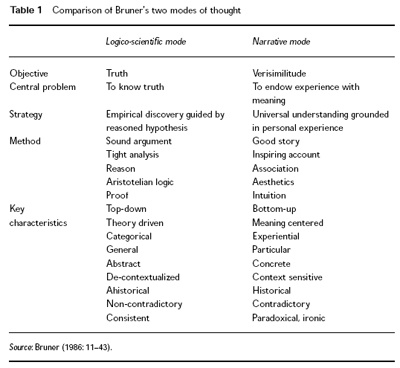
I spent a couple of hours today tracking down some papers for a course I’m helping to teach at the Hong Kong Polytechnic University on business narrative when I discovered this excellent paper by Tsoukas and Hatch called ‘Complex thinking, complex practice: The case for a narrative approach to organizational complexity’. I’m a bit of a fan of Hari Tsoukas’ work. Just read his paper on tacit knowledge to get an idea of what a great KM thinker he is. Anyway, there are a couple of paragraphs and a table that jumped out at me in this paper. The paper is based on two modes of thinking proposed by J. Bruner and goes on to say,

Bruner called the two modes of thought ‘logico-scientific’ (or paradigmatic) and ‘narrative’, arguing that:

the types of causality implied in the two modes are palpably different. The term then functions differently in the logical proposition ‘if x, then y’ and in the narrative recit ‘The king died, and then the queen died.’ One leads to a search for universal truth conditions, the other for likely particular connections between two events – mortal grief, suicide, foul play. (pp. 11–12)

To compare the two modes, Bruner claimed, is to understand the difference between a sound argument and a good story.

I’ve been working with engineers lately and I have been struggling to explain this whole issue of knowing the truth. Now I have some language to open the conversation up. This table elaborates this idea perfectly.

Bruner's-Two-Modes-of-Thoug

Bruner, J. (1986). Actual minds, possible worlds. Cambridge, MA, Harvard University Press.

Tsoukas, H. and M. J. Hatch (2001). "Complex thinking, complex practice: The case for a narrative approach to organizational complexity." Human Relations 54(8): 979-1013.

Tsoukas, H. (2003). Do we really understand tacit knowledge? The Blackwell Handbook of Organizational Learning and Knowledge Management. M. Easterby-Smith, M. A. Lysles and K. E. Weick, Blackwell Publishers.

Send this entry to:  Share on Twitter Share on Facebook    Clip to Evernote   | Email to a friend

Permalink | Comments (0) | TrackBack


Narrative for Business Workshops in the USA

Posted by Shawn Callahan - 18/01/07
Filed in .

Update: referral bonus for bloggers. See below.

We are pleased to announce that we’re running two narrative techniques workshops in the USA at Seattle and Boston on the 26 and 29th of March. Come and join us for the day and learn how to tackle seemingly intractable business issues like,

  • fostering culture change
  • building trust
  • making mergers and acquisitions successful
  • capturing the knowledge of retiring employees
  • extracting lessons from projects
  • improving occupational health and safety
  • managing risk

A full description of the workshop and information on how to register is here.

Here are some of the organisations we’ve trained that are successfully using business narrative techniques:

  • Australia Army
  • IBM
  • National Australia Bank
  • Telstra
  • The Treasury

And if you want to get a head start on learning about our techniques, take a look at our Guide to Anecdote Circles, which will be one of the techniques you will be learning.

One last thing. Some of you might be familiar with Steve Denning's work on business narrative. This workshop is nothing like that which Steve teaches (I talk about some of the differences here). Steve’s techniques are primarily aimed at helping leaders craft stories for a range of purposes (to persuade, to spark action etc.). Our techniques involve finding the stories that are already being told in an organisation and then helping decision makers make sense of these stories so they can create interventions to change how things are done.

I was inspired by Seth Godin to offer the following:

BLOG REFERRAL BONUS
If someone mentions your blog when they register, I’ll pay you $80. One blog per registration, of course, but no limit on bonuses per blog, naturally.

If you buy three seats for your colleagues, the fourth is free.

Send this entry to:  Share on Twitter Share on Facebook    Clip to Evernote   | Email to a friend

Permalink | Comments (0) | TrackBack


A new conceptualisation of expertise, advice and knowledge

Posted by Shawn Callahan - 16/01/07
Filed in Expertise location, Knowledge.

This looks really interesting:

Expertise is about more than evidence. It is also about judgement and wisdom. Our argument is not that we should reject the received wisdom in favour of the wisdom of crowds. But we need to go beyond a simple model of ‘evidence-based policy.’ Drawing on recent case studies and research with ‘lay members’ of expert committees, this pamphlet looks to a new model of expertise which is more diverse, takes better account of uncertainty, is aware of its context and trusts the public.

The pamphlet is 87 pages (down-loadable pdf) in the style, I guess, of the polemics of the 18th and 19th century. But perhaps less controversial. The work is available under a creative commons licence and I will be having a good read.

You can find the background to the pamphlet here, which says “The good folk of Defra have asked Demos and Liverpool University to consider how lay people can play a part in expert scientific advice.”

Send this entry to:  Share on Twitter Share on Facebook    Clip to Evernote   | Email to a friend

Permalink | Comments (0) | TrackBack


Exploring the language of facilitation

Posted by - 16/01/07
Filed in .

Do you facilitate groups? Have you ever thought about the language that you use whilst facilitating? What insights can language give you about your facilitation?

We have just had an article published in the IAF Group Facilitation: A Research and Applications Journal titled “exploring the language of facilitation”.

Some quotes from our paper:

“Whilst language is the means by which facilitation is realised, there has been little research to date investigating language use in facilitation.”

“Language is all around us. Like a fish in water, we are immersed in language, through words, every day. As Hall (2005) describes, one may think of language as a spell.”

“In business and organisations it may come as no surprise that there is an attitude favouring action over talk (Weick, 2004), yet in many ways it is through the very act of talking and speaking that sense is made and action enacted (Weick, 2005).”

You can download a full copy of the paper here. Enjoy!

Send this entry to:  Share on Twitter Share on Facebook    Clip to Evernote   | Email to a friend

Permalink | Comments (0) | TrackBack


Wow, is this really what a knowledge map looks like?

Posted by Shawn Callahan - 15/01/07
Filed in Knowledge.

Here’s a good idea. A neat compilation of a range of visualisation techniques arranged in the form of a periodic table. I was checking out all the different examples by rolling my mouse over each ‘element’ and then notice this one titled ‘knowledge map’.

Knowledge-map

Hmmm, of all the knowledge maps I’ve helped organisations create, they’ve never looked like this! Mind you, with my love of geography and old cartographic masterpieces, this is a gem. I suspect, however, that Edward Tufte would label it as chart junk—it looks good but it doesn’t tell you anything.

I have talked before about how there’s rarely a single ‘knowledge map’ that adequately describes an organisations knowledge assets (this post also describes the mapping process we use and its origins). The process of identifying and talking about your knowledge assets is more important than the artifact. But if I was to suggest an alternative to the example presented in the Periodic Table of Visualisation Methods I would offer this one.  

My-Knowledge-map

So to explain my example. The knowledge objects are artifacts, skills, heuristics, experience or natural talents people have in the organisation. The business processes are key processing in the organisation like engagement delivery, client satisfaction, opportunity identification. It’s not unusual to have 30+ processes listed. Ranking is the ranking of the processes from most important to least important (a difficult but important activity for a decision making group). Risk is the likelihood of the knowledge object being lost. This knowledge map is developed by a group of people in a workshop. The aim is to identify important knowledge objects that are vulnerable so initiatives can be designed.

What knowledge mapping techniques do you use?

This approach to knowledge mapping was first developed by Dave Snowden while he worked at IBM. Check out m related post above for all the references.

[via Guy Kawasaki]

Send this entry to:  Share on Twitter Share on Facebook    Clip to Evernote   | Email to a friend

Permalink | Comments (0) | TrackBack


Let's Be Brief story writing contest

Posted by Shawn Callahan - 14/01/07
Filed in Fun.

Bob Hruzek over at Middle Zone Musings is kicking off a story writing contest tomorrow, with a difference: best story wins but it can only be six words long. Bob was inspired by Hemmingway’s shortest story: “For Sale: baby shoes, never worn.” and has asked John Koetsier and I to be judges. I look forward to reading your submissions.

Send this entry to:  Share on Twitter Share on Facebook    Clip to Evernote   | Email to a friend

Permalink | Comments (1) | TrackBack


Why Command And Control Is So Bad

Posted by Shawn Callahan - 14/01/07
Filed in Strategic clarity.

Bruce Nussbaum over at BusinessWeek Online has written a short piece entitled: Lessons From Home Depot’s Bob Nardelli—Why Command And Control Is So Bad.

Autocratic top-down, command and control works great when you focus on process—cost and quality. Six Sigma measures all that stuff wonderfully.

The truth is that in the new global business culture, process controls and metrics are critical to any big company but they are now sediment, one of the things that is commoditized and laid down on the corporate structure to make way for the discipline and process of innovation.


It’s good to see commentators starting to reflect the need for leaders and managers to look beyond what can be easily measured and controlled. Sadly, most commentators, leaders or managers are still attempting to use the tools developed for command and control (such as six sigma and balanced scorecard) to address complex issues such as culture, customer service, sales, leadership and innovation. Warning, here comes some flagrant self promotion. You might think that it’s only fringe organisations that might use techniques like business narrative, most significant change, and complexity-based thinking. Not so. Here are some of the clients we have done projects for and many are global businesses.

  • BHP Billiton
  • Rio Tinto
  • ANZ Bank
  • National Australia Bank
  • Australian Army
  • AstraZeneca
  • IBM
  • The Treasury
  • CSIRO
  • DSTO

[via Bob Sutton]

Send this entry to:  Share on Twitter Share on Facebook    Clip to Evernote   | Email to a friend

Permalink | Comments (0) | TrackBack


The power of ordinary practices

Posted by Mark Schenk - 10/01/07
Filed in Anecdotes, Evaluation.

An article titled ‘The power of ordinary practices’ was the seventh ‘most read’ of Harvard Business School’s Working Knowledge articles for 2006. The articles includes the following:

I believe it's important for leaders to understand the power of ordinary practices. Seemingly ordinary, trivial, mundane, day-by-day things that leaders do and say can have an enormous impact. My guess is that a lot of leaders have very little sense of the impact that they have.

One of our projects has involved collecting about 250 anecdotes from within a large multinational on the theme ‘values in action’. The anecdotes were used as part of a management development program. After short-listing the anecdotes, teams went through the most significant change process to identify anecdotes that provided the best examples of behaviours they should model. The following anecdote was selected as the most significant by one of the teams.

A great example, you go and - even impromptu if you just knock on [name's] door if you've got something you want to talk to him he will get up and he will move to his table and he'll give you his undivided attention.  I have experienced many other managers who will continue to type, will not always turn and look at you…

That something so innocuous has such impact reinforces the ‘impact of ordinary practices’. As we regularly comment – little things can make a big difference. But, you can tell managers this sort of thing a hundred (bazillion) times without it really sinking in. So, here we see some of the power of narrative – a simple anecdote has had a major impact upon a group of senior managers by giving them a powerful example of the effect their behaviour has on others. 

Send this entry to:  Share on Twitter Share on Facebook    Clip to Evernote   | Email to a friend

Permalink | Comments (5) | TrackBack


Hierarchy of explaination or why narrative is becoming more important

Posted by Shawn Callahan - 9/01/07
Filed in .

In 1805 William Clark notes in his expedition journal that the Mandans [a Native American tribe] believed that buffalos could be attracted to close-by hunting grounds by performing the buffalo dance. According to Clark, the hunters thought they could further increase their chances by having sexual relations with a woman who had been with a more powerful man. A bevy of buffalo appeared after three days of dancing.


Last week I spent a week with my parents at their home at Jervis Bay. My father was telling me how he had some problems with a tank of petrol recently. He had to drain his little Datsun truck of all its fuel. When I asked where he got the bad gas he said it was one of two places. “One of the service stations was being refuelled by a tanker and was probably churning up all the rubbish in the underground tanks and I happened to fill up when all that muck was floating around,” he said. “I will never fill up again if I see a tanker parked at the service station.”


You might have read the buffalo dance example and thought, “What a quaint belief. How could people believe that dancing and sexual relations improve a buffalo hunting season?” I hoping that when you read the second example you concluded what I did—we create rules of thumb for ourselves all the time based on stories we tell ourselves. The fact is, we’re all obsessed with explaining why things happen. How many have you sat in front of the TV and are assailed with pictures of car crashes on the news and you think to yourself, “He Must have been speeding, and he was probably drinking.” We need very few facts to create a plausible story.


So what happened here?


Strange-car-accident-242x200


See, you are doing it again.


As I have hinted, the key to whether we adopt a story is based on its plausibility. If, based on our experiences and knowledge, the story seems plausible we’ll go with it. Closely linked to the idea of plausibility is that of trust because while a story might be plausible we need to know whether the source is trustworthy (do you trust the picture of the car in the telephone wires? Is it a setup?). Trust is a big topic which is not the point of this post but let me just say that we normally trust ourselves and what we see. Seeing is believing, right? As a side-bar, isn’t it interesting how we don’t explore all the possible stories and compare which one suits the situation the best through a rational, reductionist approach. As Gary Klein points out in Sources of Power, we grab the first thing that pops into our minds and if it is plausible then it’s good enough. A classic satisficing strategy.


OK, so here's what I mean by a hierarchy of explanation. First, I would like to suggest that some explanatory techniques are more resource intensive than others (hence a hierarchy). The most resource intensive approach for explaining what happened is ‘the scientific method’. We know this method works (of course you need to apply the right science to the right type of problem). It is a marvellous technique if you have the time and resources to develop hypotheses, craft double-blind experiments, investigate statistically significant populations and are able to wait months, no years, for the results to be published in a peer reviewed journal. OK, I might be overstating things.


Another explanatory approach is religion. It is also resource intensive requiring prayer, regular meetings, reading and understanding key texts, and a myriad of other rituals. For many, religious explanation is sufficient to understand the phenomena we encounter. I think religion is slightly less resource intensive than the scientific method but still highly resource intensive..


After scientific method and religion there is a significant drop in resource requirements for the next method people use to explain the world around them: stories. Of course scientific and religious approaches both have narrative characteristics but what I’m talking about here is the stories we create in our mind to explain what we experience. For example, we see the boss coming out of a colleague’s office: “So it looks like Doris got the promotion. She deserves it. I must remember to go to all the social events this year.” We build mini stories and from these stories we deduce rules of thumbs and make decisions. We also hear stories from others. It’s a good way to experience an event without being there. Our stories and the ones we hear guide our actions.


On the bottom of the hierarchy, with the lowest resource requirements, is intuition, or if you are a bloke you might feel more comfortable if I call it ‘gut instinct’. Using intuition we take action without even constructing a story or evaluating options. We just know what to do and find it difficult to describe how we know this is right. Intuition comes from experience. It’s not a magical capability, while it might appear to be, and it is something that can be systematically developed. Check out Gary Klein’s book on the topic: Intuition at Work: Why Developing Your Gut Instincts Will Make You Better at What You Do. Or for a popular account read Malcolm Gladwell’s Blink: The Power of Thinking Without Thinking


So my hierarchy of explanation, according to the resources required to undertake each method, is:


  • scientific method

  • religion

  • stories and rules of thumb

  • intuition

So why are stories and intuition becoming more important in a business context? You have heard this a million times so I will only give you the expurgated version. The pace of change is accelerating. Things are going faster, partly because we are now extremely well connected with a myriad of communications devices: email, Skype, instant messaging, mobile phone, sms, ipod, web (and this is just what’s sitting in front of me this morning as I type this note). More decisions are required in shorter periods of time and while it would be ideal to adopt the scientific method for everything, it’s impractical.


Consequently we need to better understand how and why narrative and intuition works. What are the limitations? When mustn’t we rely on anecdotal evidence and where is it OK? To pretend that the majority of business decisions are not made based on our stories, our experience, without hard evidence, is simply putting our heads in the sand and hoping it will go away. The evidence-based management wave is a good thing as long as EBM practitioners realise that there will be always be decisions made without hard facts and that is not a failing. If an organisation overly promotes EBM without recognising the efficacy and role of stories and intuition, decision makers will make decisions the best way they can given the circumstances and then put extra effort in making them look evidence-based. 


So what can you do to better understand the role of stories and intuition in your organisation? Start by listening for stories—get attuned to what stories in a business context sound like. When you’re at a meeting listen for people saying things like: “Something like this happened to me last year. We had a difficult start to the project …” or “Six weeks ago I was responding to a client request …” These are the beginnings of stories. Once you have tuned in to stories start asking for stories in addition to the facts. Here are some questions. Next, read up on business narrative. I’ve put together this resource on the topic of business narrative which includes a range of resource links and book suggestions. But nothing beats experience, so I recommend you find a problem that is difficult to tackle using just the facts like culture change, knowledge retention or leadership development and experiment with some narrative techniques.


Our US readers might like to know that Shawn and Mark will be presenting our Narrative Techniques for Business workshop in Seattle and Boston this March 07. For the full details check out the workshop description

Send this entry to:  Share on Twitter Share on Facebook    Clip to Evernote   | Email to a friend

Permalink | Comments (7) | TrackBack


Postdoc in KM Technologies at The Hong Kong Polytechnic University

Posted by Shawn Callahan - 8/01/07
Filed in .

An opportunity exists for a postdoctoral research fellow to work on KM technologies at The Hong Kong Polytechnic University (PolyU) from 2007. The successful candidate needs to be a PhD graduate within the last 3 years, IT-savvy and possesses a strong publication record. Potential research areas include, but not limited to, ontologies, data/text mining, search engines, knowledge portals, peer-to-peer collaboration tools, E-Learning systems, and knowledge visualization tools/algorithms. PolyU's KM Group aggressively pursues action research with clients and collaborative companies and has an established track record of research and commercial KM projects in the region. Remuneration is approximately A$50k/year (and HK has a capped tax rate of 17%).. Interested parties please contact Professor Eric Tsui at Eric.Tsui@polyu.edu.hk , phone +852 2766 6609 or +61 2 8207 0138.

Send this entry to:  Share on Twitter Share on Facebook    Clip to Evernote   | Email to a friend

Permalink | Comments (0) | TrackBack


KM is harder than rocket science

Posted by Mark Schenk - 6/01/07
Filed in Knowledge.

This post from Jack Vinson titled ‘Knowledge management is hard?’ reminded me of a presentation I give at the iKMS Conference in Singapore in November. During questions someone asked ‘why is KM so hard? Its not like its rocket science?’ A gentleman in the audience responded “Hmmm, I am a rocket scientist. In rocket science I can generally find a demonstrably correct answer. You can’t do that with KM. KM is harder than rocket science because it is so ‘soft’”.

KM Singapore Nov 06 smallI also met some great people at the conference. The happy snaps shows (L to R) me with Noor Faridah Rahim, Jerry Ash and David Gurteen. Thanks to Farida for the photo.

Send this entry to:  Share on Twitter Share on Facebook    Clip to Evernote   | Email to a friend

Permalink | Comments (2) | TrackBack


People don't leave organisations

Posted by Mark Schenk - 6/01/07
Filed in Strategic clarity.

I was working with Tony High before Christmas when he made the point to the group that ‘people don’t leave organisations, they leave managers’.  This is certainly consistent with my experience. Even if your job is fantastic, if your manager isn’t then thoughts inevitably turn to ‘what next’ and it’s a slippery slope once you start thinking about leaving an organisation. Conversely, I have endured lousy jobs because of a fantastic manager.

One of the areas that managers have a big effect is upon creativity and innovation. Teresa Amabile, in an article titled ‘The Power of Ordinary Practices’ in HBR’s Working Knowledge points out that if people are in a good mood on a given day, they're more likely to have creative ideas that day, as well as the next day. Below is an extract from the article:

The team leader's behavior is critical. I found that there are five leader behaviors that have a positive influence on people's feelings … One of these is supporting people emotionally. The second is monitoring people's work in a particularly positive way, and that has to do with giving them positive feedback on their work or giving them information that they need to do their work better. The third behavior is just plain recognizing people for good performance, particularly in public settings. The fourth is consulting with people on the team—that is, asking for their views, respecting their opinions, and acting on their needs and their wishes to the extent that it's possible. And the fifth category was a grab bag of things. But the most important aspect here was collaborating—that the team leader rolled up his or her sleeves and actually spent time collaborating with somebody on the work.

All this reinforces the importance of Bob Sutton’s ‘no asshole rule’

Send this entry to:  Share on Twitter Share on Facebook    Clip to Evernote   | Email to a friend

Permalink | Comments (1) | TrackBack


Stop trying to solve the problem

Posted by Mark Schenk - 3/01/07
Filed in .

Early last year Shawn and I delivered a workshop on narrative techniques in Hong Kong for a group of Masters students who were engaged in projects for several clients of the university. About two-thirds of the way through the workshop one of the students asked “when do we get to the stage where we can tell the client what the answer is?” This literally stopped us in our tracks – we were so accustomed to working on the basis that complex problems have no single correct answer that we hadn’t explicitly explained this and we had bumped headlong into a prevailing management mindset.

Jack Vinson refers to a recent post from Bruce MacEwan titled Vision, Decision (And Reservations) as follows:

Not only do you need to articulate what to do and why, but you also need to articulate the reservations you have about the particular course of action.  What does that give you?

  • The reservations enlist genuine support, changing "We're going to do this so shut up and get on-board," to "We're going to do this so long as...."  It makes  your decisiveness and your vision realistic, in other words.
  • And, surprise, admitting things might not be perfect enlists support.  You're not omniscient, and claims to the contrary alienate rather than attract.  Decision; vision; reservations; speaking each individual's language.  Leadership.

 Good advice. We generally find with complex issues that once you go into ‘problem solving mode’ you start heading down the wrong path – trying to prove your decision is ‘right’. Much better to encourage debate about the issue and help people to understand it and why a particular path was chosen. As mentioned in an earlier post, our advice to clients often includes the admonition ‘stop trying to solve the problem’.

Send this entry to:  Share on Twitter Share on Facebook    Clip to Evernote   | Email to a friend

Permalink | Comments (0) | TrackBack


Knowledge sharing principles

Posted by Mark Schenk - 3/01/07
Filed in Knowledge.

The previous blog contained some reflections on the considerable amout of knowledge strategy work we did in 2006. One of the things mentioned was the establishment of sets of principles (I’m not sure they are principles but it gets us into the right space) to help guide behaviours to improve knowledge sharing. The following list gives an idea of the types of things that have been included in various strategies. Simple statements like these make explicit the types of behaviours that the organisation desires. Importantly, such principles must be customised for each setting and they generally work best when co-created rather than delivered from on high. 

  • Encourage questions. Encourage people to ask questions, and recognise them when they do. Create opportunities for open and rigorous dialogue that allows assumptions to be explored and debated.
  • Go to the source. Knowledge deteriorates as it is transmitted through a hierarchy. Wherever possible find the source and have a conversation with them.
  • Share. Share what you know and help others to learn.
  • Relationships. Value relationships and understanding between all divisions and invest in the development of these relationships.

  • Have we done this before? Build on what has been done rather than creating something from the ground up. Managers should ask, 'have we done this before?' when approached with ideas and issues.
  • Collaborate. Link up with people outside your area to see if they are doing something your area can use. Form teams to collaborate on projects/tasks.
  • Value diversity. Get new ideas and fresh perspectives into play. Teams work best when the people within them are diverse in both background and approach.
  • Synthesise. Try to combine ideas from different fields.
  • Be approachable. Approachability and accessibility have major impacts on knowledge sharing and communication.All staff, especially senior managers, need to be approachable and ensure all staff have the context they need to be successful in their roles.
  • Learn. Learn before, learn during and learn after. Take time to reflect on what's happened and discuss this with your colleagues. Learn from experience (actively search for others' ideas, be willing to discuss failures and be open to feedback). Help others learn and grow. View mistakes and near misses as learning opportunities.
  • Be a team player. Promote cooperation and trust; participate openly and actively in team projects, task forces and networks; uphold the team's ideas and proposals. Bring credit on yourself by acknowledging the contribution of others.
  • Empathise. Consider things from the perspective of others. When you communicate, remember that people look at events in different ways and the value of your message is determined by the receiver, not by the sender.

Denham Grey also suggested a set of KM Principles some time ago and these are worth a look in addition to the ones listed above. Importantly, don’t try to ‘boil the ocean’ by having a list as long as the one above. Focus on the key few that reflect the core themes of the knowledge strategy.

Are there any additional ‘principles’ that could be included for your organisation?

Send this entry to:  Share on Twitter Share on Facebook    Clip to Evernote   | Email to a friend

Permalink | Comments (2) | TrackBack


« December 2006 | Main | February 2007 »