The problem with Wayne Gretzky’s puck advice
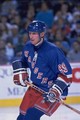 Last week we were talking about metaphors used in organisations and how they affect they way people think, and act. One popped up which got me thinking. I’d heard it before, in fact I’d heard many times—this Fast Company article has a great dig at consultant’s over-use of the phrase. Attributed to ice hockey great, Wayne Gretzky, who apparently said:
“I skate to where the puck is going to be, not where it has been.”
There is an underlying assumption contained in this quote: we can predict an outcome (where the puck is going to be) based on the detection of weak signals (where the puck is and what is happening at the time). I’ve only seen one ice hockey game (in Boston) so I can’t really comment about ice hockey specifically but I watch and coach a lot of basketball so let’s move the analogy to the basketball court.
When getting yourself free in basketball, say on a fast break, the good player creates a range of possibilities rather than running to a single point where they think the basketball is going to be. They help create a pattern which takes account of the weak signal but creating possibilities which are resilient to a range of outcomes.
I think if organisations take the Gretzky’s quote to heart and think it means they need to be able to predict outcomes, they are setting themselves up for failure. It should also be noted that a player with the skills of Gretzky can create a far greater set of possibilities and a stronger resilience when things don’t go to plan.
I’d like to thank Dave Snowden for helping me see this idea of resilience as a desired outcome of detecting weak signals. Dave, would you like to expand on this idea?

Shawn, author of Putting Stories to Work, is one of the world's leading business storytelling consultants. He helps executive teams find and tell the story of their strategy. When he is not working on strategy communication, Shawn is helping leaders find and tell business stories to engage, to influence and to inspire. Shawn works with Global 1000 companies including Shell, IBM, SAP, Bayer, Microsoft & Danone. Connect with Shawn on:
Comments
Comments are closed.
Well, at least the ice on the hockey rink provides a “level playing surface” 🙂
Do you think the quote might have been the result of an interviewer analytically seeking the secrets of Gretzky’s success, like a focus group seeks ways to control a market or to confirm pre-prepared plans, but may only succeed in hearing what people say, not what they mean?
The quote does have attractive meme-like qualities, perhaps due to the simple language, lacking the complicated multi-syllabic abstraction of most management speak – it could even make a great strap line for those wickedly funny (un)motivational posters. Of course, to use another cliche, “there is no i in team”, and the use of “always”, in the quote, raises more alarm bells, of post event rationalising and, to paraphrase Phil Jackson, not “realising the power of surrendering we over me”. The idea of weak-signals brings to mind information processing, but also stronger links (in social network theory) to Jackson’s use of the triangle offense – we can see the puck/ball, but the changing space between the fast moving players can instill confusion, through information overload, too much complexity for an individual opponent to absorb. And Weick talks of “when events don’t play by the rules”, which captures it well.
Jackson’s Sacred Hoops book, describing his time at the Bulls, was a good read: do you know what happened when he went to the Lakers, or if the follow up book is as good?
P.S. There was some aussie rules on the box tonight – wow, they even measure the outcome of multiple players following the same strategy (ball following), it seems to be reflected in the match statistics – which listed “significant injuries” (e.g. punctured lungs, collarbones, broken legs etc.). Ouch! Easy to see why hockey has protective padding to guard against the effects of competitors arriving at the same point in space and time :o)
Hockey as always seemed to me a form of organised thuggery in which I can never see the puck anyway! However I think you have it right. Its not about predicting where the puck will be, its abouting positioning yourself to cover possibilities. So sensing weak signals of a likely action (which in effect is havingmore patterns in your brain) will make the system more resilient. Older players as they loose speed can still compete as they have more savvy (patterns) so they can often be in the right place without really knowing why, whereas younger players rely on speed.
If we take a real game – Rugby (and I mean Union not heritic games involving 13 players) then a good team will be able to pass a ball into space, knowing that someone will be there to pick it up ….
Gretzky’s qoute sounds like an application of John Boyds “OODA loop” theory.
In a nutshell, Action (going to the puck or where it will be) comes from a decision cycle called Observation where an individual observes the many aspects of his and his enemies immediate environment, Orients himself to it and makes an intuitive Decision based on his observations and Acts on it. Observe, Orient, Decide, Act. Whoever moves through this cycle quickest wins.
I think Gretzky’s qoute illustrates the fact that whomever Observes, Orients, Decides and Acts with the best intuitive feel of a subject/sport/market will be succesfull more often than not. Gretzky won a LOT of hockey games with finesse and quickness of foot and mind. In a league where thuggery and defensive play was the norm.
Gretzky’s quote, “I skate to where the puck is going to be, not to where it has been.” is a quote that refers how he studied the game when he was growing up as a kid. His father, Walter Gretzky, used to make Wayne draw a picture of a rink on a sheet of paper and follow the puck with a pen on that sheet of paper with the rink on it. After every period he’d look at the sheet of paper to see what areas of the rink were the darkest. This is what he refers to when he talks about being able to “predict” where the puck is going to go next.
John, Gretzky played in a league where thuggery was pretty normal, but defense was nowhere to be seen at that time. Even the defensemen were more offensively minded. Defensive play in the 80’s and early 90’s, Gretzky’s best years, was not nearly as refined as today’s edition of the league.
The commentary misses the point that hockey is played in a rink with boards. Seeing one game would have perhaps not been enough to recognize this. As a result, hokcey is not at all like basketball.
The comment comes from an exercise that Gretzky’s father used to do, shooting the puck along the boards from the right hand side. Some players would natutrally head to where the puck was (on the right side boards, say) while Walter insisted that Wayne “go to where the puck would be” — to the left of the net. That way, he got to the puck first and could set up another player. Gretzky’s greatest talent was as a playmaker – he had 1963 assists along with his 894 goals.
As a young boy, his father had him draw the flight of the puck around the rink while watching hockey on TV. This gave him a greater sense of “where the puck would go.”
This ability to predict within the confines of what is predictable (the limits caused by the boards) is highly appropriate in terms of decision-making and outcomes.
Gretzky’s advice applies better to hockey than to basketball. I suggest you watch more of the game.
often in hockey (like other sports) when you get “open” it forces you teammate to get the puck to you. He was just stating that went to the holes and as a result the puck came to him. Rather than going to where the puck already was he created oppotunites and helped shape the play.
The expression does apply to life though. Many great observations already made here.
If you’ve coached basketball you should also know that a post in a lot of offenses can gain advantages by not “chasing” the ball from block to block. He observes the situation, understand where the ball is going, and might just get a great seal because he pre-positioned himself.
In business this could easily be adaptable. Instead of chasing every trend, current focus, and thinking inside the box — you can stick to your principles, think outside the box, and use some foresight and thinking — you might just be where the puck is going.