« March 2006 | Main | May 2006 »
Improved whitepaper availability on the Anecdote site
Filed in .
James Farmer and James Robertson both suggested we ditch our requirement to enter your details in order to download our whitepapers. We had been thinking about this for a few months and have now made the changes to our website so you can go directly to a list of whitepapers and articles and download the pdf.
Here is the whitepapers page.
Over time we will include a full html version of the paper as well. I’ve done one today here and look out for the others over the next few weeks.
If you want early notification for new whitepapers just sign up for the Anecdote newsletter. We have a policy of making new whitepapers available to our subscribers for a week before posting them to the website for general access.
All feedback is welcomed as we want to incrementally improve our site. Thanks to James and James for acting as a trigger to this improvement.
Permalink | Comments (1) | TrackBack
Weaving Together Online and Face-To-Face Learning
Filed in Communities of practice.
John Smith and Beverly Trayner have written an interesting and useful paper describing how community coordinators can use a combination of online technology and face-to-face meetings to enhance learning. In particular their designs for ramping-up discussions online in preparation for face-to-face meeting and then ramp-down online, shows how we better integrate the virtual with the real.
Permalink | Comments (0) | TrackBack
Phase changes in social systems
Filed in .
You may have heard of the Forming-Storming-Norming-Performing metaphor for team development. This metaphor provides a lens by which you can view a groups evolution through the initial ‘forming’ right through to when teams are ‘performing’. Just as water, when boiled, goes through a phase change from liquid to gas, social systems also go through phase changes. It seems to me that a phase change for a group or teams’ evolution would be the moving from ‘storming’ to ‘norming’. Another kind of phase change might be the awareness and perception of ‘insiders’ versus ‘outsiders’ in a developing community of practice.
Network theory provides interesting insight into phase changes. In this tiny application (3.2M) called ‘Connectivity Avalanche’ you can see a demonstration of how a collection of nodes, getting randomly connected at each step goes through sudden, unpredictable phase changes characterised by what is known as a connectivity avalanche. That is, there are periods when the whole system remains fairly unconnected, and then suddenly the system will undergo a phase change and go from low connectivity to high – in this example around 5% to over 60%. You can see repeated avalanches as the system keeps unfolding.
When it comes to thinking about phase changes in social systems, I wonder what some other kinds of phase changes might be?
Permalink | Comments (3) | TrackBack
8 ways to avoid complexity
Filed in Fun.
- Do not do business
- Reduce your activities to zero
- Don't leave the house
- Don't call
- Don't talk to anybody
- Stay in bed
- Close your eyes
- Stop breathing
This list comes from a German business magazine which devoted an issue to complexity in business. You will need to be competent in German to read the articles but Walter Baets provides a short summary.
Thanks to Walter Baets for the links.
Permalink | Comments (0) | TrackBack
Evaluating the soft stuff
Filed in .
Decision-makers are under increasing pressure to justify their decisions and then account for their success (or otherwise) to a variety of stakeholders. Evidence-based management (1) is further increasing this pressure. While we know intuition plays a significant role in decision-making (2-4), large decisions (Will we merge and how? How will we change our culture?) will require thoughtful deliberation as well as experimentation. A conundrum emerges, however, when dealing with programs designed to change behaviours: how do we know that the program of activities is responsible for the change?
Initiatives designed to change behaviour are notoriously difficult to assess using traditional techniques. Let's take a learning initiative called After Action Reviews (AAR) as an example. This intervention is designed to create knowledge and new behaviours through personal and group reflection. A group is facilitated to answer and discuss 3 questions in relation to a current or recently completed project: What was supposed to happen? What happened? What accounts for the difference?
Once a program of after action reviews is in place, is it the AARs or something else creating new knowledge? This knowledge, the argument goes, should create new behaviours. But it is the knowledge gained from the AAR, or something else, creating the behaviours? Finally these new behaviours should impact organisational outcomes. Again, are the new behaviours creating the impact or something else? There are two many causal links in this complex system to know for sure (5).
Assessing hard facts alone is insufficient in helping stakeholders appreciate the impact of a program designed to change behaviours. Qualitative perspectives are essential. The need for a balance to hard facts is heightened by the increasing number and variety of stakeholders involved, each one having their own criteria and needs. A new method of evaluation was required and its development occurred in the most unlikely place.
In 1994 Rick Davies was faced with the job of assessing the impact of an aid project on 16,500 people in the Rajshahi zone of western of Bangladesh (6). The idea of getting everyone to agree on a set of indicators was quickly dismissed as there was just too much diversity and conflicting views. Instead Rick devised an evaluation method which relied on people retelling their stories of significant change they had witnessed as a result of the project. Furthermore, the storytellers explained why they thought their story was significant.
If Rick had left it there the project would have had a nice collection of stories but the key stakeholders' appreciation for the impact the project would have been minimal. Rick needed to engage the stakeholders, primarily the region's decision-makers and the ultimate project funders, in a process that would help them see (and maybe even feel) the change. His solution was to get groups of people at different levels of the project's hierarchy to select the stories which they thought was most significant and explain why they made that selection.
Each of the 4 project offices collected a number of stories and were asked to submit one story in each of the four areas of interest to the head office in Dhaka. The Dhaka head office staff then selected one story from the 16 submitted. The selected stories and reasons for selection were communicated back to the level below and the original storytellers. Over time the stakeholders began to understand the impact they were having and the project's beneficiaries began to understand what the stakeholders believed was important. People were learning from each other. The approach, called Most Significant Change, systematically developed an intuitive understanding of the project's impact that could be communicated in conjunction with the hard facts.
Rick's method was highly successful: participation in the project increased; the assumptions and world views surfaced, helping in one case resolve an intra-family conflict over contraceptive use; the stories were extensively used in publications, educational material and videos; and, the positive changes where identified and reinforced.
To date the application of Most Significant Change has been mostly confined to NGO programs and other not for profit organisations. But this is changing. Corporations are also recognising that issues such as culture change, communities of practice, learning initiatives generally and leadership development could benefit from an MSC approach. Anecdote is currently assisting one large IT and consulting company implement MSC to evaluate the impact of its culture change program.
Jessica Dart (an Anecdote Associate) and Rick Davies have published the technique in the prestigious American Journal of Evaluation (7) and have made a guide freely available to anyone interested in implementing the technique. Anecdote and Jess Dart have teamed up to provide support services to corporations and public sector agencies to help them get the most out of Most Significant Change.
References
1. Pfeffer, J.; Sutton, R. I. Hard Facts: Dangerous Half-thruths & Total Nonsense: Profiting from Evidence-based Management. Harvard Business School Press: Boston, MA, 2006.
2. Gladwell, M. Blink: The Power of Thinking Without Thinking. Little, Brown & Company: New York, 2005.
3. Klein, G. Intuition at Work. Currency Doubleday: New York, 2003.
4. Gigerenzer, G.; Todd, P. M.; ABC Research Group. Simple Heuristics That Make Us Smart. Oxford University Press: Oxford, UK, 1999.
5. Dixon, N. The Organizational Learning Cycle: How We Can Learn Collectively. Gower Publishing Company, 1999.
6. Davies, R. An evolutionary approach to facilitating organisational learning: An experiment by the Christian Commission for Development in Bangladesh. Centre for Development Studies: Swansea. UK, 1996.
7. Dart, J.; Davies, R. A Dialogical, Story-Based Evaluation Tool: The Most Significant Change Technique. The American Journal of Evaluation 2003, 24, 137.
Would you like to streamline how you do Most Significant Change? Check out zahmoo.
Permalink | Comments (1) | TrackBack
Complex adaptive system—driving in India
Filed in Fun.
From YouTube. Driving in India. Mesmerizing!
Permalink | Comments (3) | TrackBack
Jajah may be more useful than Skype
Filed in .
I discovered today that Daniel Pink writes a column for Yahoo Finance discussing trends. In his latest piece he suggests water will be more valuable than oil, that Do It Yourself is really taking off, and Jajah is a new voice over IP service which utilises your desk phone with really cheap rates.
Jajah works as follows. Register on the site, then type in the number of your land line or mobile phone. When you want to make a call, pull up the site, and type the number you want to call. A few seconds later, your phone rings. Pick up your phone, the phone you're calling then rings -- and your call is connected. That's it. No need to strap on a Time magazine operator headset or shout into your laptop's mini-microphone.
Jajah is really worth a look.
Permalink | Comments (0) | TrackBack
The problem with Wayne Gretzky's puck advice
Filed in .
Last week we were talking about metaphors used in organisations and how they affect they way people think, and act. One popped up which got me thinking. I’d heard it before, in fact I’d heard many times—this Fast Company article has a great dig at consultant’s over-use of the phrase. Attributed to ice hockey great, Wayne Gretzky, who apparently said:
“I skate to where the puck is going to be, not where it has been.”
There is an underlying assumption contained in this quote: we can predict an outcome (where the puck is going to be) based on the detection of weak signals (where the puck is and what is happening at the time). I’ve only seen one ice hockey game (in Boston) so I can’t really comment about ice hockey specifically but I watch and coach a lot of basketball so let’s move the analogy to the basketball court.
When getting yourself free in basketball, say on a fast break, the good player creates a range of possibilities rather than running to a single point where they think the basketball is going to be. They help create a pattern which takes account of the weak signal but creating possibilities which are resilient to a range of outcomes.
I think if organisations take the Gretzky’s quote to heart and think it means they need to be able to predict outcomes, they are setting themselves up for failure. It should also be noted that a player with the skills of Gretzky can create a far greater set of possibilities and a stronger resilience when things don’t go to plan.
I’d like to thank Dave Snowden for helping me see this idea of resilience as a desired outcome of detecting weak signals. Dave, would you like to expand on this idea?
Permalink | Comments (7) | TrackBack
The relationship between projects and communities of practice—redux
Filed in Communities of practice.
Mark and I thoroughly enjoyed ourselves over the last couple of days delivering our communities of practice workshops. The discussions were excellent. Thanks to all the participants.
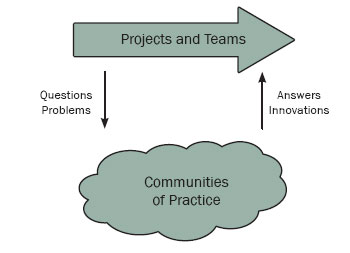
One conversation led me to rethink how to conceptualise the relationship between projects and CoPs. In many organisations projects are the lifeblood. It’s how things get done. These projects consist of teams striving to kick goals and hit targets. Communities of practice, on the other hand, are designed for learning and improving the capabilities of their members. While they might have a stated mission their trajectory evolves rather than being predefined. I used to draw these two entities as an arrow and cloud.

Projects often pose questions to the communities and practice. The adept community of practice is aware of the projects it can assist and pro-actively provides answers and ideas.
The problem with this combination of metaphors (arrow and cloud) is it reinforces the stereotype that communities of practice are fluffy, ethereal, add-ons which are only exist to serve the real business of the organisation—the projects.
Here is an alternative depiction where the community of practice acts as the solid core supporting the project’s activities. The back and forth interaction between the community and the project remains but the message changes to one where the community is a solid and real foundation to how things get done around here.

I would love to hear of other ways to represent these ideas.
Permalink | Comments (8) | TrackBack
Welcome to the blogosphere - Straits Knowledge
Filed in .
Patrick, Edgar and Paolina over at Straits Knowledge (in Singapore) has just started a blog (Green Chameleon) and it will be one of my must reads. Check it out and subscribe to the RSS. You’ll thank me.
Permalink | Comments (1) | TrackBack
Facilitation for engineers and scientists
Filed in Communities of practice.
It’s interesting how I’ve found myself drawn into discussion lately around the difficulties of facilitating engineers and scientists. If facilitating engineers and scientists is difficult, imagine then, the challenge of how to educate, train and inform engineers and scientists on ‘how to be more facilitative’. With many organisations now developing communities of practice to meet strategic knowledge management objectives such demands on scientific and engineering staff may be more common than you think. Given that ‘being facilitative’ is one of the requirements for successfully nurturing and developing communities of practice, how does one go about about being facilitative?
Of course, nothing is impossible. Scientists and engineers are at a disadvantage though. The big disadvantage I see is that scientists and engineers often live in fear of (publicly) asking stupid questions. When you have spent most of your life training to be ‘a problem solver’ or to ‘have the answer’ some light is shed on the problem of being facilitative. Being facilitative requires one to often ask what appears to be stupid questions, maybe even naive questions. At least I think so. If you’ve spent alot of your time, training and effort, being the one to answer questions, how hard is it going to be for you to ask “what do others think?”.
I think that being facilitative requires one to be happy with not knowing and yet maintain the desire to know. For group sensemaking this is a critical insight. If the facilitator is willing to live with the uncertainty of not knowing, which by the way is where you will find yourself spending alot of time as a facilitator, the group will find itself getting to better outcomes. Being happy with not knowing yet maintaining the desire to know sets up a great precondition for sensemaking. Dissonance. For a scientist and engineer who might presume to know, the possibility for group sensemaking immediately starts to close down.
As we have been finding from our reflective practice on language in facilitation, language is something which emerges from a mindset and there definitely appears to be a mindset which goes along with ‘being facilitative’. I’ve blogged before about what I think are foundational elements for facilitation, many of these reflect this mindset element.
Facilitation is more than just finding some great processes like you might at the citizen science toolbox and applying them. Though this is a great place to start. Facilitation is something you have to get your hands dirty with to learn. Action learning if you will. Once you start you will soon learn the power of empathy, asking stupid questions and laughing at yourself along the way.
Permalink | Comments (5) | TrackBack
New whitepaper - how to talk about knowledge management
Filed in Knowledge.
For years we have been listening to presentations, reading articles and working with organisations in the KM field and probably the only consistent theme is the lack of agreement as to what KM is. The lack of a consistent way to talk about knowledge management effectively disempowers us from taking concerted action. It makes competitors of those who need to work together to make organisations more effective and attractive. We see far too much time and effort spent to-ing and fro-ing over what KM is and not enough in doing good things. For these reasons, we have written our latest whitepaper to provide our thoughts on how to talk about KM building on our experiences and on the lessons of those who have most influenced our journey. We hope you find it useful in developing your thoughts on how to talk about KM in your organisations.
Permalink | Comments (0) | TrackBack
The role of stories in reasoning
Filed in .
If you are unsure of the power of narratives read the restorative justice story in Malcolm Gladwell’s latest New Yorker piece. The article introduces some work by sociologist Charles Tilley who argues that there are 4 types of reasoning:
- conventions (social formulae—”honey, we need to talk”),
- stories (common sense narratives—what we deal with at Anecdote),
- codes (legal formulae—I didn’t quite understand this one) and
- technical accounts (specialised stories—e.g. business process re-engineering).
Gladwell expands on his article in a short blog post.
The clear message for me is the utmost importance of context and how stories provide relevant context for a reason to make sense.
Permalink | Comments (1) | TrackBack
Connecting People: How to Foster and Harness Your Organisation’s Connectors
Filed in .
I wrote this article with Stewart Forsyth from FX Consultants. Stewart and I have done a few projects together in New Zealand and it is always a pleasure working with him.
=======
While passers-by see the granite and glass of high-rise buildings, well-connected people think of the organisations within as collections of interesting people they want to meet. Mention a business and these ‘connectors’ will spill out the names of key informants and decision-makers. Connectors know lots of people.
One of us worked once with a business developer who, no matter what south-east Asian city he was in, always had names and contact details of locals in his PDA. According to legend, he was once arrested and thrown into a cell for not having the appropriate visa, but he was out within hours—he wangled a call to a mate who had the right connections. Connectors have the happy knack of getting things done, often making it look so easy in the process.
Connectors such as these are the human circuit-makers through which ideas, opportunities and resources flow. They ensure that the products proposed by R&D teams can be made economically and will sell. They help their organisation to spot competitor activity and environmental shifts that present threats and opportunities to be managed. They pick up even the weak signals. In our view, the informal connections made by your people are more important than the formal channels in getting the job done. The benefits to your business are increased responsiveness and adaptability.
Our emphasis is not only on how these people work. We want to help you mobilise their capabilities, and so your organisation’s capability. Specifically, how do you identify and develop people with connector potential?
Looking at the level of team performance, there is good evidence1 that teams with effective connectors are more productive. Just schmoozing and collecting information is not where it's at. In fact broad environmental scanning can be counter-productive. Two purposeful sorts of connecting make a difference—promoting the team and securing resources, and reinforcing linkages with other groups in the work flow. It is just impossible for the team to know everything, so it is critical that they can find the person who has the requisite knowledge or skills.
Assuming that you want to build the effectiveness of your up-and-coming connectors, to keep your teams and your business plugged into break-through thinking and emerging opportunities, what would you look for?
The behaviours of those who manage to develop networks across and beyond the organisation seem to include2:
- Listening—based on a genuine spirit of inquiry, and including listening for emotional meaning as well as information (a useful question: ‘So what are you working on?’)
- Being prepared to take a stand and being interesting—so that others know what they stand for and want to talk with you
- Cultivating people and, importantly, building reciprocal and collaborative relationships (and a reputation for integrity)
- Having a reputation for making useful introductions, and being authentically helpful without a tit-for-tat mentality
Using social network analysis (or even analysing email traffic, or nominations for 360-degree reviews) could help you identify those who have the mix of both strong (and deep) and weak (but extensive) ties to people in other groups, inside and outside your organisation.
A ‘quick and dirty’ approach (and illustrating what we mean by ‘connectors’) is to identify those people who are likely to be connectors based on their role or some other identifiable characteristic. Here is our first cut of connector categories. Our contention is that these types of people are most likely to be connectors—there are of course others.
- Union reps
- Successful business developers (connectors outside the organisation)
- Personal assistants
- Professional association leaders
- Community of practice leaders
- Good (internal) head-hunters
- People who travel around the organisation
It is useful to pause for a moment to consider the network structures of which connectors form an integral part. As we have suggested, connectors are hubs. For example, in Figure 1 the main connector is Louise. People come to her and she connects to others. Nick is also a connector.

The biggest connectors—the ones with the most connections—by their very nature will attract further connections. This ‘rich get richer’ feature is predominant in social networks. The highly connected will always have an advantage over new entrants. It’s a bit like Microsoft’s DOS operating system: while it wasn’t the best system available, it became popular and so eventually became the de facto standard.
This is not to say that other connectors cannot emerge. If there is a dearth of connectors, new hubs will have space and will help to join up a network. But there is a carrying capacity of connectors in a network and you definitely don’t want a social network full of connectors because it makes the system unstable.
If aspiring connectors offer what other connectors already offer, then they will always remain second and third-order connectors. However, if they can offer something completely new, a better way, a better fit, then they can overtake the established hierarchy of connectors. We’ve seen this happen when Google offered a better way to search and trumped Alta Vista and Yahoo.
There are some similarities between effective connectors and entrepreneurs and leaders. Entrepreneurs, amongst other attributes (such as high need for achievement and resilience), have the ability to create, recognise and shape opportunities. Where do the opportunities come from? They are spotted by the entrepreneurs and then exploited through their networks.
Effective leaders also get results through people. Inspiring, supporting and developing the people in their teams or business groups are their most visible roles. But leaders also have to get resources (including people), develop a positive and relevant vision, and ensure the outputs that their people produce meet a market need. All of these tasks require networks—for obtaining resources, gaining environmental intelligence, and selling products (or meeting the needs of those further along the business process).
While we do not consider that effective connectors will necessarily have the full complement of entrepreneurial or leadership skills, aspiring entrepreneurs or leaders do need to develop the connecting skills that will improve their capabilities.
We think it is also important to highlight another, less positive, similarity—that between connectors and some personality disorders. You may have met some delightful people who were not all they claimed to be. He (males are disproportionately represented in this group) is charming, articulate, plausible, and usually with very good connections—or at least good at dropping the names that indicate he has such connections. It usually takes time before people realise that the appearance is a sham, that if this person delivers at all, it is based on ‘borrowing’ the effort and output of less visible others.
This is a description of an organisational psychopath. While the people who leave a trail of broken promises and unfulfilled hopes in organisations may not be violent, or even fully fit the clinical definition of psychopathy, it is possible for their ‘sub-clinical’ behaviour to be very disruptive and counter-productive.
In promoting the careers of up-and-coming connectors, especially to the point where they represent your business and personify your brand, you need to know that they have an interest in sustaining your business’s reputation as well as achieving their own immediate gratification.
Some development suggestions:
- Include appropriate ‘connecting’ training (including the behaviours described above) in the development plans of your knowledge workers and all those involved in project work.
- Introduce these people to established communities and to well-connected coaches who can model as well as guide the development of these skills.
- As a leader and shaper of your organisation's culture, get in the habit of asking, ‘Who do we need to have on this job?’ You'll ensure that you get the best talent, and also encourage people to think about who are the people with the various talents, both inside and outside the team, group or business.
- Appreciate connecting, and especially its knowledge-sharing and idea-generating benefits, as a performance indicator, but whatever you do, don't make it a target!
Connectors may not bring in the greatest amount of business, but they are building your capability to do the business.
Stewart Forsyth, FX Consultants
Stewart is Director of FX Consultants, an organisational improvement consultancy known for its creative approaches to lifting individual, team and organisational performance http://www.fxc.co.nz
References:
1 Ancona, D. G., and Caldwell, D. F. (1992). ‘Bridging the boundary: External activity and performance in organizational teams’. Administrative Science Quarterly, 37, 634–635.
2 Baker, W. E. (2000). Networking Smart: How to Build Relationships for Personal and Organizational Success. Lincoln, NE:iUniverse.com, Inc.
Permalink | Comments (0) | TrackBack
GAP Forum and increasing links in a social network
Filed in .
I was invited to attend the GAP Forum on Leveraging Networks in Business last week and caught up with some old friends like John Finnigan and Robert Kay. The two days were focussed on getting an interesting group together to work out ways to apply network theory and practice in a business and trade context.
John’s presentation on network theory got me thinking. Particularly the idea of network avalanches—how connectivity in a network progresses in sharp transitions rather than gradually (this feature of a network is what worries people about avian flu). I’m sure Andrew will talk about this phenomena at his seminar about making social network analysis more social, so I wont say more about it here. It did get me thinking about ways we can create new links in a network. Please feel free to suggest others.
- communities of practice
- open space facilitation
- training course cohorts
- out-placements and secondments
- being able to express multiple identities at work (I’ll talk more about this idea in another post)
- membership of clubs
Partly tongue in cheek, Andrew suggested that the person running the social club raffle has a good opportunity to form new social ties. But I think a social tie’s strength (remembering the strength of weak ties) relies on shared experience and perhaps the amount of pain or pleasure you’ve shared. I remember hiking up Pigeon House mountain with 4 guys, 2 or whom I only knew briefly before the walk. We left late, it started raining, the last 100 metres involved climbing up rusted and rickety ladders and we didn’t take any food. Needless to say the walk was miserable but the friendships are enduring.
Westpac's use of Cynefin techniques
Filed in .
As a Cynefin practitioner and a business partner of the Cynefin Centre (soon to be renamed I hear) it is always good to see some descriptions of how the techniques are being used.
Over at Michael J’s Notio there is an interesting post talking about a presentation done by Bruce McKenzie and Robert Kay (Westpac) on the risk management work they are doing at Westpac.
Permalink | Comments (0) | TrackBack
Tapping into the right brain through sensemaking
Filed in .
In January, I described Communities of Practice as ‘the right brain of the organisation’, and Shawn recently posted about the role of sensemaking in creating new knowledge. During the recent international symposium on meaning making in organisations held at the ANU, the group I was working with identified a list of additional approaches that take a sensemaking approach and help organisations tap into their right brain capabilities. I have added to the list since the symposium, and am sure there are many more that can be added:
- Narrative techniques, including story telling, business narrative and Most Significant Change
- SNA sensemaking
- Open Space Technology
- Lessons Learning approaches including concepts such as alternative histories
- Appreciative Inquiry (although is may also be not sensemaking in that the negative is effectively out of scope)
- Clean Space / Socio-Drama
- Prediction / Value Markets
- Complex Systems Model (Ralph Stacey)
- Syntegrity Protocols (Stafford Beer)
- Dialogue (David Bohm)
- Clean language
- Delphi Techniques
- Social dreaming
What other approaches take a sensemaking (rather than analytical) approach and help organisations get more value from their right brains?
Permalink | Comments (0) | TrackBack
Silencing the facilitator - looking at facilitator turn taking
Filed in .
An interesting and thought provoking post by Johnnie Moore on Trust, Control, Power, Silence.
I've been reflecting a lot on the notion of silence in meetings. I've found silences increasingly powerful points in meetings I've been facilitating.
I’ve also been thinking / reflecting on this. You may have seen my last post on building trust in anecdote circles - use silence. To follow this further, I wondered what percentage of “turn-taking” facilitators have for different group processes. A facilitator takes a ‘turn’ whenever they make a spoken utterance in a group. The figure below shows some initial stats I have pulled together based on live transcript data for these facilitated processes.

The initial findings suggest:
- in more traditional group facilitation the facilitator takes a ‘turn’ speaking almost every second go (eg. Facilitator – Participant – Facilitator – Participant …)
- in a small anecdote circle (3–4 people) the facilitator takes a ‘turn’ speaking 3 out of every 10 times
- in a large anecdote circle (8–10 people) the facilitator takes a ‘turn’ speaking approximately 1 in every 10 times
- in open space (averaging it out) the facilitator takes a ‘turn’ approximately 1 in every 25 times
Thinking about empowerment and trust experienced in groups, I wonder whether there might be a trend towards less facilitator turn taking and greater trust and empowerment within groups?
What level of facilitator turn taking do you have?
Permalink | Comments (2) | TrackBack
3 big problems for social network analysis
Filed in .
You’ve probably noticed that Social Network Analysis is experiencing a surge in popularity. As a result many organisations are likely to invest significant time, effort and money only to shelve yet another consultant's report. I suggest that Social Network Analysis needs to move beyond mere analysis and overcome 3 big problems: engendering trust, dispelling the illusion of accuracy, and taming the expert mindset. A sensemaking approach might just be the answer. To read more about our thoughts on this click here, or you might prefer an upcoming seminar.
Permalink | Comments (0) | TrackBack
Modelling Human Ecosystems with Agents
Filed in .
Pascal Perez is running a short course in Canberra I thought you might like to know about. Here are the details:
Modelling Human Ecosystems with Agents
An Intensive Postgraduate Course: June 19 – June 30, 2006.
9.30a.m. - 5.00p.m
Course Convener: Dr Pascal Perez
This course aims to introduce students to the principles and operation of Agent based Modelling in studying Human Ecosystems. It will provide a clear understanding of the possibilities (and limits) of this approach recognising that these human eco-systems are inherently unpredictable, as their global behaviours emerge from their local interactions in complex, interwoven ways. Agent-Based Modelling deals with the problem of complexity and the related search for simple representations of the real world. This course uses real case studies to demonstrate how these models are developed, and in its teaching approach is equally divided between academic lectures, computer demonstration, and hands on training. It is expected that by the end of the course students will be able to develop their own simple computer application to a human ecosystem, and be able to identify future opportunities for integrating them in social science research.
ANTH8021 is a 6 point course provided as part of the MAAPD program, and is offered as an elective for students enrolled in other programs. The course is also available on a non-award basis for students not wishing to enrol in a full University program.
For further information contact:
Prof. Patrick Kilby, MAAPD Coordinator
patrick.kilby@anu.edu.au
Ph 6125 4041.
Permalink | Comments (0) | TrackBack
Making social network analysis more social
Filed in .
There sure is a lot of talk going on about Social Network Analysis. What you probably haven’t heard of however is a Sensemaking approach to Social Network Analysis.
If you’re interested we’d like to invite you to attend a free 2 hour seminar with lunch included! This seminar will be held in the heart of Melbourne's culture capital Brunswick.
In this seminar I will aim to cover:
- Key concepts and common approaches of social network mapping and analysis
- Application areas for social network mapping and analysis
- 3 big problems for current Social Network Analysis
- Towards socializing the analysis through sensemaking approaches
THE DETAILS:
Date: Thursday 27th April
Time: Lunch starts at 12 noon. Meeting adjourned 2pm.
I look forward to seeing you there!
To RSVP and receive location details send me an email: andrew@anecdote.com.au.
Also see our courses page.
(You can find more of our writings on Social Network Analysis here)
Permalink | Comments (0) | TrackBack
Some complexity quotes
Filed in Quotes.
I’m always on the lookout for good quotes. I found these in the forward to Michael Lissack and Johan Roos’ book The Next Common Sense: Mastering complexity through coherence.
"What we observe is not nature itself, but nature exposed to our methods of questioning." Walter Heisenberg
"Our theories determine what we measure." Albert Einstein
"You don't see something until you have the right metaphor to let you perceive it." Thomas Kuhn
My next task is to find out where they came from. Any ideas?
Permalink | Comments (5) | TrackBack
Little things make a big difference
Filed in .
In working with organisations using business narrative, one of the objectives is to identify a suite of interventions intended to move things in the desired direction. Often the interventions appear insignificant, especially to those who didn’t participate; but with complex issues little things can make a big difference.
We supported the Department of Family and Community Services in a narrative project last year to evaluate their provision of research services to client departments. On Friday I chatted with Nerida Hart and Tracey Bicknell from FacS who gave a great example of how one of the interventions identified has significantly affected their business.
The intervention was to call clients a week after providing research services to check if their requirements had been satisfied, and to address situations where clients weren’t quite satisfied but didn’t want to ‘hassle’ them for extra work (a theme identified in the sensemaking workshop). As it turns out, the courtesy call has resulted in lots of follow-on research requests from clients and has made a big step towards achieving the consultancy-style research service FaCS have been trying to establish. This is a great example of how small interventions can make a big difference.
Permalink | Comments (0) | TrackBack
How to get the best out of training
Filed in Knowledge.
David Maister has posted a list of things organisations should do to get the most from their training efforts. Here are two points which I’ve seen make a real difference when people attend our workshops:
- It is usually better to train people in groups formed from the operating units they work in, so that the training can be action- and decision-oriented. (Collective commitments.) Training classes drawn from different parts of the firm force program to be ‘educational’ only. I prefer it when training sessions end with specific action commitments, which are monitorable.
- It really helps if the operating group leader attends the training simultaneously, as a participant. In fact, it should be mandatory. This ensures action-orientation, public commitment (‘We’re going to do this!’) Too often, we send the junior people off to be trained, and they continue to speculate whether the seniors or leaders are really committed and serious about all this. Even if they’ve heard it a million times, it’s good for them to be there. If it’s designed to be action oriented, it’s also economic for them to be there.
For David’s full list, go here.
Permalink | Comments (0) | TrackBack