« February 2006 | Main | April 2006 »

Antidotes to the metaphors we live by

Posted by - 31/03/06
Filed in .

A book that has found its way into my den as a result of our reflective practice on the language of facilitation is Metaphors we live by. It's great.

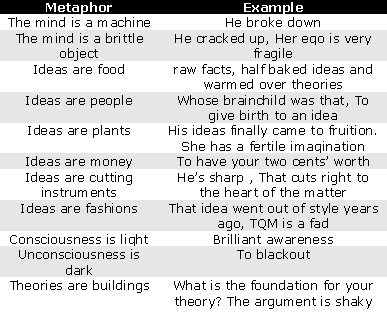
Some examples of metaphors we live by are:

Metaphors

Consider argument is war, As Lakoff explains in Metaphors we live by:

Try to imagine a culture where arguments are not viewed in terms of war, where no one wins or loses, where there is no sense of attacking or defending, gaining or losing ground.

Imagine a culture where argument is dance, the participants are seen as performers, and the goal is to perform in a balanced and aesthetically pleasing way.

In such a culture, people would view arguments differently, experience them differently, carry them out differently, and talk about them differently.

I think you could view argument is dance an antidote to the argument is war metaphor.

Another example is time is money. I wonder how things might be different if an antidote to this, say, time is play, was more prevalent in our society. Maybe that's what the slow movement is about. 

What are some other metaphors you live by?

What are some antidotes?

Send this entry to:  Share on Twitter Share on Facebook    Clip to Evernote   | Email to a friend

Permalink | Comments (2) | TrackBack


Our new courses page

Posted by Shawn Callahan - 31/03/06
Filed in .

Over the last week or so we’ve been working on our Anecdote Courses page on the website. Please take a look and we would love to hear your feedback. I’m sure there are still a few things to iron out.

Send this entry to:  Share on Twitter Share on Facebook    Clip to Evernote   | Email to a friend

Permalink | Comments (0) | TrackBack


Stories, ROI and communities of practice

Posted by Shawn Callahan - 30/03/06
Filed in Communities of practice.

Steve Denning has compiled some of his recent posts on list-servs like com-prac and made the compilation available on his website. He covers the following topics:

  • Is a request for the ROI of COPs legitimate?
  • Is ROI the right measure for CoPs?
  • Do stories support numbers or vice versa?
  • What’s the motive behind asking “what’s the ROI?”
  • Does the ROI help when it comes to the crunch?
  • The problems of the worst CoPs

Send this entry to:  Share on Twitter Share on Facebook    Clip to Evernote   | Email to a friend

Permalink | Comments (0) | TrackBack


Last day for early birds

Posted by Shawn Callahan - 30/03/06
Filed in .

Just a reminder that tomorrow is the last day for the early bird price for Starting and Sustaining Communities of Practice workshop. Either fax your registration form or give me a call.

Send this entry to:  Share on Twitter Share on Facebook    Clip to Evernote   | Email to a friend

Permalink | Comments (0) | TrackBack


Data, Information, Knowledge: a sensemaking perspective
Posted by Shawn Callahan - 30/03/06
Filed in Knowledge.

The relationship among data, information and knowledge is often depicted as a pyramid. With data at the base, it’s converted to information and information converted to knowledge. This metaphor of a pyramid or ladder to explain these concepts is unhelpful because you start to believe one is better than the other and there is a tendency to extrapolate to the next level believing that knowledge is simply extrapolated to form wisdom—I have even heard people talk about wisdom management. My two days at the meaning making symposium has helped me see this relationship differently, that is, viewing data, information and knowledge as a system.

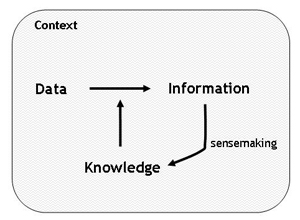
Thanks to John Barton at the symposium reminding me of a view of data, information and knowledge first brought to my attention by Dave Snowden which I will extend to include the role of sensemaking and context.

DIK-Diagram

Knowledge acts as an interpretant to turn data into information. The information we notice (we don’t notice all information channelled toward us), might create some level of dissonance (its surprises us or we ask ourselves, “What’s the story here?”) and if we care about resolving this dissonance we create knowledge. Knowledge is created through a sensemaking process.

But data to one person is someone else’s information. A commodities trader might stare at a computer screen of numbers which would look to most people as raw data. To the commodity trader, however, slight changes in the numbers conveys messages which act as information they might convert to knowledge (via sensemaking) and take action. Consequently, context is a key ingredient acting as an underlay to all three concepts of data, information and knowledge.

Send this entry to:  Share on Twitter Share on Facebook    Clip to Evernote   | Email to a friend

Permalink | Comments (10) | TrackBack


The 1st Annual Symposium on Meaning Making in Organisations

Posted by Shawn Callahan - 30/03/06
Filed in .

Mark, Andrew and I spent Monday and Tuesday at the Australian National University’s Symposium on Meaning Making in Organisations. The event was organised by Paul Atkins and Jennifer Garvey Berger and was a tremendous success—for one thing there were no presentations, only discussions. This event will be run again in September in Washington DC.

Many ideas percolated as a result. I began to understand that sensemaking is triggered by someone noticing something and the level of meaning is related to how much you care about what you’ve noticed; I learned about Robert Keagan’s theories of complexity of mind; we explored the relationship between group and individual sensemaking; I wondered whether the Csikszentmihalyi’s concept of flow was the opposite of sensemaking; sensemaking is knowledge creation; and dissonance seamed to be a characteristic of sensemaking.

Bob Dick made the following remark which seems to me as the essence of sensemaking: “I do my most creative things when I’m desperate and in action.”

Send this entry to:  Share on Twitter Share on Facebook    Clip to Evernote   | Email to a friend

Permalink | Comments (0) | TrackBack


Lessons from MySpace on getting communities established

Posted by Shawn Callahan - 25/03/06
Filed in Communities of practice.

Aber Whitcomb, CTO for MySpace, revealed to Robert Scoble some of the secrets behind MySpace’s popularity. They sound similar to the advise one might give to anyone starting a community of practice.

  • They made sure influentials in Hollywood (stars, bands) were among the first users.
  • They listen to their users and add features frequently (usually noticeable new features every week).
  • They let the users tell them what to do. He mentioned that other services, like Friendster, tried to tell their users what not to do.
  • When MySpace visitors first log on they already had a friend: the founder Tom. That was in contrast to other services where you had to work to find your first friend. His page also gave you a template to get started.

Send this entry to:  Share on Twitter Share on Facebook    Clip to Evernote   | Email to a friend

Permalink | Comments (0) | TrackBack


How social indicators influence our choices

Posted by Shawn Callahan - 22/03/06
Filed in .

Just a few weeks ago I was wondering, “What’s Duncan Watts up to these days?”  Duncan wrote a terrific book called Six Degrees and re-investigated Stanley Milgram’s famous six degrees of separation phenomena using a web-based experiment.  Well, it seems like Duncan is at the Sante Fe Institute, the bastion of mathematical  complexity research.

Watts has resurfaced (on my radar anyway) and written a paper with Matthew Salganik and Peter Dodds reporting on a recent experiment to test the effect of social influence on cultural markets. Their ingenious experiment involved building a mini-itunes where people could only download 48 songs. Some of the 14,000+ participants could rate the tune (5 star system) and see the ratings of others. A second group were denied any indicators of others selections. 

Here are the key points as I understood them:

  • social indicators have an enormous influence on the outcome
  • social indicators make the result far more unpredictable
  • the rich get richer and the poor get poorer—popular songs become very popular and vice versa
  • a good quality song never ends up on the bottom of the pile but impossible to predict whether it will be at the top and by how much

Here is a quote:

We conjecture, therefore, that experts fail to predict success not because they are incompetent judges or misinformed about the preferences of others, but because when individual decisions are subject to social influence, markets do not simply aggregate pre-existing individual preferences. In such a world, there are inherent limits on the predictability of outcomes, irrespective of how much skill or information one has.

It’s a scientific paper so a little heavy going but it’s short and definitely worth a read if you are interested in how networks operate, how crowds respond and wish to further your understanding of complex systems.

Send this entry to:  Share on Twitter Share on Facebook    Clip to Evernote   | Email to a friend

Permalink | Comments (1) | TrackBack


Cartoon caption contest

Posted by Shawn Callahan - 19/03/06
Filed in Fun.

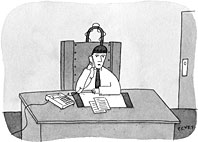
The New Yorker is having its yearly cartoon caption contest. I noticed that anyone outside the US is uninvited so I thought we could have the rest of the world represented here.

So in 25 words or less what caption would you write?

Here’s the cartoon.

Add your captions to the comments. I’ll post the first one.

This is an incredibly good exercise to develop your right-brain aptitudes.

UPDATE: The cartoon has moved so here it is:

060320onca_contest_p198

Send this entry to:  Share on Twitter Share on Facebook    Clip to Evernote   | Email to a friend

Permalink | Comments (11) | TrackBack


Observation: leaving things to the last minute

Posted by Shawn Callahan - 19/03/06
Filed in .

COP_webHave you noticed that people seemed to leave more and more things to the last minute? There are some good reasons for a decision-delaying strategy. If the situation you are facing is uncertain, changing, and their are plenty of options and competing possibilities then one strategy is to just wait and see what happens. The problem of today might very well be a distant memory tomorrow. Technologies like mobile phones support this strategy. Who needs to precisely plan a get together when you can text some friends on the spur of the moment, find out where they are and nominate a rendezvous point there and then. Does this sound uncomfortable? Get used to it because this is the way the world is moving.

A decision you shouldn’t delay, however, is signing up for our communities of practice workshops. The early bird discount is available up until the 31 March. You can download the brochure here.

Send this entry to:  Share on Twitter Share on Facebook    Clip to Evernote   | Email to a friend

Permalink | Comments (0) | TrackBack


Incubating communities of practice thru projects

Posted by Mark Schenk - 17/03/06
Filed in Communities of practice.

ProjectI was reminded last week that projects provide great opportunities to develop communities of practice.  No surprises really, with all that project time and effort spent consulting with stakeholders, reconciling divergent positions and building relationships to effect a meaningful change.

But many opportunities are missed to create communities of practice as part of project or project-like activities - communities that can maintain the project 'domain' once the project is declared complete and the project team dismantled.  Communities of practice provide the cross-organisational structures that can help maintain the changes introduced by the project.  Our organisations undertake many ‘projects’ that develop bodies of 'practice' – often very good ones. The reality however; is that they start dating from the moment they are published and progressively become less accurate and relevant and useful, until someone decides that a new project is needed to revamp the body of practice. 

With a different mindset and a few extra resources, communities of practice can be nurtured as part of the project.  In many cases, these communities can undertake much of the maintenance work need to keep the body of practice up-to-date and useful.  Of course, projects can also be undertaked with the express purpose of building a community of practice.

Kathy Kuryl from the Tasmanian government pointed out a great example of this last week.  The Tasmanian government undertook a project to improve the practice of project management. An impressive and tailored set of resources were developed that have been well received across all Tasmanian government departments. A cross-government community of practice has also been nurtured that plays a a major role in maintaining and improving these resources.  Go to http://www.projectmanagement.tas.gov.au/ to see the results and output of this project.

Send this entry to:  Share on Twitter Share on Facebook    Clip to Evernote   | Email to a friend

Permalink | Comments (0) | TrackBack


Weak signals

Posted by Shawn Callahan - 17/03/06
Filed in .

There is a discussion on ActKM this morning about weak signals and Dave Snowden has relayed some observations he heard from Gary Klein this week which I thought I would share. Four things which are commonly believed yet are untrue about sensemaking:

  1. Sensemaking is basically ‘connecting the dots’ and fitting the pieces of the puzzle together
  2. Sensemaking builds up from data to produce a story
  3. People should avoid premature consideration of a hypothesis
  4. More data leads to better sensemaking (I’ve posted what Karl Weick’s thoughts on this)

Just trawling through my hard disk and del.ico.us and found these things people have said about weak signals:

"… we must regrind our lenses to monitor the periphery, that is, the edges of our business. At these edges lie our richest opportunities for value creation and our strongest protection against value destruction." (Hagel III and Brown 2005: 10)

Roy Greenhalgh, from ActKM, provides the following references:

Weak signals were written about by Ansoff in the mid 1970s, and in 1990.  See Ansoff, Igor H, "Implanting Strategic Management" 2nd edition, 1990 Prentice Hall.

But a more readable paper is by Turo Uskali, which formed  his PhD submission. See Innovation Journalism, Vol 2 No 11 2005 or ISBN 1549-9049. Uskali reviews weak signals from a journalistic viewpoint, and discusses the four main categories of weak signals in his definition: feelings, uncertain signals, almost certain signals and exact signals.

Hagel III, John, and John Seely Brown. 2005. The Only Sustainable Edge: Why Business Strategy Depends on Productive Friction and Dynamic Specialization. Boston: Harvard Business School Press.

Send this entry to:  Share on Twitter Share on Facebook    Clip to Evernote   | Email to a friend

Permalink | Comments (0) | TrackBack


Reflective practice interview with Sandy Schuman

Posted by - 16/03/06
Filed in .

A little while ago I mentioned about a reflective practice we are running on the language of facilitation, specifically open and closed language. Surprisingly we have a group of over 60 people worldwide who are interested in being part of this reflective practice.

As part of this I am taking the opportunity to have skype hookups with those who are participating. This morning I just had a great skype hookup with Sandy Schuman. You can download the audio file here (9.6M, 40 mins).

We covered:

Speaking facilitatively - How can we speak facilitatively
 The phrase - "What do others think"
 You want to say something but invite more thought. As compared to a phrase that would close things down which might be a statement like "what you think".

Group facilitation helps a group tell its story
 The wall of wonder
 Timeline techniques a powerful way to build identity for a group

Improvisation in facilitation
 Group facilitation IS improvisation - there is no script
  "Improvisation takes a lot of practice"
 "Being in the present" & "Having presence of mind" & "Being HOT"
 "Facilitation is not a creative act, it's memory"

Language is a behaviour
 Language that closes things down or retains or creates openness
 Gestures: Hand motions - palms-up, beckoning, palms-down
 Open and Closed facilitation - if your going to acknowledge anybody your going to acknowledge everybody

Opening words
 When and Where as opposed to How and What
 "tell about a time when, tell about a time where"
 When- the event aspect of when
 Where- brings to mind image
 Imagery is evocative

Where is this all going?


I’d love to hear your thoughts…

Send this entry to:  Share on Twitter Share on Facebook    Clip to Evernote   | Email to a friend

Permalink | Comments (1) | TrackBack


David Maister says training is useless

Posted by Shawn Callahan - 16/03/06
Filed in Knowledge.

David has a thought provoking post about why most of the training people take in business is useless. I particularly liked his test of whether a particular workshop or training course is well timed:

If the training were entirely optional and elective, and was only available in a remote village accessible only by a mule, but people still came to the training because they were saying to themselves ‘I have got to learn this – it’s going to be critical for my future’, then, and ONLY then, you will know you have timed your training well. Anything less than that, and you are putting on the training too soon.

Send this entry to:  Share on Twitter Share on Facebook    Clip to Evernote   | Email to a friend

Permalink | Comments (0) | TrackBack


A Whole New Mind by Daniel Pink

Posted by Shawn Callahan - 15/03/06
Filed in Book reviews.

WholeNewMindIf I were to write a book laying out the argument for our Anecdote approaches, I couldn’t be happier if I’d written A Whole New Mind by Daniel Pink. This book makes a simple and powerful case: to thrive in a complex, outsourced and topsy-turvey world people need to augment their rational, linear and analytical thinking (how you got ahead in the information age) with  empathy, creativity, meaning and the ability to sense patterns (required to flourish in the conceptual age).

Pink wants us to increase our skills in 6 areas:

  • design
  • story
  • symphony (ability to see the big picture and integrate)
  • empathy
  • play
  • meaning

You can imagine my excitement when I read this list of what Daniel calls ‘the 6 senses.’

Here is a short article by Pink describing the basic argument of how outsourcing to Asia, the abundance of almost everything and automation are creating an environment where right-brain thinking (the creative, holistic side) increases in importance.

And here are a couple of mind maps describing the book.

But neither sources replace reading the book.

Of course I quickly flipped to the chapter on story and I was pleased with Pink’s reasoning for including story in his list of 6 senses, which includes the observation that facts are so ubiquitous that people need to place these facts in context and deliver them with emotional impact; a role served superbly by stories.

I have, however, one concern with the story chapter. A reader without a background in narrative techniques might believe the only use for narrative is how to craft a persuasive story to affect change. I’ve talked about the difference between storytelling and story listening before, and Pink provides examples of story listening, such as the use of narrative medicine. But these ‘listening’ example follow compelling stories of Robert McKee’s script writing workshops and Steve Denning’s World Bank storytelling examples. 

And because it’s a best seller you should be able to find a copy at your local bookstore. Or if you are like me, just pick one up at the airport newsagent.

Send this entry to:  Share on Twitter Share on Facebook    Clip to Evernote   | Email to a friend

Permalink | Comments (0) | TrackBack


The data entry rat

Posted by Shawn Callahan - 12/03/06
Filed in Fun.

RatDataEntry

My old friend David Pope drew this cartoon (and 2 others) for a paper we wrote in the mid 90s. I still get a chuckle out of it. Some of our “let’s capture all knowledge and put it in databases” friends should take a look at this one!

Send this entry to:  Share on Twitter Share on Facebook    Clip to Evernote   | Email to a friend

Permalink | Comments (0) | TrackBack


Sharing the seeds

Posted by Shawn Callahan - 11/03/06
Filed in Anecdotes.

2005-winner-2In October for the past 36 years Half Moon Bay in California holds a pumpkin competition. The biggest pumpkin grown in a season wins. One winner, upon accepting the prize, gave a handful of his winning pumpkin seeds to his neighbours. When asked why he would give such a marvellous advantage to next year’s competitors he said, “pumpkins grow by cross-pollination and if everyone around me was growing healthy and large pumpkins, I have a higher chance of growing healthy and large pumpkins.”

Send this entry to:  Share on Twitter Share on Facebook    Clip to Evernote   | Email to a friend

Permalink | Comments (0) | TrackBack


Building trust in anecdote circles - Use silence

Posted by - 10/03/06
Filed in .

To follow on from Shawn’s post on building trust and rapport in anecdote circles there is one key element which I think is often overlooked. Silence. I have blogged before about the power of silence, however it is the silence of the facilitator which I want to emphasise in this post.

In todays environment of facilitation, there seems to be an emphasis, maybe even an expectation on the facilitator leading the group, keeping a high profile and always having something to say. I think of this as the control mode of facilitation.

Facilitating anecdote circles is different. The facilitator takes a very low profile, letting the group evolve and emerge with its own dynamics and content. I have found that by using the words like “exploring themes” rather than “I have some questions for you to answer” is a kind of open language which allows for the spirit of group empowerment to emerge.

Reducing eye contact with those sharing their stories, yet respecting and listening is another way the facilitator takes a low profile. The final one is the use of silence. One side of this is helping a group feel comfortable with silences. The other is, as a facilitator, how do you keep silent? Especially in the west with our predominance of the ‘thinking mind’ it is very easy for us to get enticed into the ‘why’s’ of a conversation and want to ‘interject’. However, in an anecdote circle that is not the facilitators role. Their role is to provide a safe and comfortable environment for participants to share their stories.

We are currently collecting and processing data from evaluations of our anecdote circles and  it appears that this approach of ‘safe silence’ appears to help groups experience trust and deep sharing within a group.

What is your experience of silence in group situations?

Send this entry to:  Share on Twitter Share on Facebook    Clip to Evernote   | Email to a friend

Permalink | Comments (2) | TrackBack


Connector heuristics

Posted by Shawn Callahan - 10/03/06
Filed in .

Malcolm Gladwell’s post on a quick and dirty way of picking winning NBA Knicks teams got me thinking about other helpful heuristics. In particular I was asked by a client how they might identify the connectors in their large (10,000+ people) organisation. Sure, you could attempt a social network analysis, perhaps analyse email traffic, but both approaches are time consuming and don’t really fit my ‘quick & dirty’ concept.

Stewart Forsyth and I were talking about this idea yesterday and we hit on the thought of simply identifying those people who are likely to connectors based on their role or some other identifiable characteristic. Here is our first cut of connector categories. Our contention is that these types of people are most likely connectors—can you think of others?.

  • Union reps
  • Successful business development (connectors outside the organisation)
  • Personal assistants
  • Professional association leaders
  • Community of practice leaders
  • People who travel around the organisation (high travel costs)

We discover heuristics during knowledge mapping exercises and each time it’s a key breakthrough for our client. It’s important, therefore, we make more of finding and applying heuristics. To get a good feel for this area I recommend you start by reading Blink, then have a look at Gary Klein’s Sources of Power. Gladwell references this paper and while I haven’t read it I have a copy of Simple Heuristics That Make Us Smart which features the same author.

Send this entry to:  Share on Twitter Share on Facebook    Clip to Evernote   | Email to a friend

Permalink | Comments (0) | TrackBack


Starting and Sustaining Communities of Practice - New Workshop

Posted by Shawn Callahan - 9/03/06
Filed in .

COP_webWe are excited to announce our new Starting and Sustaining Communities of Practice workshop. We will run it in Melbourne and Canberra on the 19th and 20th of April respectively. Mark and I will be your facilitators and we look forward to meeting you.

Here is the brochure describing the workshop with the form for registration.

Send this entry to:  Share on Twitter Share on Facebook    Clip to Evernote   | Email to a friend

Permalink | Comments (0) | TrackBack


Giving feedback

Posted by - 9/03/06
Filed in .

I’ve recently been hearing some difficulties expressed around people giving feedback in organisations. I’ve heard words used like “constructive criticism”, “constructive feedback” and “positive feedback”. The question remains, how do you give helpful feedback?

One of the best things I have learnt from participating in Toastmasters is how to evaluate someones performance, and, give feedback.

In toastmasters, everything is evaluated, even the evaluators. The aim is to improve and learn on every activity that one undertakes. Now this might seem daunting. There you are getting up to face maybe your greatest fear and just to make it even worse you will be evaluated!

Toastmasters however have a recipe for evaluation which, I think, really works. The recipe is simple: “Praise – Recommendation – Praise”. The recipe is to provide the recommendation wrapped in praise. You might ask, but what if there is no praise? My answer: I’d suggest you need to take another look at the situation and your perspective and ask yourself whether you really are being helpful because there is always something to praise! It could be something really existential like: Thanks for being here. Thanks for being on time…

How to give good feedback? I think you can’t go to far wrong with “Praise – Recommendation – Praise”. Try it, see whether you think it makes a difference.

Send this entry to:  Share on Twitter Share on Facebook    Clip to Evernote   | Email to a friend

Permalink | Comments (1) | TrackBack


Thoughts from Karl-Erik

Posted by Mark Schenk - 9/03/06
Filed in Knowledge.

Karl-Erik Sveiby was one of the keynote speakers at the KM for Professional Services conference in Sydney last week.  Sveiby book
I was fortunate to have dinner with him on the night before his presentation and hear about his soon-to-be-released book ‘Treading Lightly – Revealing the Hidden Wisdom of the World’s Oldest People”.  Karl-Erik lived in Australia (well, OK, it was Queensland) for about 10 years and the book relates to research with an Aboriginal group in North-Western New South Wales. The book will be released in the next few weeks.

In his keynote presentation the next morning, Karl-Eric had a simple graphic that displayed how organisational priorities can be out of whack with reality.  He listed the following five points as being, in descending order, the things offering the highest ‘value potential’ in KM:

1.    Align KM with business strategy – a knowledge-based strategy
2.    Improve climate for knowledge creation and sharing – collaborative climate
3.    Improve knowledge sharing with clients
4.    Invest in internet-based communication
5.    Build organisation for content management (on-line library, databases)

His slide then changed to show where the most money was spent in KM.  And you guessed it…. it is the exact opposite from the list above. So most money is spent on item 5, and least money on item 1.  These thoughts are well worth bearing in mind when developing your organisation’s knowledge strategy and funding proposals for KM initiatives.  As Kate Andrews  said several years ago: “spend first on beer and travel, then on technology”.

Send this entry to:  Share on Twitter Share on Facebook    Clip to Evernote   | Email to a friend

Permalink | Comments (1) | TrackBack


Andrew, Shawn & Mark

Posted by Shawn Callahan - 8/03/06
Filed in .


Andrew, Shawn & Mark
Originally uploaded by Shawn Callahan.


Just trying out how you can post to your blog from Flickr. This photo is of Andrew, me and Mark on nearly the first day we started Anecdote mark II. Not the best photo in the world. I took it with my Palm Treo.

Send this entry to:  Share on Twitter Share on Facebook    Clip to Evernote   | Email to a friend

Permalink | Comments (1) | TrackBack


Building trust and rapport in Anecdote circles

Posted by Shawn Callahan - 7/03/06
Filed in .

There are many ingredients which make a successful anecdote circle, but one that eclipses all others is the level of trust that can be fostered between the participants and the facilitator. Building trust is a vital first step and in my experience a great deal of trust building occurs in those 5–10 minutes when everyone is milling around before the session formally starts.

Here are 3 things I keep in mind in order to build trust with anecdote circle participants:

  1. Be friendly and relaxed. It’s important to get the chit chat going before the session. Ask people informal, easy questions such as how long they have worked in the organisation or whether things are busy at the moment. Listen to them and have some fun. Offer them food and drink. Before the session is also a good time answer any burning questions and explain why this approach is being taken. On this point I tell participants we are seeking people’s real-life experiences rather than their opinions because opinions can be easily disregarded but a person’s story is difficult to refute. People take notice of stories.
  2. Be open. Last week I facilitated an anecdote circle and before the session one of the participants asked who else was going to provide their stories. Rather than giving a thumbnail sketch I handed him the list of everyone planning to attend. The group eagerly poured over the names and I sensed that this helped them feel comfortable with the process and help me build rapport. Describing the process for the project is also a useful pre-session topic. In particular letting everyone know that names will be removed from the transcripts and the anecdotes will not be analysed individually.
  3. Dress appropriately. Over my career I have worn suits, business casual and even shorts and thongs (thongs in Australia, by the way, are footwear in case your were wondering). So I feel comfortable in a range of attire. Matching your attire to the organisation is important. For example, lawyers like you to wear suits, government agencies, research organisations and calls centres (a couple of environments I’ve worked in) like you to be in business causal. I’ve yet to find an opportunity for shorts and thongs! I would cause a great deal of suspicion wearing a suit while conducting anecdote circles in a call centre.

Send this entry to:  Share on Twitter Share on Facebook    Clip to Evernote   | Email to a friend

Permalink | Comments (1) | TrackBack


ActKM: the story of a community

Posted by Shawn Callahan - 5/03/06
Filed in Knowledge.

Jkm-coverA paper Trish Milne and I wrote over 12 months ago has just been published in the Journal of Knowledge Management. It’s called ActKM: the story of a community and it reports on a research project that sought to discover the value of the online discussion list to its members; how members manage the postings, the degree of off-list activity generated through the list; and the impact of the list on KM practice.

Of course ActKM has changed considerably over the last 3 months with its disappearance and re-emergence but the characteristics we found seemed to have endured in the new reincarnation of ActKM.

Send this entry to:  Share on Twitter Share on Facebook    Clip to Evernote   | Email to a friend

Permalink | Comments (0) | TrackBack


New web-based collaboration tool

Posted by Shawn Callahan - 4/03/06
Filed in Knowledge.

I’m always on the lookout for better tools for collaboration. foldera looks impressive and while it has only been available on the web for 12 days, and still in beta, they have had 400,000 sign ups. Here are some of the features

  • document management
  • calendar
  • instant messages
  • email
  • task management
  • contact management
  • activity folder to pull it all together

Send this entry to:  Share on Twitter Share on Facebook    Clip to Evernote   | Email to a friend

Permalink | Comments (1) | TrackBack


Comments problem fixed

Posted by Shawn Callahan - 3/03/06
Filed in .

Have you tried to comment lately and was refused saying you content was questionable? Well I was duped by a spamming commenter and accidently blocked all comments that had ‘s’ in the comment. 296 comments blocked!

Anyway, all fixed now and sorry for the inconvenience.

Thanks to Felix and Dorine who were persistent enough to use the contact form to ask for their comment to be posted. Without it I would have never known I was having a problem with comments.

Send this entry to:  Share on Twitter Share on Facebook    Clip to Evernote   | Email to a friend

Permalink | Comments (0) | TrackBack


Social network analysis principles

Posted by Shawn Callahan - 3/03/06
Filed in .

Social Network Analysis is more ‘social’ than ‘analysis.’ It’s true that data is fed into network analysis tools to create interesting charts but the value comes from people interpreting these charts and trying to understand what they mean. Making meaning is a social process and we’ve found in our SNA work that it is important to have some principles to guide SNA activities.

Here are 4 principles we use. Would love to hear of others you think are important.

  1. use SNA for good not evil: the natural tendency when looking at SNA charts is to find your own name, or your group's, and compare it with other people and groups in the organisation. This can quickly lead to comparisons of things like one group having more hubs than another etc. Comparisons like this (from a measurement perspective) are unhelpful and should be avoided. It is better to ask yourself what connections would be healthy and see if they exist or look for structural issues (e.g.. no links between clusters) and then devise ways of helping people get into these structural holes. It's of foremost importance that the SNA never becomes a performance measure (implicitly or explicitly) because this will result in the technique ceasing to be a useful indicator of what's really happening—people will game the survey and fear the results.
  2. don't jump to conclusions: there are many reasons why a link is missing or why a person might not be as big a connector as expected. Rather than jump to conclusions, use the observation to investigate further and seek to understand what is really happening.
  3. engage from the outset those who will interpret the SNA results: people need to be prepared for the type of information they will see and what it can be used for, its limitations and understand their role in the sensemaking process. It’s important to get people who will interpret the charts on board from the beginning.
  4. treat SNA data sensitively: without the background knowledge, such as understanding the role the original question plays in interpreting the results, SNA charts can be misinterpreted. Furthermore when people's names are visible levels of interest increase—and stories begin to be told. SNA data should be viewed as confidential and the charts and their interpretations should remain with those people with an understanding of the technique.

These 4 principles help guide actions and help get the most value from social network analysis. In a more complex world as things become more connected we will need tools like SNA to make sense of what’s happening. If not used well, however, the tool will become sullied in the organisation and become unavailable for future use. The way in which SNA is used at the outset will set in train the culture of how SNA is used in organisation.

Send this entry to:  Share on Twitter Share on Facebook    Clip to Evernote   | Email to a friend

Permalink | Comments (0) | TrackBack


« February 2006 | Main | April 2006 »