anecdote.com.au

« August 2005 | Main | October 2005 »

30/09/05 |

Want to get more things done? Communicate!
By Andrew. Filed in News.

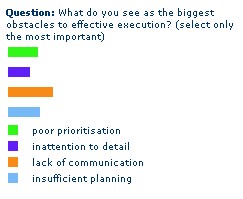
It’s interesting (maybe even common-sensical) that a recent poll on http://www.ceoforum.com.au has found that lack of communication is considered a key obstacle to getting things done.

Ceo survey identifying communication 

Permalink | Comments (0) | TrackBack

28/09/05 |

A powerful intervention: Silence

By Andrew. Filed in Open space.

IMG_1490When I first saw Brian Bainbridge run an Open Space Technology workshop I was impressed most by his use of silence. I know that in public speaking using silence, or pause, is a powerful way to bring the audience together. To really get their attention.

It is not surprising that many people feel uncomfortable with silence within groups, especially if you are the “leader” or “facilitator”. As Catherine Durnell Cramton has written in an article called “Finding common ground in dispersed collaboration”, silence has meant all of the following at one time or another:

  • I agree
  • I strongly disagree
  • I am indifferent
  • I am out of town
  • I don’t know how to address this sensitive issue
  • I am busy with other things
  • I did not notice your question
  • I did not realise that you wanted a response

Recently reading Practical Facilitation I came across the concept of “Bending Space and Time”. Here the author discusses how a storyteller can move the group (or listener) into a different time and space by the use of extremely long pauses.

I feel that the real power of silence, for a leader or facilitator of a group, is to really get a chance to listen to the group. To see what wants to emerge from within the group. Too often the facilitator or group leader is looked to for all the answers when, really, the group just needs time to look within.

Permalink | Comments (0) | TrackBack

27/09/05 |

What would you like to read more of here on our Blog?

By Andrew. Filed in News.

PeoplequestionmarkOne of things which we do alot of at Anecdote is Listen. Shawn has posted previously that story-telling is just half the story. The other half is listening, or as Shawn says “story listening”. 

So, I’d love to listen to you, to your story… to hear what you would like to read more of here on the Anecdote blog.

Please, send me an email: andrew AT anecdote DOT com DOT au 

Permalink | Comments (0) | TrackBack

27/09/05 |

A couple of things I've learnt about interventions

By Shawn. Filed in Complexity, Narrative.

Late last year I described some initial thoughts on what makes an intervention. Here is an excerpt:

We call them ‘interventions’ because they are designed to intervene in the ‘natural’ way of things. They are undertaken to create a ‘disturbance’—thus allowing new patterns to form. This approach is different from a project in which a clear end-result is envisaged from the outset. A project approach assumes an ordered world. In contrast, interventions are small ‘probes’ that are designed to create new possibilities.

Over the last year we’ve helped a range of organisations design interventions. During this time I’ve learnt the following:

  • people have a strong desire to completely solve the issue they’re facing and can easily move from intervention design to project planning. Interventions shouldn’t attempt to solve the issue. Rather, they are designed to head the system in the right direction.
  • interventions are discrete tasks which can be implemented within about three months.
  • interventions are not further research or planning, they involve action

Here are some examples:

  • turning off the blind copy functionality in an email system to send a message about trust
  • providing manager’s with notebooks with the inside cover listing all the things a manager CAN do: what they can spend on whom, what awards they can give etc.
  • stocking the stationary cupboard for mobile employees — a statement about trust

 A set of small interventions can then form a portfolio approach to tackling a complex issue.

Permalink | Comments (0) | TrackBack

27/09/05 |

Brisbane this week

By Shawn. Filed in News.

I’ll be in Brisbane on Thursday this week. If you would like to catch up for a coffee please drop me a line: shawn AT anecdote DOT com DOT au

Permalink | Comments (0) | TrackBack

26/09/05 |

Sick of boring conferences? Maybe creating new stories can help

By Andrew. Filed in .

SherlockHolmesEarlier this year Johnnie Moore put together an interesting podcast on Unconferencing, asking the question of how can we get away from unsatisfying and boring conferences?

I just heard a great story from Rob Thomson a library technician at BlueScopeSteel who designed a detective game to help get delegates more engaged with exhibitors and their stands at a recent 2005 ALIA National Library and Information Technicians Conference . The game was based on the idea of getting delegates to seek out clues from exhibitors stands which would help them locate a missing book. Rob told me that his inspiration came after hearing that forensic courses at Uni had exploded because of CSI/Cold Case type shows and had said to his daughter that if only there was a TV show about Librarians then maybe interest in being a librarian would soar…

Prior to the conference, Rob circulated the rules of the game to the delegates, including a great story  around the founders of a (fictional) agency called the Library Book Recovery Agency  (LiBRA) with two central characters Winston MacArthur Leeds and Victoria Follows. Follows and Leeds were co-sponsers of the conference.  An amusing story which emerged was how several people thought that LiBRA was a real organisation and had passed it on to their bosses… maybe as an answer for all those missing books out there……

Permalink | Comments (0) | TrackBack

25/09/05 |

Learning initiatives need stories not measurement

By Shawn. Filed in Narrative.

I learnt from Nancy Dixon that it’s difficult (perhaps impossible) to determine the organisational impact of a learning initiative. Say, for example, you introduce After Action Reviews (AAR) in your organisation. This intervention is designed to create knowledge through personal and group reflection but once the practice is in place is it the AARs or something else creating new knowledge? This knowledge, the argument goes, should create new behaviours. But it is the knowledge gained from the AAR, or something else, creating the behaviours? Finally these new behaviours should impact organisational outcomes. Again, are the new behaviours creating the impact or something else? There are two many causal links in this complex system to know for sure. In these situations your best strategy is to capture stories of change and use them to persuade people of the learning initiative’s effectiveness.

Kathy Sierra over at Creating Passionate Users also advocates capturing stories in her handy guide on how to make progress inside corporate behemoths like Microsoft:

Keep a notebook or hipster PDA with you always and whenever another employee, blogger, (or user) tells you something good or bad about a real user's experience, write it down. Build up a collection, and make sure these stories are spread. Be the user's advocate in your group and keep putting real users in front of employees (especially managers). Imagine that you are the designated representative (like the public defender) of specific users, and represent them. Speak for them.

The hipster PDA is a great invention. Personally I use an Olympus DS-4000 and transcribe the anecdote. Either way capturing a set of stories of how your interventions made an impact should be part of any project.

Permalink | Comments (0) | TrackBack

24/09/05 |

Latham's diary is a lesson on why we don't edit anecdotes

By Shawn. Filed in Narrative.

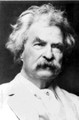
Twain1I was reading excerpts of Mark Latham’s diaries last weekend and I was struck by how neat and complete his entries were and my immediate reaction was, “these must’ve been written and re-written way after the fact”. I even joked with my wife that it was probably a fake. Perhaps my reaction was influenced by my copy of Mark Twain’s diaries which have been left by its editors in pretty much their original form. For example the entry for 1 July 1867 Twain starts with:

“After all this racing, & bustling & rollicking excitement in Africa, it seems good to get back to the old ship once more. It is so like home. After all our weary time, we shall sleep peacefully tonight.”

Which is then followed by a detailed account of his hotel bill at the Royal Hotel, Tangier, Morocco.

To me the mixture of the literary and banal makes the Twain diary ring true while the other Mark’s contribution sounds false regardless of its actual veracity.

This is why we make a point never to edit the anecdotes we collect in organisations. The incomplete sentences and incorrect grammar help the reader hear the voice of the teller and if their story doesn’t resonate it’s quickly discounted as a fake or half truth.

Anderson, F., M. B. Frank, et al., Eds. (1975). Mark Twain's Notebooks & Journals: Volume 1 (1855-1873). Berkeley, University of California Press. pp. 367-368.

Permalink | Comments (0) | TrackBack

24/09/05 |

Google Blog Search is now available

By Shawn. Filed in News.

G_bsrch_logoIf you are looking for blogs try Google Blog Search. One of the nice features is the ability to subscribe to your search via RSS or Atom. I’m using it to see who’s referring to our posts in the blogosphere so I can pop on over and contribute a comment.

Permalink | Comments (0) | TrackBack

21/09/05 |

Don't Prepare - Just show up!

By Andrew. Filed in Complexity, Fun.

ImprovwisdomA great little book which I’ve been working my way through lately is Improv Wisdom .

There are some great wisdoms for life in this book, like the following four:

  • “Say Yes”
  • “Be Average”
  • “Make Mistakes, Please”
  • “Take Care of Each Other”

From an organisational perspective I often wonder about the “Say Yes” maxim. It seems to me that there is a culture in some organisations where the person who actually does practice the ‘say yes’ maxim is somehow considered inferior or weak, a walk over. I remember one of my first jobs working as a systems administrator. Saying “No” seemed to be a lesson in self-preservation, a protective mechanism against drowning in the overwhelming demands from everyone important in the company. Like the book suggests, however, it is often when we “Say Yes” that we find ourselves in the most interesting, unexplored and unchartered territory.

I wonder what culture change might occur in an organisation which considered and took seriously the above 4 maxims….?

Permalink | Comments (6) | TrackBack

20/09/05 |

The Anecdote team grows to three

By Shawn. Filed in News.

I’m pleased to announce that Anecdote has moved to a new and exciting phase of its evolution with Mark Schenk and Andrew Rixon joining the company as Directors and experienced practitioners.

Mark and I have had a long association starting with SMS Consulting Group where we kicked off their knowledge management programme. Since then we have been working together on knowledge management projects and more recently we’ve been collaborating on narrative projects, such as a Defence Materiel Organisation occupational, health and safety project. It makes great sense for us to join forces.

Andrew and I met 18 months ago at a CSIRO workshop on memes and complexity. Andrew’s PhD is in complexity science and while he has a background in mathematics (we can’t hold this against him :-D), Andrew is a practised open space facilitator and focuses his mental energies these days on social system dynamics.

We’ve updated our website with Mark and Andrew’s biographical sketches. I look forward to introducing them to you f2f in the near future. In the meantime you will see their blog posts right here.

Permalink | Comments (0) | TrackBack

20/09/05 |

Firefighters in the US deploy a narrative database of near misses

By Shawn. Filed in Narrative.

Wired has just reported that 38 fire departments across the US are beginning to use the National Fire Near-Miss Reporting System. Firefighters are encouraged to record their stories of what happened in the field for the day so other colleagues and other fire departments might learn from their experience.

One unusual danger reported during the database's pilot run is that vehicle air bags can deploy from static electricity, even after a vehicle's battery is disconnected.

"If you're leaning over the steering wheel, attending to the patient ... these things come out at 200 miles per hour, and that's going to put some hurt on you," said Deputy Chief Steve Mormino of South Farmingdale, New York.

BHP Billiton has a similar system which forms the backbone of their safety program. The interesting thing about near misses is that people are more likely to talk about them, whereas in the case of a death or major accident there is a tendency to keep mouths shut for fear of reprisals.

The most important thing about this story is the recognition that anecdotes provide more context and are more engaging than a bland description of an incident.

Permalink | Comments (0) | TrackBack

18/09/05 |

How marketers can exploit the full power of stories

By Shawn. Filed in Narrative.

Story-telling is a hot topic in marketing. There is a growing and well-founded belief that legendary brands, such as Apple, Nike, and Harley, have been successful by building great stories around their products-stories in which people want to share. Books are appearing by people such as Seth Godin and Laurence Vincent, which instruct marketers in how to build a company’s brand by using stories.

But this is only half the story! Everyone is focused on story-telling, while neglecting the huge potential of story-listening.

For some time, marketing professionals have recognised the power of collecting stories. For example, Dupont collected stories about women's thoughts on wearing pantyhose, and eventually discovered (after first hearing nothing but disdain for these garments) that wearing pantyhose made women feel more sensual, sexy, and attractive to men. Dupont modified its brand image to match these feelings. Similarly, Kimberly-Clark collected stories from parents who were toilet-training their children, and discovered that parents experienced tremendous stress from having children 'still in nappies'. 'Pull-ups' were introduced, and a new $400 million-per-year product was born (Leiber, 1997).

In both cases the marketeers understood that they were unlikely to discover the telling factors through formal interviews and focus groups. Stories provided a natural way of expressing (and hearing) what was actually happening. The stories provided the context for getting to the heart of the issue.

Listening to stories is one of the best ways to understand what is happening in a complex and dynamic situation. Analytical methods are effective when an issue can be divided into logical components, but much of life is not that simple. The issues faced by marketers often involve ill-defined problems, unpredictable outcomes, and intuitive action. Stories clarify the emerging patterns upon which effective interventions can be formulated.

Three essential skills are required if marketers are to become effective story-listeners. They must be able to:

  • elicit stories from those who have relevant stories to tell (including customers, staff, stakeholders, and shareholders);
  • make sense of the information contained within and across the stories they collect; and 
  • formulate interventions that take account of the complex nature of the issue being tackled.

Consider the specific example of aligning brand promises with customer service. Companies spend millions of dollars in developing a brand image, but this image can be significantly eroded if staff members misunderstand the brand, and consequently deliver service that contradicts its image.

Dave … saw an ad by Tweeter that emphasized its staff's "boatload of knowledge". He needed a minidisk player and walked into a Tweeter HiFi Buys store wanting to take advantage of that knowledge. "Hi, I want to buy a minidisk player and accessories if someone can show me how to use it." He was told, "I don't know how it's used, but they're supposed to be really easy." Dave says, "The boatload of knowledge just capsized." (Barlow and Stewart 2004: 49)

Imagine the effect of this scenario occurring in your organisation hundreds (if not thousands) of times. The result would be complete erosion of your brand image-an image in which you have invested heavily and on which you have pinned the future of your company.

The appropriate response to a case like this is to go out and collect anecdotes from staff members-anecdotes which they believe are illustrations of 'on-brand service' and 'off-brand service'. These stories can then be used in a workshop environment to extract the key themes, values, and archetypes of the problem. Workshop participants (the organisation's decision-makers) are thus exposed to new perspectives, and can use these insights to develop appropriate interventions to improve the alignment between brand image and customer service.

Narrative is a powerful technique. But many marketers are currently utilising only half its potential power. Become a story-listener as well as a story-teller-and reap the rewards.

Barlow, J.and P. Stewart. 2004. Branded customer service: the new competitive edge. San Francisco: Berrett-Koehler.

Leiber, R.B. 1997. "Storytelling: A new way to get close to your customer." Fortune 135(2):102-106.

Permalink | Comments (0) | TrackBack

14/09/05 |

Using photos to jog memories

By Shawn. Filed in Narrative.

DigitalcameraIt seems everyone has a mobile phone with a camera in it these days. And digital cameras are as common as blades of grass on a footy field (it is nearly grand final day!). With all this pixel grabbing capability we should start using it to pictorially document our projects. Why? Because when you look back over a project, racking your brains to remember what actually happened, pictures help us recollect the project stories.

Remember the last time you sat down to flick through a photo album and see the photo of Uncle Johnnie (substitute your own relatives here) building the sand castle with little Katie and you instantly recollect the story of how Johnnie got incredibility drunk that night and fell into the bonfire. The next morning he vowed to be a tea totaller. The same story recollecting effect can be created in your organisation with each each project you undertake.

So what do you do with all the images? One thought is to start loading them on Flickr or an equivalent service in-house. Some organisations are already avid image snappers. UrbisJHD, for example, is an urban planning consultancy. They’re always snapping digital images to support planning proposals and new urban designs. As an offshoot of having plenty of digital cameras around they also take plenty of photos of company events. These photos can be a treasure trove of memory joggers.

So if you have the job of finding stories in an organisation, start by asking whether they have a photo archive. If they don’t, suggest they start building one. If nothing else it will be fun.

[thanks to Andrew Mitchell for the UrbisJHD story]


Permalink | Comments (0) | TrackBack

13/09/05 |

Advanced dotmocracy

By Shawn. Filed in Complexity.

Jason Diceman just made a comment on the dotmocracy post pointing us to the Advanced Dotmocracy approach. There is even a comparison of both techniques on his website. Looks very well described and supported with handouts. I’ll have to give it a go to see how it works.

Permalink | Comments (2) | TrackBack

13/09/05 |

KM in legal firms

By Shawn. Filed in Knowledge.

Joy London at excited utterances writes one of the best legal KM blogs around, and Joy, a New Yorker, seems to have an interest in Australia. Joy reports on a recent survey conducted by the recruitment agency, Mahlab, noting, among other things, that salaries for knowledge managers in legal firms are pretty healthy—$A140–250K for a National KM Manager.

I wasn’t surprised to hear that only 20% of people where “very satisfied” with their role in a legal firm with more than half indicating they were planning to leave their current firm in the next 12 months. Legal firms are being hit with talent problems due to their hothouse environment and the generation X and Ys wanting a different work experience which allows for a social life. Until the new guard takes over lawyers are trapped in a cycle of moving from one firm to another in search of better working conditions.

Just to give you a snapshot of a large legal firm environment let me tell you this anecdote. Eight months ago I was asked to facilitate a workshop of all the partners in a legal firm. About 50 people attended. One of the new partners, a woman in her mid 30s, stood up to report back the discussion their small group was having. “We think that when we re-fit our offices everyone should get similar workspaces. Partners shouldn’t get big plush offices while the rest are in cubicles.” There were howls of laughter with jibes flying across the room. This woman went red as a stop sign. I had to quieten everyone down so she could finish her report.

Permalink | Comments (0) | TrackBack

11/09/05 |

Johnnie Moore's weblog and Margaret Wheatley's Essay

By Shawn. Filed in Complexity.

I love it when a friend sends me a link to a new weblog suggesting I might like it. Andrew Rixon just sent me a link to Johnnie Moore’s blog and from the first few posts I’ve read, I love it. A post from yesterday alerts us to a new essay by Margaret Wheatley on disturbance being our friend in a complex world. Margaret has a lovely turn of phrase. How may times have you heard people say the world is getting more complexity and the pace is quickening. While I know it is an important point I tend to yawn when this is the first paragraph—I’m sure I’ve done it myself. Anyway, here is how Margaret put us in the context—and it’s not her first para:

But everything has changed since those sweet, slow days when the world seemed knowable and predictable, when we actually knew what to do next. The growing complexity of our times makes certainty about any move or any position much more precarious. And in this networked world where information moves at the speed of light and "truth" mutates before our eyes, certainty changes and speeds off at equivalent velocity.

It would be great to hear what you favourite blogs that you think I might like. Just pop your ideas in the comments.

Permalink | Comments (1) | TrackBack

9/09/05 |

New narrative techniques workshop for Oct-Dec

By Shawn. Filed in Narrative, News.

Our popular narrative techniques workshops are scheduled again. If you have heard about narrative techniques but perhaps came away wondering what you would actually do, this is the workshop event to attend. We will delve into the nitty gritty of running a narrative project: how to collect anecdotes; how to make sense of the information; and how to design interventions based on complexity principles.

Here are the brochures for Melbourne and Canberra. Sydney and Brisbane will be announced soon. We will also be conducting workshops in Auckland and Wellington, New Zealand,  on the 16th and 17th of November.

Permalink | Comments (0) | TrackBack

8/09/05 |

Book review - Wisdom of Crowds

By Shawn. Filed in Books, Complexity.

Fast Company calls it an ‘idea-driven narrative’. This genre, made famous by Malcolm Gladwell, takes a simple (but important) idea and uses research, case studies, and personal experiences to enable the reader to see the world from a new perspective. Wisdom of Crowds, by James Surowiecki, is a notable addition to this enriching genre.


I enjoyed reading this book. The simple idea upon which Surowiecki builds is that, under certain conditions, groups of people make better decisions than any individual could hope to make. There are three conditions: the group must be diverse; the individuals should make their decisions independently; and the people must be decentralised, thus ensuring that decisions are based on local knowledge.


This book is essentially about the theme of complexity, and how group decision-making provides a way of tackling uncertain situations and solving apparently intractable problems. Three types of problems are examined, each with its own chapter: (i) cognitive problems: which have verifiable answers (such as calculating the weight of a bull after it has been slaughtered and dressed); (ii) coordination problems: in which people coordinate their behaviour, knowing that others are behaving similarly (such as buyers and sellers finding each other and trading goods at a fair price); and (iii) cooperation problems: which involve getting people to work together for a common good (such as paying taxes or reducing pollution), over and above their individual interests.


The first half of the book provides the theory, with chapters covering the three conditions and three types of problems. The second half presents a set of case studies that reiterate the key points—with additional factors, pitfalls, and flights of fancy thrown in for good measure. For example, Surowiecki points out that diversity and independence are important because “… the best decisions are the product of disagreement and contest, not consensus and compromise”. The author’s call for dissent in group decision-making is a recurring theme throughout the book.


It is apparent that Surowiecki has a strong interest in financial matters—as might be expected from an author who writes the popular ‘Financial Page’ for the New Yorker. Much of the research and examples in Wisdom of Crowds has an economic flavour—which would usually have put me to sleep, but which, in this book, was presented in an interesting and fast-paced style that maintains the reader’s interest.


My only criticism is that the second half of the book often takes the reader on circuitous routes. On several occasions the reader begins to wonder what this has to do with group decision-making. When the text does eventually return to the point, the connection is often somewhat tenuous. I was left with the feeling that I had put in the effort to go with the author on his various excursions, but had returned without any really clear pictures of the scenery. However, taking the book as a whole, this is a minor criticism; the fact that I zipped through the book is always a good indicator of how much I enjoyed it.


Wisdom of Crowds has had three major impacts on my thinking: first, I have always intuitively taken opportunities to use group decision-making in my workshop activities, but I now have a logical rationale for its usefulness; secondly, I can now differentiate between group decision-making and collective meaning-making; and thirdly I can understand why, as Surowiecki laments, few organisations have implemented group decision-making—because it removes power from those who have the authority and responsibility to implement the decisions. A book that gets you thinking like this deserves to be highly recommended.

Permalink | Comments (0) | TrackBack

7/09/05 |

Learning from experience using video

By Shawn. Filed in Knowledge, Narrative.

Channnel9guyVideo is finally making it into the mainstream for organisations to see and hear, almost first hand, the experiences of their colleagues. The availability of reasonably priced video capture and editing solutions are now available. It is simple for someone to pick up a video recorder, film a colleague, download the video to a computer and make the clip available for anyone to view. There is an interesting video-driven lesson learning activity occurring on the web called Channel 9 run by Robert Scoble at Microsoft (see http://channel9.msdn.com/). Robert is visiting his Microsoft colleagues and asking them to talk about their projects. There are many interesting features of what has been built on Channel 9, but the most important is the efforts to build community around the video with features such as the ability for anyone to comment and rate each video posted.

While I was reading through some of the comments of a clip of Bill Staples talking about Microsoft’s web server (some commenters suggests that the first bit of the video was slow and uninformative but the second half was great), it occurred to me that a useful enhancement to the site would be to enable people to edit a clip so they can cut out the bit they found most useful. Then invite people to resubmit their edited versions. Add to this a way to rate the interestingness (concept at Flickr) and useful clips would bubble to the surface.

Permalink | Comments (0) | TrackBack

5/09/05 |

Collective meaning and group decision making

By Shawn. Filed in Communities of practice, Complexity.

I just had an interesting distinction drawn to my attention: the difference between collective meaning and group decision making. I’ve just finished Wisdom of Crowds which argues that under certain circumstances a group will make a better decision than any one individual. The author, James Surowiecki,  provides many examples including finding a submarine, guessing the weight of livestock, and Google’s ability to find relevant web pages. Wisdom of crowds are all examples of group decision making.

For Nancy Dixon the intended outcome of collective meaning making “… is a new way of understanding something that is shared across the collective.” Nancy goes on to illustrate her viewpoint with an anecdote about a North American Indian tribe of hunter-gatherers originally told by Bohm (of dialogue fame).

“From time to time the whole tribe would come together in a circle and talk. No one appeared to have called the meeting nor led it; the group made no decisions and seemingly had no agenda. Yet when the meeting ended people what to do because they know understood each other. The might then get together in small groups and make plans or decide to do something.” (pp. 58)

My work at Anecdote is primarily about collective meaning making. We use narratives collected from an organisation to help people have conversations that they wouldn’t normally have. That said, most companies are unwilling to spend time just talking, especially in the outcome focussed culture of Australia. Consequently, we follow meaning making with intervention design.

Dixon, Nancy. 1999. The Organizational Learning Cycle: How We Can Learn Collectively. 2nd ed: Gower Publishing Company.

Permalink | Comments (0) | TrackBack