« July 2005 | Main | September 2005 »
The problems with a dotmocracy
Filed in .
Have you ever used the technique we call a ‘dotmocracy’ to get a group to prioritise a set of ideas/initiatives/actions? Each person is given five sticky dots (red ones usually—the ones you find placed next to paintings in a gallery to denote they’ve been sold). Each dot-carrier is then invited to place any number of their dots next to the things that they think are most important. You can use all your dots on one thing or spread them judiciously. The things with the most number of dots is voted by the group as the most important.
Many people have used a dotmocracy before or quickly work out how it works. Consequently there seems to be always a handful of people who hold onto their votes with the hope that their late placement might swing the priority result in their favour.
I’ve observed another interesting dotmocracy pattern. When a cluster of dots form on an issue it seems to attract more dots. I believe economists call this an information cascade where the actions of some influence others creating a domino effect. It’s how fads and market bubbles form. I’m sure I’ve seen dotmocracy fads.
It’s true that a group of people can make a better decision than any single expert—this is the persuasive argument developed by James Surowiecki in his book, Wisdom of Crowds. But group-based decision quality is based on preconditions being satisfied: the group must be diverse; decisions must be made independently; and decision making information is decentralised. These conditions can be satisfied in a workshop prioritisation activity by simply conducting a secret vote.
One thing I like about the dotmocracy approach is the mayhem and excitement is creates with everyone milling about one another. I wonder if the secret vote approach would kill that dynamic?
Do you know of other ways to aggregate a group decision in a workshop environment?
Permalink | Comments (8) | TrackBack
Talent magnetism
Filed in Knowledge.
I was in New Zealand for a couple days this week. I caught up with my colleagues at Future of People and Organisations (FPO) – more about FPO in a future post. It reminded me that I should tell you about the project Stewart Forsyth, on of my fellow directors, and I did for an Auckland law firm. We used narrative techniques to help define their brand as part of a talent magnetism program. Stewart has written about talent magnetism here.
The most interesting outcome for me was noting how the values which emerged from the narrative were, in some cases, quite different to their stated values. The stated values were things like professionalism, integrity, innovation. A value which emerged was “being nice to people”. I wonder if that would have been included in a formal values creation exercise?
Permalink | Comments (0) | TrackBack
Founder of complexity?
Filed in .
I noticed Ark Group has given Dave Snowden the title of “Founder of Complexity” on their KM Asia website. Sounds to me like marketing hyperbole out of control.
UPDATE:
Dave contacted me today to let me know that he has asked Ark to remove “the founder of complexity” title. As I suggested in my post this was Ark’s idea and Dave had no inkling until he found my post.
UPDATE:
Nilay Gencturk from Ark Group has posted in the comments the following correction:
CORRECTION: Ark Group wishes to apologise to Mr Snowden for misprinting a reference to him being “Founder of Complexity”. Dave Snowden is an acknowledged founder of organic knowledge management and acclaimed expert on narrative patterns. He is Director of the Cynefin Centre for Organisational Complexity which focuses on the application of complexity theory to organisational issues.
Permalink | Comments (3) | TrackBack
Understanding community indicators - time to share our chocolate
Filed in Communities of practice.
After a little bit of gentle cajoling, Nancy White has started to describe what she means by community indicators. And in good community building style Nancy invites us all to participate in the conversation. I love the simple and lyrical language Nancy employs. The idea of ‘signs of life’ (SoL) as an early indicator of a nascent community appeals to me. Those interested in developing communities must be sensitive to these signs of life which Nancy describes as like:
… weather reports. They give us an inkling of what might be coming. They are like ideas that wake us up in the night, but which we can only partially remember in the morning. Like the first bulbs peeking up through the snow to assure us spring is coming, even if we have to wait two more months. SoLs reassure us that this is a human endeavour and community may emerge.
Boundaries are typically difficult to discern in a complex environment which might be doubly true when trying to decided if something is a SoL or CI. I’m sure it doesn’t matter as long as community members are noticing something. Some people are better at detecting these weak signals and they will see signs of life first. Their greatest challenge will be to convince others that they actually exist.
Here is how Nancy defines community indicators:
Community indicators are patterns of group member behavior that help us pay attention to the emergence and life of a community.
This works for me. Here is another example of a community indicator. In the early days of ActKM we had a member who whenever he posted the community would buzz and when he was absent the community felt flat. This member’s activity was one of our community indicators.
Interestingly, over time the membership became used to this member’s style and some even became cynical or turned off by what he was posting. His role as a community indicator diminished. This example highlights the need for those who are nurturing the community to regularly reassess their understanding as a group of what are the useful community indicators. A white CI one day can be a black one in the future and vice versa.
The simple act of seeking community indicators is a community building exercise. I can imagine asking community members to help identify CIs and this group activity will create new relationships, new conversations and stronger communities—much like what Nancy is doing with the community_indicators tag.
How do we tune into CIs? How can we improve the chances of noticing signs of life?
Technorati tags: community_indicators
Permalink | Comments (1) | TrackBack
Chip Goodyear says $8.5B profit partly due to communities of practice efforts
OK, so Chip didn’t say that exactly. I heard part of Chip’s speech (on ABC radio) to the market announcing their record profit and he said their success came on the back of “efficiencies gained by sharing knowledge” across the company. I know BHP Billiton has a significant communities of practice program which forms the foundation of their Operational Excellence Division. It’s this division which is responsible for helping people share what they know. They are world leaders in the adoption of communities of practice approaches and this comment pays significant recognition to their good work.
I scanned the papers this morning and did a couple of searches and couldn’t find any journalist picking up this angle of the story. Interesting.
Permalink | Comments (0) | TrackBack
The work of stories - MIT
Filed in .
In May this year MIT hosted the Media in Transition conference which had the theme of: the work of stories.
You can view the videos and papers here.
Here are some direct links to audio or webcasts.
- Narratives of science
- Migratory Narratives: Why Some Stories Replicate Across Media, Cultures, Historical Eras
- Why Are Stories Violent?
[via elearningpost]
Technorati tags: business_narrative
Permalink | Comments (0) | TrackBack
Community indicators, indicator species and persausion

Filed in Communities of practice.
I love what Nancy is doing jotting down the many things which might indicate “community lives here”—yes, turn it into a book Nancy! I discovered these many interesting posts, all with the ‘community_indicators’ Technorati tag, a week ago. Frustratingly I was unable to find a post describing Nancy’s initial idea of a community indicator – Nancy, can you point me in the right direction?
This discovery came at a serendipitous time. I was thinking about the reasons why we try and measure communities of practice and came to the conclusion that trying to determine the link between community activity and organisational performance is a futile task. So what do we do?
I’m not sure if the following analogy has already been drawn, but community indicators are like indicator species; they indicate the health of a the community/ecosystem. Green frogs are my favourite ecosystem example-albeit an inaccurate and imprecise one. If a green frog is an indicator species of a healthy ecosystem, introducing a gross of green frogs doesn’t improve the ecosystem’s health. The same is true of community indicators. These indicators help people inside the community understand and nurture their ‘environment’ but, please, please, please don’t turn them into management targets.
Now what about senior decision makers and their valid need to be convinced of the business value of communities of practice—the needs and foibles of these decision makers is well described by David Pollard today. I think the key is to remember the purpose: community leaders must persuade these decision makers and realise objective measurement is impossible. So where do look for ways to persuade these decision makers? I think a good place to start is with the ideas of Howard Gardner’s Changing Minds and Robert Cialdini’s Influence. Neither book is on a typical knowledge management reading list but this should change.
Technorati tags: community_indicators
Permalink | Comments (1) | TrackBack
Using Quickplace to support a Communities of Practice
Filed in Communities of practice.
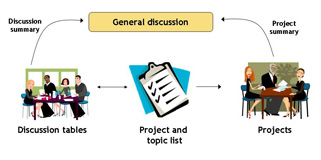
Quickplace out of the box is a useful collaboration tool for teams but its default configuration is unhelpful in supporting communities of practice. Here is what I have done to modify Quickplace for some of my clients, at a conceptual level—no code here I’m afraid. It is based on the simple idea that people learn best if they are working on things together.

The General discussion area is a discussion list in the top room (‘room’ is a Quickplace term) of Quickplace. All members should be encouraged to subscribe to this discussion and receive email notifications of new posts in this area. Consequently it’s important to only put things in this space that is interesting to everyone in your community.
Discussion tables occur in a separate, subordinate Quickplace room. Each table is the equivalent of a Quickplace ‘discussion.’ A discussion table is typically convened by someone interested in a specific topic—the topic might have come from the project and topic list (see below). The discussion leader invites a table-full of people (of course this is a virtual table but 8–10 people is a good number) and spends a fixed period of time, say 2 weeks, discussing this topic online. A summary of the discussion is posted to the general discussion. Potential projects and other topics are added to the project and topic list.
Projects are where people band together to tackle a suggested project from the project and topic list. Ideally 2–3 people work together to get something done for the community. It might be building a simple tool, writing a paper, capturing some experiences from a colleague who is leaving. The summary of the results of this mini project are posted to the general discussion with a link to any artifacts created. Working on mini community projects puts into practice the following principle: “Find others in the community who care about the same things as you, and share an activity with them. Then tell the community what you’ve done.” Projects are done as separate Quickplaces so the team members have access to all the QP facilities.
The Project and topic list is built from ideas generated from discussion tables and projects. You could add a voting mechanism to this list to see what issues the community is most interested in. The project and topic list is a simple Quickplace list at the top level.
There are other features that come with Quickplace I haven’t mentioned such as a group calendar, document library etc. Of course you should use these. What I’ve presented, I believe, are some of the essential elements, from a technology support perspective, designed to keep the community moving forward.
Technorati tags: community_indicators community_technology
Permalink | Comments (1) | TrackBack
What is business narrative?
Filed in .
The term ‘business narrative’ hasn’t really taken off, yet I’m finding more and more people in organisations are drawn to these techniques because traditional approaches have failed them. I would love to hear how other organisations are using business narrative and to aid us in finding one another I thought we could start using the following Technorati tag in our posts: business_narrative. Click here to find posts using the business_narrative tag.
But before everyone rushes out to describe how they are using storytelling at work, let me describe what I mean by business narrative. Business narrative is more about listening rather than telling. By this I mean BN is based on collecting anecdotes (hence the name of this company) from people about how they actually do work. Then we use these anecdotes to make sense of what is really going on in an organisation so a set of interventions might be designed. Storytelling, on the other hand, is primarily concerned with crafting persuasive stories to affect change in an organisation. Both are important and complimentary uses of narrative in organisations.
If you want to conduct a small business narrative project, here are the key steps:
– craft the questions you will use to elicit the anecdotes
– run anecdote circles (a bit like focus groups but without as much focus)
– extract the anecdotes from your transcriptions—yes, it’s best to record the sessions
– conduct a workshop and get key decision-makers, planners and clients immersed in the anecdotes. During the workshop extract the key themes and values from the narrative and design interventions.
As much as possible should be done by people in the organisation. Getting outsiders, like consultants, to do the work for you is a mistake because the business narrative process engages people in a change process and you want these people to be you, not outsiders. It’s worthless having an ‘expert’ analyse a situation and provide a report.
Technorati tag: business_narrative
Permalink | Comments (0) | TrackBack
The smackdown model for learning makes sense
Filed in Knowledge.
Kathy Sierra's smackdown model for learning made me smile AND nod—what a great idea. I agree, we should be presenting multiple views rather than insisting there is one way forward. As Kathy argues, when we present two conflicting views people are encouraged to think and make up their own minds: learning occurs.
While the smackdown metaphor of two wrestlers in the ring, one trying to knock the other down, might be a little over the top, the idea of entertaining/exploring multiple perspectives is particular important when dealing with complex issues. As you might remember from previous posts (here, here and here), complex issues have many connected parts, are characterised by small things triggering large events and vice versa and are constantly in flux—like most organisations we know. In a complex system we can’t rely on what worked in the past because the landscape has changed. We need to try new ideas—experiment. Smackdowns should be in our kit bag.
The next time you here someone ‘telling you how it is,’ challenge them to argue the other perspective or ask someone else to help the group explore some of the other possibilities. This can only increase the level of interest in the discussion and people will hear more than just ‘blah, blah, blah.’ You never know, people might learn something too.
Permalink | Comments (1) | TrackBack
An artist and the soirée
Filed in Communities of practice.
My sister-in-law, Fern Smith, is an artist who is conducting an interesting experiment. Fern is keen to engage people in discussions about the ideas represented in her art and found the traditional art exhibition was unsatisfying. Over the last couple of months Fern has invited small groups of people to her house for a soirée to look at and talk about her art. So far the response has been enthusiastic.
My sense is that people yearn for deeper conversations yet opportunities for dialogue seem to be disappearing from the workplace. People are just scurry from one pressing deadline to the next. This sense of busyness is perhaps one of the reasons why there is a growing interest in narrative techniques, Open Space and World Cafe. Let’s bring back the soirée.
[Painting by Fern Smith, 1994]
Permalink | Comments (0) | TrackBack
VOIP Technology - you should know about this
Filed in Knowledge.
Ron Rogers at Weby Systems does a fantastic job of keeping the technologies I use up and running. He has recently been testing VOIP (Voice Over Internet Protocol — phone on the web) and here is what he has to say.
Permalink | Comments (0) | TrackBack
The role of instant messaging in communities of practice
Filed in Communities of practice.
James Dellow made an excellent post today pointing us to some articles in The Australian which explore the ‘whats’ and ‘hows’ of instant messaging (IM). I think IM is one of the most useful tools for distributed community development and, interestingly, you don’t even have to use it to chat and it still helps. Let me explain.

Here is part of my Skype buddy list. The names with the green circles and ticks are online and I can send them an instant message now (with Skype and can also talk to them). The green circles with the moons tell me they are online but away from their computer. All the rest (the grey ones) are offline.
Now here’s the kicker. Research (see below) has shown that just being able to see those names and green circles makes you feel you are still connected to your community. This is an important point for community of practice leaders. By simply making IM available you are enhancing community interaction and a feeling of connectedness.
Last month I did a series of interviews with John Smith, Etienne Wenger, Hubert Saint-Onge, and John Vucko (BHP Billiton Global CoP Leader) as part of a project to design a community of practice approach for one of the Australian Defence Groups. And while there was strong agreement that technology couldn’t make a community of practice—and in fact in some cases could kill a community—there was agreement that there is a minimum set of technology capabilities required when members are geographically distributed.
- teleconference facilities—I’m constantly amazed at how many large organisations don’t have a simple way to create and attend a teleconference. In IBM we used to just create a teleconference online then all participants would dial a 1300 number to attend.
- a place to store documents
- online threaded discussion
- member profile directory
- online presence and IM
Nardi, Bonnie A., and Steve Whittaker. 2002. The Place of Face-to-Face Communication in Distributed Work. In Distributed Work, edited by P. J. Hinds and S. Kiesler. Cambridge, Massachusetts: The MIT Press.
Permalink | Comments (1) | TrackBack
IBM and Sun build their blogging approach
Filed in .
B.L. Ochman compares IBM’s and Sun’s blogging policies.
It is interesting to note how IBM developed their approach:
The core principles — written by IBM bloggers over a period of ten days using an internal wiki — are designed to guide IBMers as they figure out what they're going to blog about so they don't end up like certain notable ex-employees of certain notable other companies. … this isn't a policy that IBM is imposing upon us — it is a commitment that we all have entered into together.
Wikis are a fabulous tool for collaborative document building. I now co-create proposals with my clients using a wiki.
Permalink | Comments (2) | TrackBack
Components of a community of practice
Filed in Communities of practice.
This article in Harvard Business Review Working Knowledge is both helpful and confusing. It’s helpful because it reminds community practitioners of the need to stay immersed in the detail of the domain. It’s at this level which inspires member participation. It is also useful because it provides additional case study material.
It’s confusing because I think the authors are talking about different types of leaders. There are the community leaders who care about the community’s wellbeing and actively act as connectors, facilitators, cajolers. Then there are the executives who sponsor the community. Their role it to provide the community with a level of legitimacy, provide funding and support and knock down any organisational barriers which are impeding the community’s work.

Etienne Wenger provided a useful model at KM Australia this year which helps us make some important distinctions. I wont describe what he means by domain, practice and community as you’ll find them described in many of Etienne’s papers and books. Let’s look at the other four factors.
Executive Sponsorship are typically senior leaders within the organisation who appreciate the value of the community and provide it with funding, recognition and guidance.
Support is provided by a small support team whose role is to maximise the value members gain while minimising their effort. The support team organises seminars, conferences, profiles new members, manages the website, connects people etc etc. They have a large and important job.
Both these roles are typically provided by people on the periphery of the community.
Participation refers to members participating in the activities and discussions of the community. There is a paradox here that all new communities will confront: members want to join a community; and a community doesn’t exists without members.
Nurture is provided by members of the community who care for its very existence in addition to caring about the domain. These people become the natural leaders of the community. They help set the community’s agenda, identify speakers, provide advice, sort out any conflicts, make connections between members and help ensure that the community’s goals are useful to the organisation. This last point is crucial because the community leaders need to act as the PR team for the community and demonstrate its efforts are delivering value.
[Thanks to Dinesh Tantri for the link to the HBR article]
Permalink | Comments (3) | TrackBack
Learning from mistakes - prerequisite for innovation
Filed in Knowledge.
In Melbourne we have a small group of mainly public sector folk who get together monthly to talk about innovation. Recently we have been talking about how innovation requires that people be supported in their mistake-making rather than vilified. Sadly the opposite is generally true in the public sector with its culture of risk aversion and blaming rarely displaying mistake-forgiving behaviour. This is a significant conundrum for governments (i.e. all of them) which rely on government agencies as their primary (innovative) policy think-tanks.
While not a solution to the public sector innovation dilemma, it was timely that Denham Grey point us to this interesting essay on how we can learn from our mistakes. I love the following quote:
The kind of mistakes you make define you. The more interesting the mistakes, the more interesting the life. If your biggest mistakes are missing reruns of tv-shows or buying the wrong lottery ticket you’re not challenging yourself enough to earn more interesting mistakes.
One of my quests in life is to meet interesting people. It looks like I will need to look out for interesting mistakes and follow the scent.
Permalink | Comments (0) | TrackBack
Knowledge Sharing Toolkit
Filed in Knowledge.
An excellent resource has been recently made available on the net: the knowledge sharing toolkit by David Bartholomew. It seems to be the product of David’s DBA studies of architectural and engineering firms. In addition to the 49 page how-to manual are the nine interesting case studies.
Permalink | Comments (1) | TrackBack
"Lessons learned" creates the wrong mindset
I have been thinking about the term ‘lessons learned’ today. In a way it’s an oxymoron. The word ‘lessons’ suggests something that is known which can be taught. With the term ‘lessons’ in your head you start thinking about how you can get people to understand these lessons and, as we were recently reminded, the knowledge transfer process is not as simple as tipping the contents from one head to another. Learning, on the other hand, suggests a complex, social, back and forth—an interaction. The two words are at odds and no wonder there is a level of discomfort among knowledge management practitioners with the phrase.
Interestingly some of the successful lesson learned programmes have put their emphasis on learning—not lessons—and wrapped their implementation in a community of practice approach. I’m thinking here about BHP Billiton’s operational excellence division which has a clear focus on best practice transfer but has implemented its objectives within a community of practice context. US Department of Energy is another example where the learning context is provided, at least in part, by their community of practice which they call the Society for Effective Lessons Learned.
Permalink | Comments (7) | TrackBack
Etienne Wenger's slides from his recent visit to Melbourne and Canberra
Filed in Communities of practice.
In July we hosted Etienne at a range of events in Canberra and Melbourne. Many of you have been asking for a copy of Etienne’s PowerPoint slides. Well, here they are: http://www.ewenger.com/slides/05-07-19_Melbourne_public.ppt
Thanks to everyone who attended. There is nothing better than to finally meet people face to face.
Permalink | Comments (0) | TrackBack